Pipeline Stage Design for Remodeling Sales Cycles
Build remodeling pipelines around how deals actually close, not generic sales software assumptions.
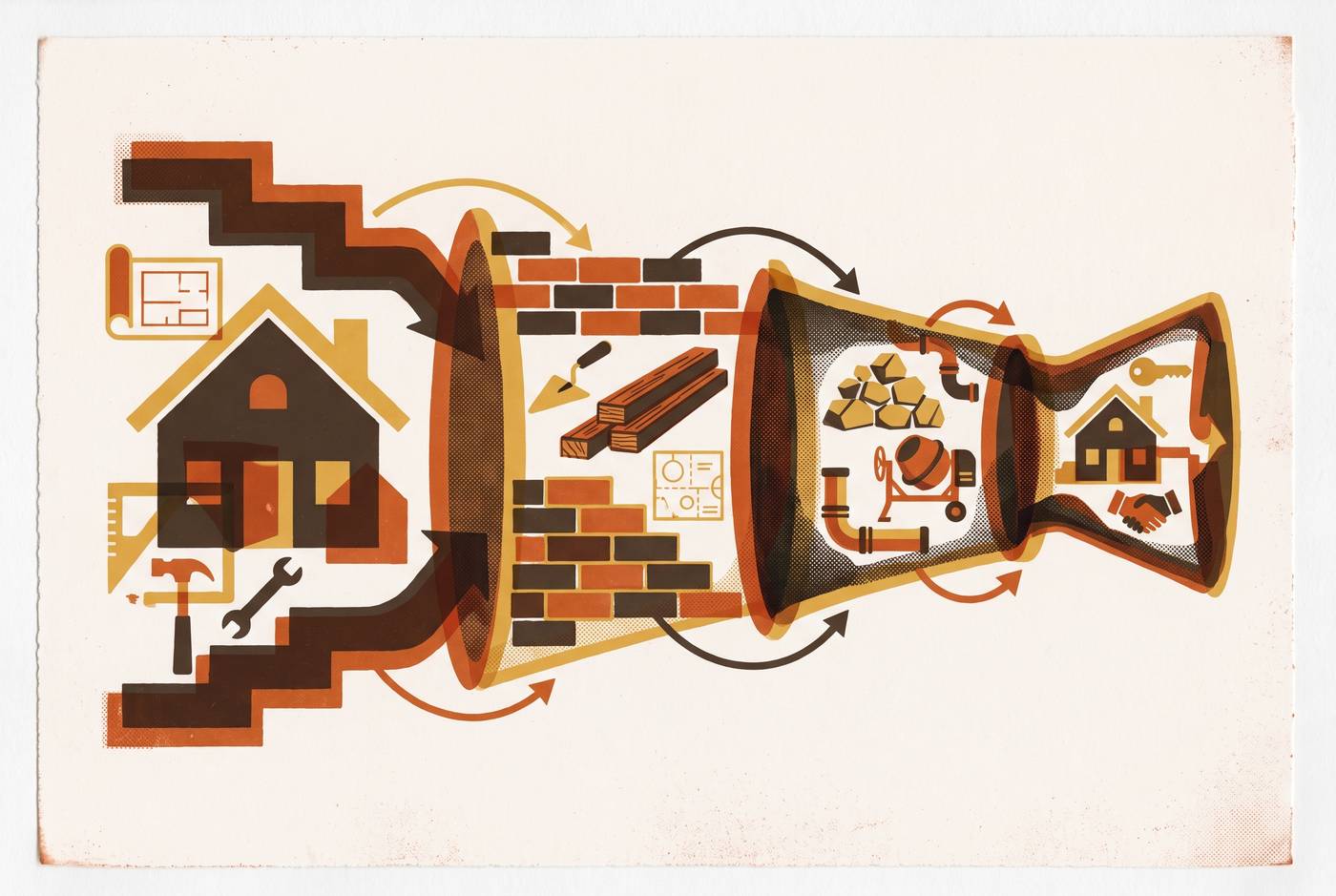
Remodeling sales cycles run 6 to 24 months from first contact to breaking ground, involve multiple decision-makers, and carry unique pricing on every single job. Generic CRM pipelines, built for short cycles and single buyers, cannot gate these deals in any way that means something. The fix is a pipeline built around how remodeling actually gets sold, with exit criteria at each stage precise enough to catch a stalled deal before it dies quietly in "proposal sent."
The stakes here are not abstract. The Ebsta/Pavilion 2025 GTM Benchmarks report, built from $48 billion in pipeline data across roughly 2,000 revenue leaders, found average win rates dropped to 19% in 2025, down from 29% the year before. When win rates compress that hard, stage accuracy stops being a nice-to-have. It becomes a forecast a contractor can plan payroll around instead of one that quietly lies to them.
What a remodeling pipeline stage needs to contain
A stage is a schema, a column in the revenue data model, with every exit criterion attached to it acting as a constraint on that column. It's a schema, a column in the revenue data model, and every exit criterion attached to it is a constraint on that column. Skipping this causes the pipeline to degrade into a contact list wearing dollar signs.
Four things every defensible stage needs:
A past-tense name comes first. "Site Visit Completed," not "Scheduling Site Visit." HubSpot's 2025 best-practice guidance backs this up for a simple reason: a past-tense name can only be entered once the action is actually done, which kills the ambiguity around when a deal earns its next stage.
An entry condition follows, spelling out what must already be true for a deal to land there. Then come two to four exit criteria, and these need to be objective and checkable against the record, not vibes. Last is a forecast weight: how much closure confidence does this stage actually represent, so that weighted revenue numbers mean something when someone runs them.
Five to seven stages is the workable range. Fewer than five is too coarse to gate anything real. More than eight, and reps stop applying the distinctions consistently because adjacent stages start blurring together.
If a stage can't produce two objective things that must be true before a deal leaves it, that's not a stage. It's a mood. And no amount of automation fixes that. If "Qualification" means three different things to three different reps, every automated trigger built on Qualification fires against three different realities. The schema error doesn't get fixed by better tooling, it gets amplified by it. HubSpot's research on this points to roughly 28% higher revenue growth at organizations running a formal pipeline process versus those without one, and the lever driving that number is defined stages with criteria that actually get enforced, not the software license.
Stage 1: Lead Qualified
Entry happens the moment a homeowner makes contact through any channel, inbound call, web form, referral, trade show booth, and someone captures the basics.
Qualification in remodeling covers four things: budget range against what the contractor actually builds, timeline (residential buyers can be anywhere from 6 to 24 months out from breaking ground), ownership and who else is involved in the decision, and whether the project's scope and location fit the contractor's wheelhouse at all.
This should run as a tight 5-to-10 minute structured call with closed-ended questions, keeping the format brisk and focused. Save the open-ended discovery for Stage 2. Many contractors hand this off to an Online Sales Counselor whose whole job is responding fast, running the script, and only booking a discovery meeting for genuine matches, which protects the senior salesperson's calendar for deals worth their time.
Exit criteria: the prospect clears budget, timeline, scope, and ownership screens, and has agreed to a discovery meeting. Missing one of those sends the lead to nurture or gets it marked closed-lost. It does not move forward on hope.
The failure mode to watch for is treating every inquiry as qualified just to keep the pipeline number looking healthy. That inflates Stage 1 and poisons every conversion metric downstream of it.
Stage 2: Discovery Completed
Discovery is not a pitch meeting. The contractor should be talking maybe 30% of the time and listening the other 70%.
Four things need to come out of this meeting: the homeowner's vision, including what's essential versus what's negotiable; their concerns, whether that's a bad experience with a past contractor or fear about disruption to daily life; whatever's actually driving the timeline, like a lease ending or a family event; and who else needs to be in the room before anyone signs anything.
Remodeling carries emotional weight that most sales frameworks never account for. This is often the largest expenditure a family makes outside the home purchase itself, and it touches the actual space they live in every day. Whatever trust gets built here carries through every stage that follows.
The notes from this meeting become the raw material for the proposal. If a discovery meeting produces no structured notes, it effectively didn't happen, at least not for pipeline purposes.
Exit criteria: a documented, clear understanding of scope and vision, every decision-maker identified by name, and the homeowner has agreed in principle to move into design or estimation. Any deal that exits Stage 2 without a named next step and a confirmed date should get flagged as stalled. Not advanced. Flagged.
Stage 3: Design Agreement Signed
Most generic CRM frameworks skip this entirely, and most remodeling contractors underuse it even when they know it exists. The design agreement, sometimes called a pre-construction or feasibility agreement, does three things at once: it separates serious buyers from homeowners window-shopping with no near-term intent, it compensates the contractor for real work like preliminary plans and a detailed budget estimate, and it creates genuine psychological commitment. A homeowner who's paid for design work has already invested in the relationship in a way that a free consultation never produces.
Deliverables here typically include preliminary design work and a budget estimate scoped close to what the final contract will actually run.
This is where tire-kickers exit cleanly, and that's a feature, not a loss. Losing them here protects the contractor's estimating bandwidth for the deals that will actually close.
Exit criteria: signed agreement, payment received, and preliminary plans plus budget estimate delivered. All three. Two out of three doesn't count. Deals that clear this bar deserve a meaningfully higher probability weight in the forecast than anything still sitting in discovery, because this is the first objective proof that the buyer is actually committed.
Stage 4: Proposal Presented
Presenting a proposal is a stage in its own right, not an email attachment. Walking a homeowner through the plans in person or by video, connecting every element back to what they said in discovery, is a categorically different act than sending a PDF and waiting for a reply.
The structure matters here. Open by reflecting the homeowner's own words from discovery back to them, which proves the contractor actually listened and that this proposal is tailored to them. Walk through scope, materials, and timeline before price ever comes up. Address the concerns from Stage 2 directly, without waiting for the homeowner to bring them up again. And leave real room for questions. A contractor who talks through the whole meeting and tacks on "any questions?" at the end hasn't presented anything. They've lectured.
The risk at this stage is well documented outside remodeling too: long sales cycles across industries routinely see deals stall during evaluation, and there's no reason remodeling escapes that pattern. Deals sit here for weeks while homeowners "think about it," and thinking about it, left unmanaged, often means nothing is happening at all.
Exit criteria: the proposal was presented live, not just sent, every question raised got documented, and a specific follow-up call or meeting got scheduled before the contractor left the room. A proposal with no next step attached is a deal that's already stalling, whether anyone notices yet or not. Deals that don't produce a scheduled next step within whatever window the contractor sets should get flagged for active follow-up rather than left to drift at the homeowner's pace.
Stage 5: Contract Signed
Negotiation here looks nothing like negotiating on a commodity. The homeowner isn't haggling over price on an identical product, they're reconciling the proposal against their actual budget, adjusting scope, or looking for reassurance the contractor will stand behind the work once it starts.
"We need to get another bid" usually signals a trust gap more than a price gap, and whoever built the strongest relationship back in Stage 2 holds the advantage in this conversation. "Can we reduce the scope?" is a legitimate ask, and the right response is removing line items with clearly documented trade-offs, never quietly cutting margin to make a number work. "We want to wait until spring" needs real digging, because the actual driver could be budget, scheduling, or a life event, and pushing back before understanding which one just accelerates the loss.
Exit criteria: signed construction contract and deposit received as specified in the payment schedule, both required. A signed contract without a deposit is still an open commitment. It's a verbal commitment wearing paperwork.
Every closed-lost deal from this point should carry a documented loss reason: price, a competitor, project postponed, budget shortfall. Without that, stage conversion data can't tell the contractor where attrition is actually happening.
Stage 6: Project Underway (Post-Sale Pipeline)
Most pipeline frameworks stop at closed-won. In remodeling, closed-won is the start of the relationship that generates the next deal.
Change orders during construction are revenue events in their own right, and scoping them with the same discipline as the original proposal protects margin and heads off scope-creep disputes before they turn into disputes. Homeowners in the middle of a project are also in daily contact with neighbors, family, and coworkers who might be planning their own remodel, and referral behavior peaks during and right after construction, not months down the line once the memory's faded. A contractor tracking milestones inside the pipeline can time a referral ask to the moment the homeowner is happiest, usually a visible, exciting milestone like tile going in or an outdoor kitchen taking shape, rather than at the final punch-list walkthrough when everyone's just tired of the disruption.
Exit criteria: substantial completion reached, final payment collected, a post-project walkthrough completed, and the homeowner asked for a review and a referral with a documented outcome either way.
A contractor who closes a project and generates even one referral from it meaningfully extends the yield of that pipeline slot. Building this stage into the pipeline makes that repeatable instead of accidental.
How exit criteria enforcement prevents the middle-of-pipeline stall
The middle-of-pipeline stall is the most common failure in any long sales cycle. Deals clear initial qualification, then never reach a hard commitment, and they just pile up in discovery and proposal stages. The pipeline looks full. The forecast built on it is fiction.
A few things cause this in remodeling specifically. Some homeowners are genuinely interested but not ready, maybe financing isn't resolved, or the timeline is soft, or a key decision-maker hasn't even been looped in yet. Some contractors advance deals just to avoid an uncomfortable conversation, parking a deal in "Proposal Presented" rather than admitting it's actually stalled. And without a defined maximum dwell time per stage, there's no trigger that forces anyone to act on a deal that's gone quiet.
Four fixes address this directly. Set dwell time thresholds: a maximum number of days a deal can sit in any given stage before it triggers a review, so Stage 2 discovery, for example, never sits 60 days with no documented next step. Make required fields into exit gates, so the CRM physically blocks advancement to Proposal Presented if "all decision-makers identified" is sitting blank. Run a weekly or biweekly pipeline review built around exit criteria instead of gut feel, where the question is never "how do you feel about this one" but "what's the specific next action, who owns it, and when does it happen." And build a dedicated stalled-deal category, so deals that blow past their dwell threshold move into a flagged state with a reactivation plan attached, instead of quietly contaminating the active forecast.
Contractor Matrix's 2026 framework tracked this in practice at a 30-person commercial subcontractor that implemented a structured 5-stage pipeline and monitored every opportunity for 90 days. The Stage 1-to-2 qualification rate came in at 45%, actually better than the contractor assumed going in. But Stage 2-to-3 conversion sat at just 60%, and Stage 3-to-4 dropped to 28%. The real attrition wasn't happening at the top of the funnel where everyone expected it. It was happening in the middle, in exactly the stretch the contractor had assumed was solid.
Using pipeline conversion data to forecast revenue the contractor can count on
Weighted forecasting is simple in concept: take the dollar value of deals sitting in each stage, multiply by that stage's historical conversion rate, and the result is a probability-adjusted revenue number. The catch is that this only works if every stage means the same thing every single time a deal passes through it. Inconsistent stages produce a forecast built on noise dressed up as signal.
If Stage 3, Design Agreement Signed, historically converts to a closed contract at some known rate based on real data going back several quarters, that rate becomes usable. It lets a contractor look at everything currently sitting in Stage 3 and say, with actual grounding, roughly how much of that dollar value will turn into signed work. Compare that to a pipeline where "proposal sent" might mean a PDF got emailed or might mean a full walkthrough happened with a scheduled follow-up, and the forecast built on that stage is worthless no matter how sophisticated the spreadsheet looks.
This is the entire argument for exit criteria enforcement. Not process for its own sake, and not a compliance exercise for the sales team to grumble about. Every enforced criterion is what makes the conversion rate attached to that stage trustworthy enough to build a revenue number on. Skipping the enforcement makes the forecast a guess wearing a formula. Enforce it, and the contractor finally has a number they can plan a crew schedule, a material order, and a payroll run against, instead of one they have to quietly discount by some factor because they know, deep down, that the stages never meant what they were supposed to mean.