
AI Voice Agents for Inbound Contractor Calls
Contractors are capturing lost revenue by letting AI answer inbound calls around the clock.
Contractors spend real money getting the phone to ring. Google Ads, Thumbtack, Angi, HomeAdvisor: all of it exists to generate one thing, an inbound call. Then the call rings out, because nobody's free to pick up. That gap between "phone rings" and "phone gets answered" is where AI voice agents now sit, and by 2026 the technology has moved past pilot programs into daily use on live contractor lines.
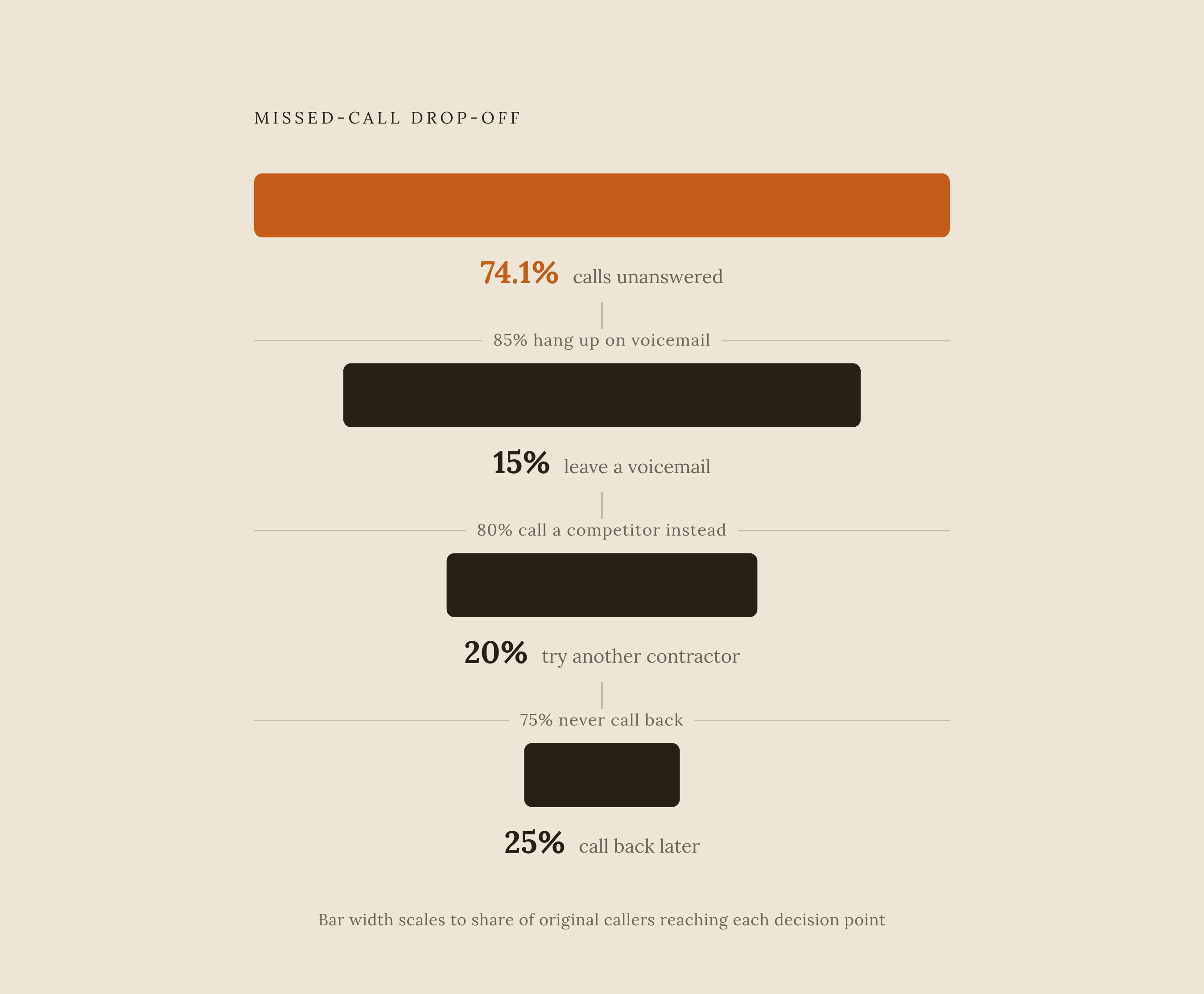
The numbers on that gap are brutal. Research on home services businesses puts the unanswered-call rate at 74.1%. Almost three out of every four calls a contractor pays to generate never get picked up by a person. What happens next makes it worse: 80% of callers who don't get through won't leave a message, they just call the next name on the list. Of the ones who do reach voicemail, 85% hang up without leaving a word. And 75% of callers who don't connect the first time never call back at all.
Add the lead aggregator dynamic on top of that, and the math gets uglier. Thumbtack, Angi, and HomeAdvisor routinely sell the same lead to several contractors at once, typically three to five. Whoever picks up the phone first gets the job. Everyone else just paid for a lead that went nowhere. Harvard Business Review's data on response time backs this up hard: a business that responds within five minutes is up to 21 times more likely to qualify that lead than one that waits half an hour. Separately, industry research finds that the first company to respond wins the job 78% of the time.
None of this is a technology story yet. It's just the operating reality every contracting business lives inside, whether they've priced it out or not.
How the math compounds: what missed calls cost per year
Put a number on a missed call, and it is around $1,200 in lost value. Multiply that across a typical year of missed volume, and the average contractor is looking at roughly $189,068 in lost annual revenue. That's not a rounding error. That's often more than the cost of hiring another technician.
After-hours calls make the picture worse, not better. Somewhere between 40% and 60% of all business calls to contractors come in outside the standard 9-to-5 window. On top of that, contractors miss about 40% of inbound calls simply because they're on a job site, hands full, phone buried in a truck console.
After-hours calls skew toward higher-value work, which stings. Emergency jobs average $4,200 compared to $3,500 for routine calls. A typical plumbing company fields somewhere between 8 and 12 emergency calls a week outside business hours. Miss those consistently, and using average emergency job values of $450 to $600, a contractor can be looking at up to $247,000 in lost annual revenue from that window alone.
So the leak isn't evenly spread. It's concentrated in the highest-margin, highest-urgency moments, precisely when nobody's staffed to answer.
What AI voice agents can do on a live contractor call in 2026
Forget the old phone tree. This isn't "press 1 for scheduling, press 2 for billing." Modern AI voice agents understand what a caller is actually saying, in normal conversational language, not a menu of keywords.
Walk through what one call looks like now. A homeowner calls at 11 p.m. with a burst pipe. The AI answers instantly and, through a natural back-and-forth, figures out how urgent the situation is. It checks the contractor's calendar for technician availability. It books the appointment right there, in real time. It processes a deposit payment over the phone. It sends the homeowner a text and an email confirming the job. It adds the job to the dispatch system. It creates a new customer record in the CRM. All of that, in a single phone call, with zero human involvement on the contractor's side.
Emergency detection is a specific, trained capability, not a guess. The AI can tell a burst pipe or a dead AC unit or a no-heat call apart from a routine maintenance request, and route accordingly: urgent calls get pushed straight to the contractor's phone, while routine bookings get handled and confirmed automatically. That routing logic is why a typical HVAC contractor deploying one of these systems can handle three to four times more inbound call volume without adding a single receptionist to payroll.
Callers aren't left stranded, either. If the AI can't resolve something, it transfers to a live person, takes a detailed message, or escalates the call up the chain. And on most routine calls, callers genuinely can't tell they're talking to AI. The conversation holds context, doesn't repeat questions already answered, and moves at a normal conversational pace.
Where CRM and scheduling integration determines whether the technology sticks
None of the above matters if the booked job doesn't show up where the contractor actually works. Integration used to be a nice-to-have. Now it's the baseline requirement. When an AI agent books a job, it needs to land inside ServiceTitan, Housecall Pro, or Jobber automatically, not sit in some separate app the office manager has to check by hand.
Done right, integration erases manual data entry, kills double-booking errors, and gets rid of the disconnected call logs contractors used to have to reconcile against the schedule at the end of the week.
Here's where demos lie, though, even when they're not trying to. Latency, dropped call transfers, rigid routing logic, calls that just vanish: none of that appears in a scripted five-minute demo. It becomes visible during a storm surge, during a holiday weekend spike, during the fourth call in ten minutes when a heat wave hits and every AC in the neighborhood dies at once. A two-second delay that seems trivial in a demo becomes a lost job when a caller with three other contractors already dialed hears dead air and hangs up.
Housecall Pro offers its own native paths here, and it's worth knowing where each one stops. HCP Assist uses live human agents around the clock, trained specifically for home services work, booking directly into the HCP calendar. It runs on per-call or per-minute pricing, roughly $300 to $600 a month for moderate call volume, and that cost climbs fast as volume grows. CSR AI is Housecall Pro's AI receptionist, built natively into the platform, but it's boxed into the HCP ecosystem: less flexible for complex call routing or connecting to other tools outside that stack. Then there's Voice, HCP's phone system built on Twilio, which handles calls but doesn't answer them automatically. It's infrastructure, not a solution to the missed-call problem itself.
Third-party AI voice platforms built outside a single FSM ecosystem tend to offer more room to maneuver: custom routing logic, multi-language support, and connections across more than one system. Which one makes sense depends entirely on call volume and what's already running in the back office.
The vendor landscape: which platforms contractors are deploying
The market backing all this isn't small or speculative anymore. The global AI voice agent market sat around $2.5 billion in 2025, with projections putting it several times higher by 2028. Home services, HVAC, plumbing, electrical, is one of the fastest-growing segments inside that number.
Three layers make up the ecosystem. Infrastructure platforms including VAPI, Bland.ai, ElevenLabs, and Retell AI form the backbone of much of what gets built on top. Vertical-specific vendors build directly for a trade, like Avoca AI for home services. And white-label agencies take that infrastructure layer and resell it under their own branding.
Assessments based on call quality, routing accuracy, CRM update reliability, and stability under load point to a few standouts. Retell AI is a noted option for inbound service work, with a 4.8 out of 5 on G2 and pricing starting at $0.07 per minute. Avoca AI fits larger home service operations that need automated job booking, emergency routing, and full customer history alongside faster speed-to-lead. Brilo AI suits smaller contractors who mainly need coverage during busy stretches and after-hours gaps. CloudTalk is another platform in the space offering phone system and CRM connectivity features. Vellum targets owner-operators who want one AI receptionist handling calls, scheduling, email, and light admin work together. Vapi is built for developer-led shops that want API-level control over call logic, with pricing starting at $0.05 per minute in platform fees. Synthflow offers no-code setup for smaller contractors and agencies, a 4.5 on G2, starting around $375 a month. AgentVoice answers calls, books jobs, and pushes details straight to the contractor. And Voice.ai's home services product answers in under a second, qualifies the project, books the appointment, and syncs with ServiceTitan and Jobber, claiming over 800 contractors using it with a no-code setup pitched as ready in minutes.
What separates these platforms in practice comes down to a short list: latency under real peak load, how they handle concurrency during seasonal surges, whether the CRM write actually happens during the live call instead of failing silently after, how accurate the emergency routing is, and how honest the pricing stays once call minutes start climbing.
What the early deployments produced: case results from live contractor operations
Case data from Avoca AI, covering 2024 and 2025 and cited by LeadLock.ai, gives a look at what this actually does to a contractor's numbers once it's running.
Aire Serv, a national HVAC franchise, saw after-hours bookings jump from 58 to 208 in a single period, a 258% increase. The AI pushed their after-hours booking rate to 90% and replaced a live answering service. It also drove a 41% maintenance plan sign-up rate during AI-handled calls, opening up a recurring revenue stream that didn't exist before.
HL Bowman, an HVAC and plumbing outfit in Pennsylvania, hit a 100% call answer rate with a 93% AI customer satisfaction score. Revenue grew 70% year over year, and cost per conversion dropped from $350 down to $215.
Larger multi-brand home service operations have similarly moved a substantial share of their inbound call volume to AI handling. Alex C., an independent contractor running Integrity Services, booked 75% of inbound calls into appointments, with 90% of those converting into actual jobs, a close rate that beat most franchise benchmarks in the space.
The broader pattern reported across deployments shows meaningful increases in booked appointments from the after-hours window specifically. The pattern holds across every case: the after-hours and emergency window is where the gains concentrate, which lines up exactly with the earlier finding that 40% to 60% of all calls arrive outside standard business hours in the first place.
The cost comparison: AI voice coverage vs. the alternatives contractors currently use
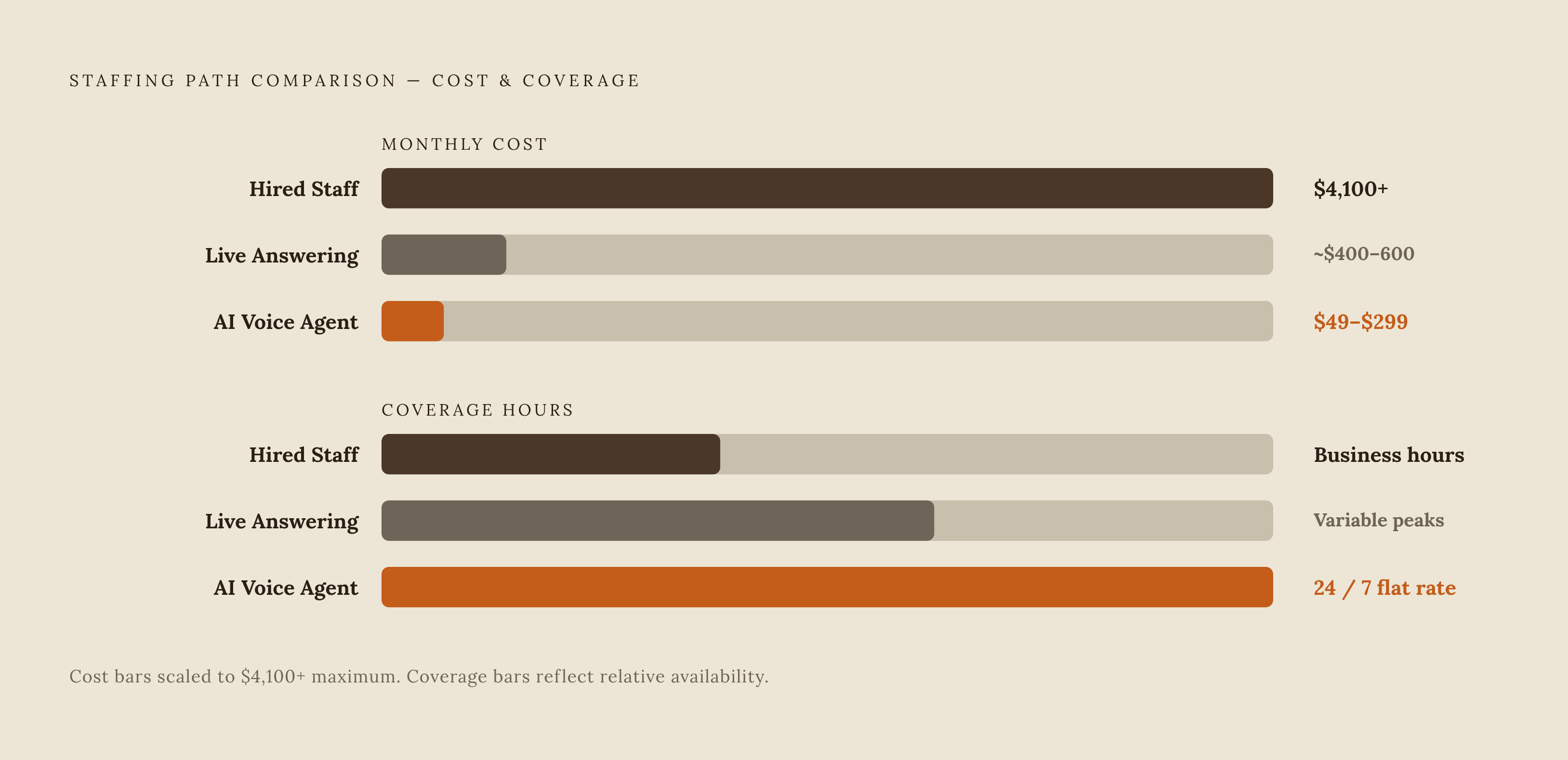
Contractors are really choosing between three paths right now. Hiring staff to answer phones runs $4,100 or more a month. Live answering services cost a wide range running into several hundred dollars a month. AI voice agents, across most platforms, run $49 to $299 a month.
Run the payback math at $199 a month: capturing just one $3,500 job covers more than 17 months of service. That's the entire calculation for a lot of contractors deciding whether to make the switch.
Cost isn't the only variable, though. Coverage matters just as much. Staff works business hours and goes home. Answering services carry per-call pricing that scales against the contractor and often come with wait times during peak call periods. AI runs at a flat monthly rate, 24 hours a day, without a shift schedule.
Roofing carries its own version of this math. Full-featured platforms with AI analytics and CRM integration run a wide monthly price range up to several hundred dollars, and roofing companies using AI for measurement and estimating are closing 30% more jobs simply by getting an accurate proposal to the homeowner first. Conservative estimates put the return on that investment above 5x within the first quarter.
For contractors not ready to commit to a full voice AI deployment, there's a smaller first step: automated confirmations and reminders alone cut down no-shows and save 3 to 5 hours a week right away. It's not the full solution, but it's a real place to start.
The comparison that actually matters isn't AI against no AI. It's the ongoing bleed from missed calls, laid out earlier, against a flat monthly fee that doesn't grow just because call volume does.
How to evaluate a platform before going live, what demos won't show you
A polished demo tells a contractor almost nothing about how a platform behaves on a real phone line. Latency, dropped transfers, rigid routing, concurrency failures: these appear under live traffic, not in a five-minute scripted walkthrough.
Retell AI's published evaluation methodology points to five things to check before signing anything. Call quality and latency come first: even a small delay frustrates a caller dealing with a burst pipe at midnight, so test the system under background noise and with a range of accents. Stability at scale comes next, since a platform that works fine on one call can fall apart the moment a storm or a marketing push sends ten calls in at once. Telephony depth matters too: phone number support, SIP connectivity, how reliably transfers actually complete, voicemail handling, and how customizable the routing logic really is. Integration realism is its own test entirely: does the CRM update happen live during the call, or does it sync later and sometimes just fail. And pricing transparency at scale rounds it out, since a rate that looks cheap at low volume can turn expensive fast once call minutes climb.
Before signing with any vendor, ask for a live test call, not a recording. Ask directly what happens when call volume spikes all at once. And ask for a reference from a real contractor in a similar trade, running a similar call volume, because that conversation will tell a contractor more in ten minutes than any demo will in an hour.