Marketing Metrics That Actually Predict Revenue for Home Services
Track where your home services marketing turns leads into jobs, not just clicks.
Marketing metrics for home services should answer one question. Which part of the business turns paid demand into signed jobs, and which part loses it? Spend, clicks, and cost per lead cannot answer that alone. The useful measures link lead cost to answer rate, booking, and closing, then to revenue per marketing dollar.
Why most contractors measure the wrong thing
Ad spend went up last month, but revenue did not move. The report shows more clicks and a reasonable cost per lead, so marketing appears to be doing its job. Yet the schedule tells a different story. A cheap lead that never books an estimate is worth nothing, and a report that stops at lead generation cannot explain the gap.
The mistake is measuring activity as though it were an outcome. Cost per lead, or CPL, describes the price of an opportunity. Scheduling and invoicing tools rarely connect cleanly with ad platforms, customer records, and call tracking. Website analytics also miss conversions that come from calls, messages, Google Business Profile actions, and Local Service Ads bookings. Without those connections, a slow month could be a lead problem, a booking problem, or a follow-up problem, while budget decisions still turn on clicks.
The funnel chain that actually connects spend to signed jobs
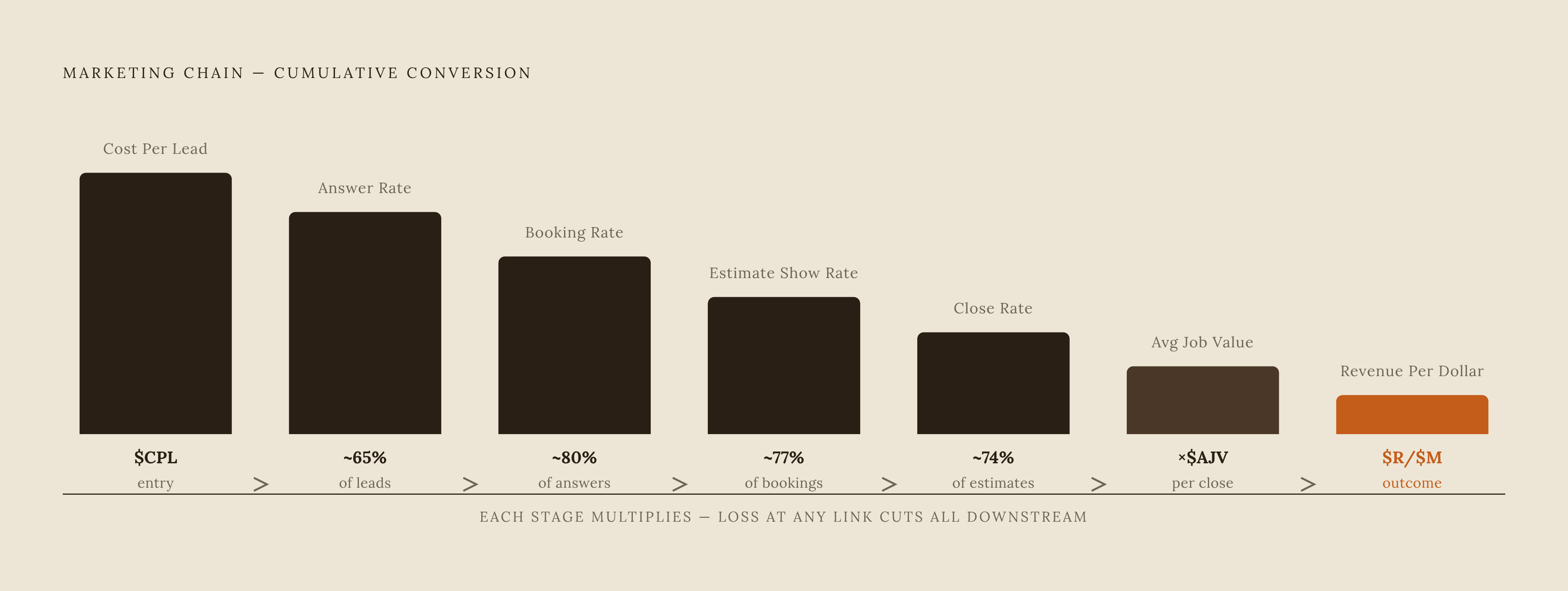
The chain starts with cost per lead, then moves through answer rate, booking rate, estimate show rate, close rate, average job value, and revenue per marketing dollar. Each link determines how much value reaches the next. Buying a lead does not guarantee a conversation. A conversation does not guarantee an estimate, and an estimate does not guarantee a signed job.
A low answer rate points to a problem in operations, while a low booking rate calls for a look at trust and follow-up. A low close rate calls for a look at sales, pricing, and what happens before the visit. From outside the chain, all three can look like “marketing isn't working.” Inside it, they call for different fixes.
Revenue per marketing dollar is the total attributed revenue divided by the total marketing spend. It gives the whole chain one output. The conversion rates that feed that output multiply rather than add, so gains in answering, booking, and closing build on each other without more ad spend. The output shows whether performance changed, while the links explain where it changed.
Answer rate: the leak before the funnel even starts
At the first operational link, the problem is often ordinary coverage. Calls arrive after hours, during lunch, or when peak-season demand overwhelms the office. The homeowner's urgency does not pause for any of that. A missed call can become the next contractor's opportunity before the first contractor has a chance to respond.
Answer rate measures the percentage of inbound calls that reach a system capable of qualifying and booking the lead. Voicemail does not count as that kind of answer. Most homeowners move on rather than leave a message, so recording a call is not the same as capturing its value. Faster follow-up helps address the gap between incoming demand and an actual conversation, but it does not make missed calls harmless.
The response need not be another staffing shift. AI-powered answering and routing can capture and qualify calls around the clock, including the periods when manual coverage fails. This is an infrastructure decision. Its value is in the answer-rate link, where the opportunities the business paid for either reach the funnel or are lost.
Booking rate: where trust wins or loses the job before the estimate visit
Once someone answers, the next question is whether the homeowner agrees to an estimate. Speed helps, but it does not work alone. Review count, a project portfolio, and the quality of the first exchange shape how much confidence the homeowner brings to that decision. Booking rate is therefore a measure of the pre-visit experience as well as office performance.
That experience continues after the appointment is booked. A professional confirmation email establishes the booking, a reminder text the day before keeps the visit in view, and a technician introduction the morning of the visit makes the arrival less anonymous. Silence offers none of those signals of reliability. These steps occur after the initial booking, so their effect also reaches the estimate show rate and the eventual close rate.
The distinction keeps the diagnosis honest. A homeowner who never books presents a different problem from one who books but does not show, even when weak trust contributes to both. Treating confirmation and follow-up as part of the revenue chain makes those differences visible. When each completed job has a meaningful value, a modest improvement in the share of callers who book can change revenue without buying more leads.
Review velocity as a revenue signal, not a reputation exercise
Reviews feed the trust that booking depends on. Review velocity means how frequently a business earns new reviews, rather than how impressive its rating looks at one moment. Fresh reviews influence both local search visibility and homeowner confidence. A static rating misses that movement entirely.
The contrast is visible before the first call. A competitor who gets fresh five-star reviews every week sends a different signal from a contractor whose profile sits still. That difference belongs in the revenue discussion because trust feeds booking rate, which helps determine cost per closed job. Reviews are not a separate branding exercise floating outside the funnel.
Useful measures include reviews earned per month, average response time to reviews, sentiment tied to specific services, and mentions of individual technicians. Each reveals a different part of the experience. Service patterns and technician mentions can inform operations, while the flow of new reviews shows whether the public trust signal is being renewed. Automated post-job requests make that renewal a repeatable process rather than an office task that happens when someone remembers.
Close rate and average job value: the two multipliers at the bottom of the chain
At the estimate visit, close rate determines how much of the earlier investment becomes signed work. Average job value then determines the revenue attached to each completed job. Neither depends on lead volume alone. More leads cannot fix a closing problem, and the same number of jobs can bring in different revenue when average job value changes.
Field data that records close rate and job value by technician can expose a drop that a company-wide average hides. That creates a field coaching question. Because pre-visit trust and quote follow-up also influence the result, a lower close rate is a reason to investigate sales ability alongside those factors.
Customer lifetime value adds the longer view needed to judge acquisition cost. A recurring-service trade can justify a lead cost that would be unprofitable for a one-and-done service. Maintenance plans and recurring agreements change that calculation by extending the customer's value beyond the first job. Tracking lifetime value by service line helps a business judge CPL for each trade rather than use the same acquisition benchmark for all of them.
How channel choice affects where in the chain the damage happens
Different channels can lose value at different links. Organic SEO leads typically take longer to arrive, but their cost per lead falls as the investment matures. Branded and local-intent searches can still bring in qualified leads even when zero-click search cuts website traffic. Quote-to-job conversion helps show whether organic leads want to buy or are window shopping, and a weak result may point to keyword targeting.
Some demand never starts with a website session. Google Business Profile calls, direction requests, and booking clicks show what people did, which impressions alone cannot explain. GEO and AEO, which target visibility in AI-generated search overviews and conversational responses, add an emerging layer before the first website visit. They are not established primary channels in this framework, and visibility there should not be confused with proof that a call was answered or a job closed.
Direct mail works differently again, acting as a precision trigger for needs such as roofing after storms or lawn care at seasonal transitions. Timing links the message to homeowner urgency, affecting booking and closing. Local Service Ads deliver 29 to 73 percent cheaper leads than Google Ads depending on trade, but that comparison still stops at acquisition. Cost per closed job by channel shows what became of cheap leads, while revenue per marketing dollar takes into account how much the work won was worth.
What a unified tracking system has to do that fragmented tools cannot
Channel-level results require a connection between the source of a lead and the outcome of the job. Disconnected tools break that connection at the handoff. Marketing sees CPL and operations sees job count, but neither sees how much it cost to bring in the completed work.
The required architecture follows the chain itself. Call tracking records source, a CRM records booking and show outcomes, and field software captures close rate and job value by technician. A reporting layer links those records to what the business spent on marketing. The purpose is to see which keywords, pages, and channels generate revenue.
This is not mainly a product-selection argument. A single dashboard is useful only if the operational and marketing data behind it connect. Otherwise, it displays separate totals in one place without making the chain visible. A unified system supplies the measurement infrastructure that lets a contractor distinguish a demand problem from a failure to convert demand.
How AI automation closes the gaps that the chain exposes
Once those connections show missed calls, stalled quotes, or reviews that are only collected now and then, automation has a clear job to do. It is not a substitute for diagnosis. Answering systems cover calls after hours and when call volume peaks, while booking confirmations help with the pre-visit experience. Their purpose is to improve the exposed link without adding the same volume of manual work.
Quote follow-up addresses a later loss of revenue. AI can draft estimate notes from job photos, apply approved templates, create reminders, and send polite nudges when a homeowner has not responded. Automated post-job review requests help at a different link by keeping new feedback coming in. AI reporting can also show patterns between keyword intent and revenue outcomes, connecting content performance to booked job value.
The platform options address different operating needs. ServiceTitan offers smart dispatch for businesses with more than one technician, while its AI lead scoring is labeled early access under capabilities coming soon. Housecall Pro offers AI chatbot booking and call answering through CSR AI for small and mid-size businesses. Jobber offers AI-powered estimates and automated customer communications for small and mid-sized landscaping, pest control, and maintenance operations.
Those differences keep the evaluation tied to the leak. Dispatch, answering, and estimate support are not interchangeable functions. The structural case for a unified AI-native stack is that capture, confirmation, follow-up, and review collection can connect with the outcomes used to measure them.
Reading the chain as a weekly operating discipline, not a one-time audit
A chain reviewed only at month-end leaves problems running longer than necessary. Weekly review gives the diagnosis a shorter operating cycle. A coverage gap or slipping conversion rate found during the month can be addressed before it consumes the rest of the month's opportunities.
The weekly review should start with revenue per marketing dollar and work backward through close rate, show rate, booking rate, and answer rate until the movement explains the result. Average job value and lead cost help distinguish changes in conversion from changes in the economics of the work. Data for each technician can help explain why the overall close rate has fallen. The link that changed becomes the focus for that week's fix.
A slow month then produces a different decision. Instead of increasing ad spend on instinct, the contractor can distinguish unanswered demand from weak booking, stalled quotes, or poor channel fit. Coverage gets attention when calls are being lost, and coaching gets attention when field conversion slips. The separation between contractors who grow and contractors who guess is this ability to locate the failure before paying to send more leads through it.