
Local Services Ads vs Google Search Ads for Remodeling Contractors
LSAs rank highest on Google but cost more per lead than Search Ads for remodeling work.
What Local Services Ads are and how the platform works in 2026
Local Services Ads sit above everything else on the page. Above the paid Search Ads, above the map pack, above every organic listing. For a local contractor, there's no better real estate on Google.
The pricing model is what sets LSAs apart from the rest of what Google sells. Contractors don't pay for clicks or impressions. They pay per lead, so money only changes hands when a homeowner actually calls, messages, or books through the ad. A scroll-past costs nothing.
Something changed in late 2025 that every contractor running LSAs needs to know. Google merged its two old trust badges, "Google Guaranteed" and "Google Screened," into a single blue "Google Verified" badge. The consumer money-back guarantee that used to ride along with the old badge went away in that merge. Anyone wanting reimbursement for a botched job had until December 7, 2025, to file, and only for work completed within 30 days of service completion. So if a contractor's website, brochure, or truck wrap still brags about "Google Guaranteed," it's pointing homeowners toward a promise Google no longer keeps.
Google Search Ads and how they differ structurally from LSAs
Search Ads run on the classic pay-per-click model. A contractor pays for every click, whether or not that click turns into a phone call or an estimate request.
What Search Ads hand back in exchange is control, and it's real control. Keyword selection, ad copy, landing page destination, time-of-day scheduling, device targeting, geographic radius: a contractor can dial in every one of these. None of that exists inside LSAs, where Google runs the matching and the creative behind the scenes without asking permission.
Getting into Search Ads is also just easier, and that ease cuts both ways. Google verifies the advertiser is who they claim to be, but there's no license review, no insurance documentation, no background check the way LSAs require. The lower barrier means a more crowded auction, full of competitors who didn't have to prove anything to show up.
Google's AI Max for Search came out of testing in April 2026. It automates keyword expansion and ad creative generation at the platform level, so a campaign's behavior shifts even when the contractor hasn't touched a single setting.
What each channel costs for remodeling and general contracting leads
Numbers here move by trade and by month, so a blended average hides more than it shows.
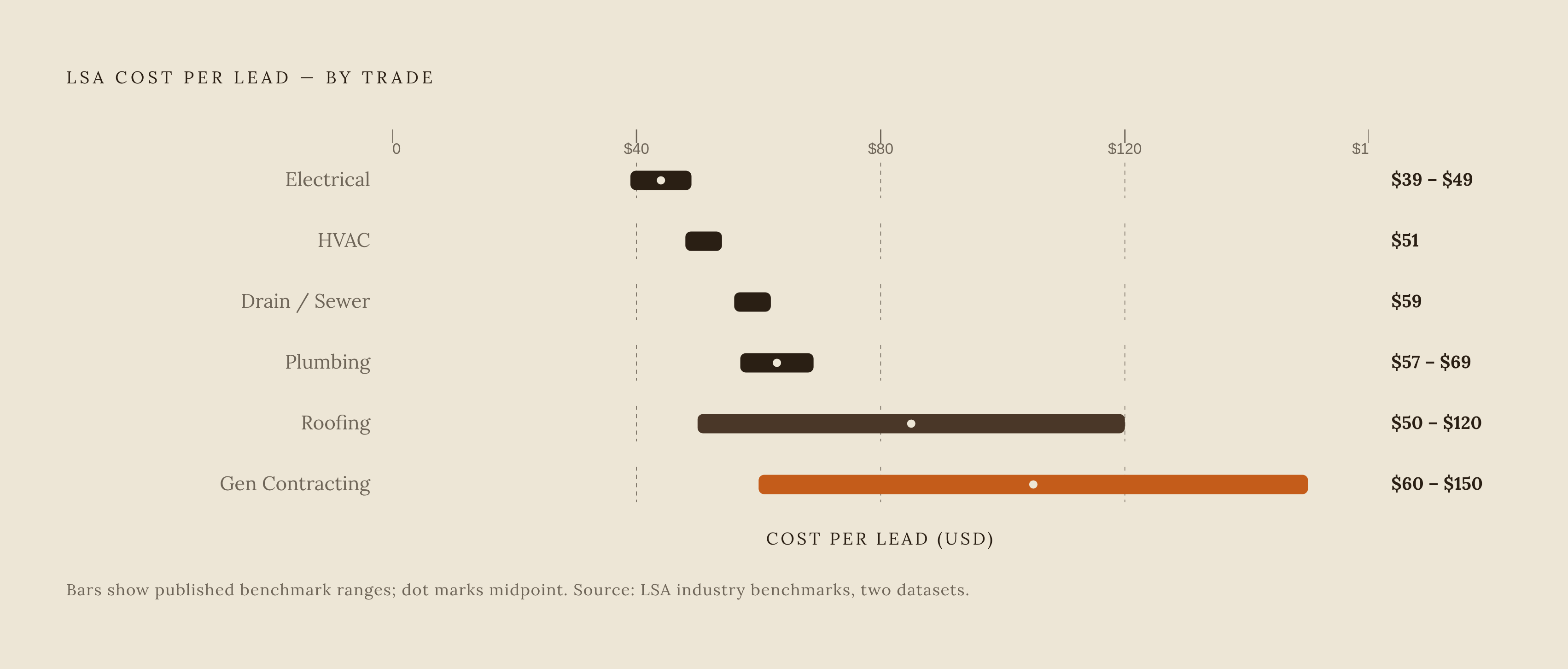
A benchmark from SearchLight Digital, drawn from $6.72 million in observed LSA spend across 888 contractors and 126,650 leads, put per-trade costs at $39 for electrical, $51 for HVAC, $57 for plumbing, and $59 for drain and sewer work. A separate dataset from Data-Driven Trades, covering 1,011 home services businesses, showed plumbing climbing to $69.26 and electrical to $49.02 between February and May, tracking the seasonal demand curve into spring and summer. General contracting and remodeling sit well above those trade averages, running $60 to $150 per LSA lead, with roofing close behind at $50 to $120.
Search Ads benchmarks for 2025 to 2026 follow a similar pattern by trade: HVAC between $45 and $65, plumbing between $40 and $55, roofing between $85 and $120, landscaping between $30 and $45. Remodeling-specific Search Ads costs don't appear as their own line in the data available, and that gap deserves to be named rather than papered over with a guess.
On paper, LSAs often run at a meaningfully lower cost than a blended Search Ads lead. That comparison is misleading on its own, because it treats every lead as interchangeable. A $120 LSA lead that closes into a full remodeling job carries completely different math than a $60 Search Ads lead that needs three more follow-up touches before it converts. Cost per lead is the wrong number to anchor on here. Cost per closed job, weighted by the size of that job, is the number that actually tells a remodeler something useful.
How LSA ranking works and remodelers' vulnerability to its failure modes
Google ranks LSA placement on several signals, including review count, review rating, response speed, and proximity to the searcher. A contractor with a lower bid and a five-minute response time can outrank a competitor bidding higher but answering slowly.
Response time is the signal that trips up remodelers hardest, and it's not close. LSAs punish missed calls, and every missed call chips away at future ranking. The system's design rewards immediate responsiveness, which suits emergency trades where a homeowner expects someone to pick up right now.
That's a mismatch for remodeling work. A $60,000 kitchen or addition project involves weeks of back-and-forth: multiple estimates, a sales conversation, real deliberation on the homeowner's end. LSAs are tuned for the contractor who answers in five minutes and shows up same-day. LSAs are the worst-fit paid channel a remodeler runs, full stop, because the pricing and the ranking logic were both built for high-frequency emergency work. That's still not a reason to skip the channel. It's a reason to know what job to hand it, and to stop expecting it to carry the whole funnel.
What Google Search Ads do that LSAs cannot, and their place in the remodeling sales cycle
Search Ads let a contractor separate intent by keyword in a way LSAs never allow. "Kitchen remodel cost estimate" and "emergency plumber" describe two completely different homeowners at two completely different moments, and Search Ads let the contractor match ad copy and landing page to whichever one is actually searching.
Big remodeling decisions stretch over weeks or months, with homeowners running the same searches over and over before they ever pick up the phone. Search Ads can stay present through that whole stretch. LSAs, in contrast, appear only at the very last step, once someone has already decided to call a contractor today.
Growth is where Search Ads pull ahead, and the gap is structural. Raising the budget on Search Ads grows reach roughly in proportion to the spend. LSA volume doesn't work that way, since it's capped by how many people in a given market are searching right now. Past that cap, more money buys nothing.
A homeowner weighing a $50,000 outdoor living space isn't ready to call after seeing a phone number. They want finished project photos, financing options, some proof this contractor has done this before and done it well. Search Ads can route that homeowner to a landing page built for exactly that job. LSAs can't. There's no landing page in the LSA experience, just a business profile and a call button. That's why big-ticket remodeling work leans so heavily on Search Ads to close the gap.
The case for running both channels together and dividing the work between them
Across the marketing groups that study this space, WolfPack, Engineered Reach, BG Collective, the conclusion lines up: contractors doing this well run both channels. The real work is deciding what job belongs to which one, and getting that division wrong wastes money faster than picking the wrong channel.
A workable split looks like this. LSAs handle the homeowner who's already decided today is the day they call a contractor: high intent, lower cost per lead, but a volume ceiling and a hard requirement to answer the phone fast. Search Ads handle everyone earlier in that process, catching keyword variations the LSA budget never touches, scaling past whatever ceiling LSAs hit, and giving the contractor a landing page to walk a homeowner through a longer sales cycle. Underneath both is the Google Business Profile and map pack, which costs nothing to maintain and compounds over time, and it produces that effect by giving the contractor a free, always-on presence that neither paid channel replicates. Businesses appearing in both LSA slots and the organic map pack have seen click-through rates 40 to 60% higher than those appearing in only one placement, which makes profile optimization closer to mandatory than optional.
On budget, the SBA recommends established businesses spend 7 to 8% of revenue on marketing. For a remodeling contractor, the resulting monthly budget will vary with annual revenue, and the split between LSAs and Search Ads should track which jobs the contractor is chasing and how crowded the local market already is.
None of this works without one piece in place first: phone answering has to be near 100% during business hours. Skipping that makes LSA ranking degrade no matter how much gets spent, because the whole system depends on someone actually picking up.
Where lead aggregators, Meta Ads, and GEO fit around the Google channels
Aggregator platforms like Angi, Thumbtack, and HomeAdvisor are losing ground as budget shifts toward Google Ads and channels a contractor actually owns. Once remodeling's Google cost-per-lead is already built into the budget, paying an aggregator for the same lead gets harder to justify by the month.
Meta Ads with neighborhood-level targeting deliver 3x to 5x return on ad spend at $300 to $1,500 a month, and they work especially well with homeowners between 35 and 65, a range that overlaps heavily with the two buyer types who drive most remodeling work: the practical backyard upgrader and the homeowner investing in quality of life for retirement. Meta reaches someone before they've started actively searching, planting the idea of a project. It also catches the visitor who clicked a Search Ad, left without converting, and needs to see the brand again before picking up the phone.
Generative Engine Optimization is the newest piece of this puzzle. A growing share of consumers, 45% by one recent estimate, now ask ChatGPT or similar tools for local business recommendations instead of typing into Google. A contractor who doesn't appear in those AI-generated answers is invisible to that slice of early-stage researchers, no matter how well the Google campaigns are running.
Sources
- Local Service Ads vs Google Ads (And How to Use Both Right) | WolfPack
- Are Google Local Service Ads Worth It for Home Service Companies? - Cube Creative Design | Digital Marketing
- Google Ads vs. Google Local Services Ads for Contractors: Which Wins in 2026?
- Are Local Services Ads Worth It for Remodelers?
- wizardofads.org