Lead Scoring Configuration for Home Service CRMs
Urgency and property data predict closures better than generic engagement metrics in trades.
Home service CRMs get configured wrong constantly, because the default lead scoring logic built into most platforms comes from B2B software sales. That model assumes a slow, multi-touch buying cycle with a marketing-qualified lead, a sales-qualified lead, and a committee somewhere signing off. Trades work doesn't move that way. A homeowner with a burst pipe isn't nurturing anything, they're calling whoever picks up.
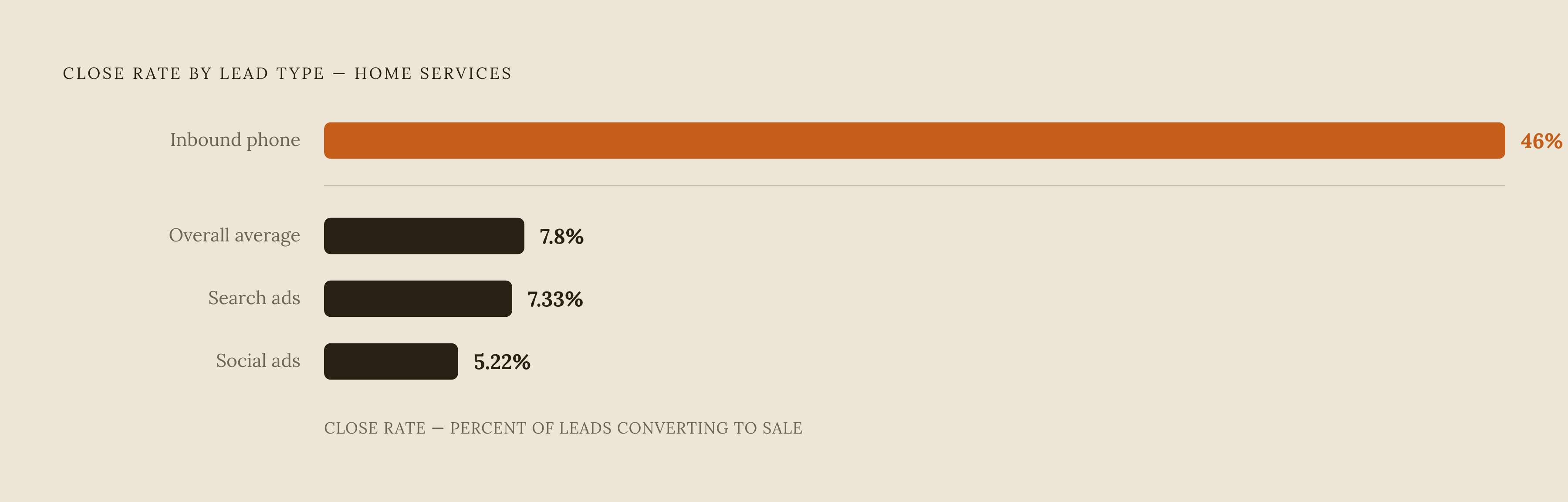
That mismatch has a real cost. Reps end up deprioritizing the urgent, high-value leads because the score looks low, and chasing engaged-but-empty inquiries because the score looks high. The signals that actually predict a closed job in home services, urgency, property type, which channel the lead came from, how fast someone responded, are absent from an off-the-shelf scoring template because those templates are built around generic engagement metrics rather than trades-specific buying behavior. Home service businesses close an average of 7.8% of leads overall, but phone leads close at 46%, with 37% shutting on the first call, which is urgency-driven behavior rather than a considered buying process. That's urgency, not a considered buying process, and a CRM that doesn't score for it is scoring the wrong thing. That's urgency, and a CRM that doesn't score for it is scoring the wrong thing.
The four signal categories that predict conversion in home services
Four categories of signal do almost all the predictive work in a trades CRM. Each behaves differently and needs its own scoring logic.
Project urgency. "My AC died and it's 95 degrees" and "thinking about redoing the patio next spring" are not the same lead, and treating them the same is the single most common scoring mistake in the industry. Urgency language appears right in the initial inquiry, whether that's a form field, a call transcript, or a chatbot capture, and it's about as clean an explicit signal as you'll get. Reactive urgency (a burst pipe, a dead furnace in January) should be separated from elective urgency (the house is going on the market in 60 days, the last contractor no-showed). Both score high. They route differently.
Property profile. Property age, ownership status, and estimated home value all correlate with project scope and the odds someone actually moves forward. A large share of the housing stock is sitting right at the edge of replacement age for major systems. That macro pattern becomes a scoring variable at the individual lead level. Homeowner versus renter is a clean binary that knocks out unqualified leads immediately, and estimated home value or neighborhood tier can proxy for budget, which matters a lot in hardscape work where spend ranges swing wildly between jobs.
Channel source. Not every channel hands you the same buyer. Leads from search ad platforms convert at around 7.33% and social ad platforms at around 5.22%, while referral and direct channels tend to outperform both significantly. Referrals and repeat customers deserve the top scores in the whole system. Leads from aggregator platforms like Angi or Thumbtack should carry a built-in friction discount, since a form fill from Facebook and an inbound call off an LSA are not remotely the same prospect, even if the score treats them that way today.
Response timing and behavioral recency. Speed-to-lead is probably the highest-leverage variable in the entire funnel. Responding inside 60 seconds can lift conversion by up to 391%, and waiting even five minutes dramatically cuts the odds of qualifying that lead. Score decay has to be built in here, because a lead who inquired three weeks ago and never got a callback is a different prospect than one who submitted a form ten minutes ago, even if every other data point about them looks identical.
How scoring models work mechanically
Three generations of scoring technology are in active use right now, rules-based, predictive/statistical, and AI or machine learning, and many organizations end up running some blend across these approaches rather than picking one exclusively.
Rules-based scoring adds or subtracts points from known properties and explicit actions: a form fill, a call source, a property type, an urgency flag someone checked. It's the right starting point for most home service businesses, because it's transparent, easy to audit, and fast to stand up. The tradeoff is that it's static. It won't adjust on its own as buyer behavior shifts or as a business's own win patterns change season to season.
Predictive and AI-driven scoring looks at historical win and loss data, finds the patterns that showed up before jobs actually closed, and weights new leads against those patterns. This kind of scoring used to live exclusively in enterprise software; now it's a standard feature inside mainstream CRM platforms rather than some premium tier. The catch is data volume. These models need a real stretch of historical closed and lost jobs to train against, so a smaller operation without months of clean scored-lead history in the CRM won't get much reliability out of it yet.
Collapsing everything into a single blended score is where most setups still fall short, even good ones. A two-axis model works better. Put fit (property profile, geography, project type match) on one axis and intent (urgency, channel, recency, behavior) on the other. A single number hides the routing decision that actually matters. Nurture is the right move when fit is high but intent is low. High intent with low fit means deprioritize. High fit and high intent means immediate handoff to a live person. Even a rules-based CRM running on spreadsheet logic should adopt this two-axis structure, because it produces sharper routing than any single blended score can.
Score decay needs to run continuously. A lead who went silent for 48 hours is a fundamentally different follow-up situation than one from this morning, and letting a stale lead sit at the top of the queue just wastes a dispatcher's time. Scoring criteria overall should get reviewed at least once a quarter, since seasonal patterns and buyer behavior shift enough over a few months to quietly drift the model out of alignment with reality.
Negative scoring: the inputs that should lower a lead's priority in a home service CRM
Positive scoring gets all the attention, but negative scoring is what keeps the whole system honest. Without it, every lead just accumulates points over time and the priority queue stops meaning anything.
A handful of signals should count against a lead explicitly in a home service CRM:
- Renter status, not homeowner, which removes decision-making authority for most project types
- Geography outside the service area, which should auto-disqualify rather than just knock a few points off
- A request for a service the business doesn't offer
- Aggregator-platform submissions with documented price-shopping behavior, like someone requesting five quotes at once
- No response across multiple follow-up attempts, which should decay the score aggressively rather than gently
- Unsubscribes or spam flags, a strong and explicit disengagement signal
- Extended inactivity, 30-plus days with no reactivation, with steeper score cuts applied at the 60- and 90-day marks
None of this means abandoning those leads for good. It means routing them into a low-cost automated nurture track instead of letting them eat a dispatcher's or salesperson's active hours. About 79% of leads in this space fail to convert, and that's rarely because follow-up never happened, it's because the same amount of effort gets spread evenly across qualified and unqualified prospects alike. Negative scoring is what fixes that distribution.
Speed-to-lead as a scoring and routing trigger, not just a metric
Industry reporting puts the average lead response time across home service companies at 3.7 hours. That number compounds losses across every single delayed inquiry, day after day. Industry data consistently shows that contractors who respond within five minutes win a disproportionate share of jobs, with the first caller holding a decisive advantage.
The configuration lesson here is straightforward: speed-to-lead scoring needs to trigger automated routing on its own, not wait around for a human to glance at a queue. A score threshold combined with an urgency flag should fire an automated text or email inside 60 seconds, before a dispatcher even sees the lead land. This has to live in the CRM's workflow automation layer. It can't depend on someone remembering to check.
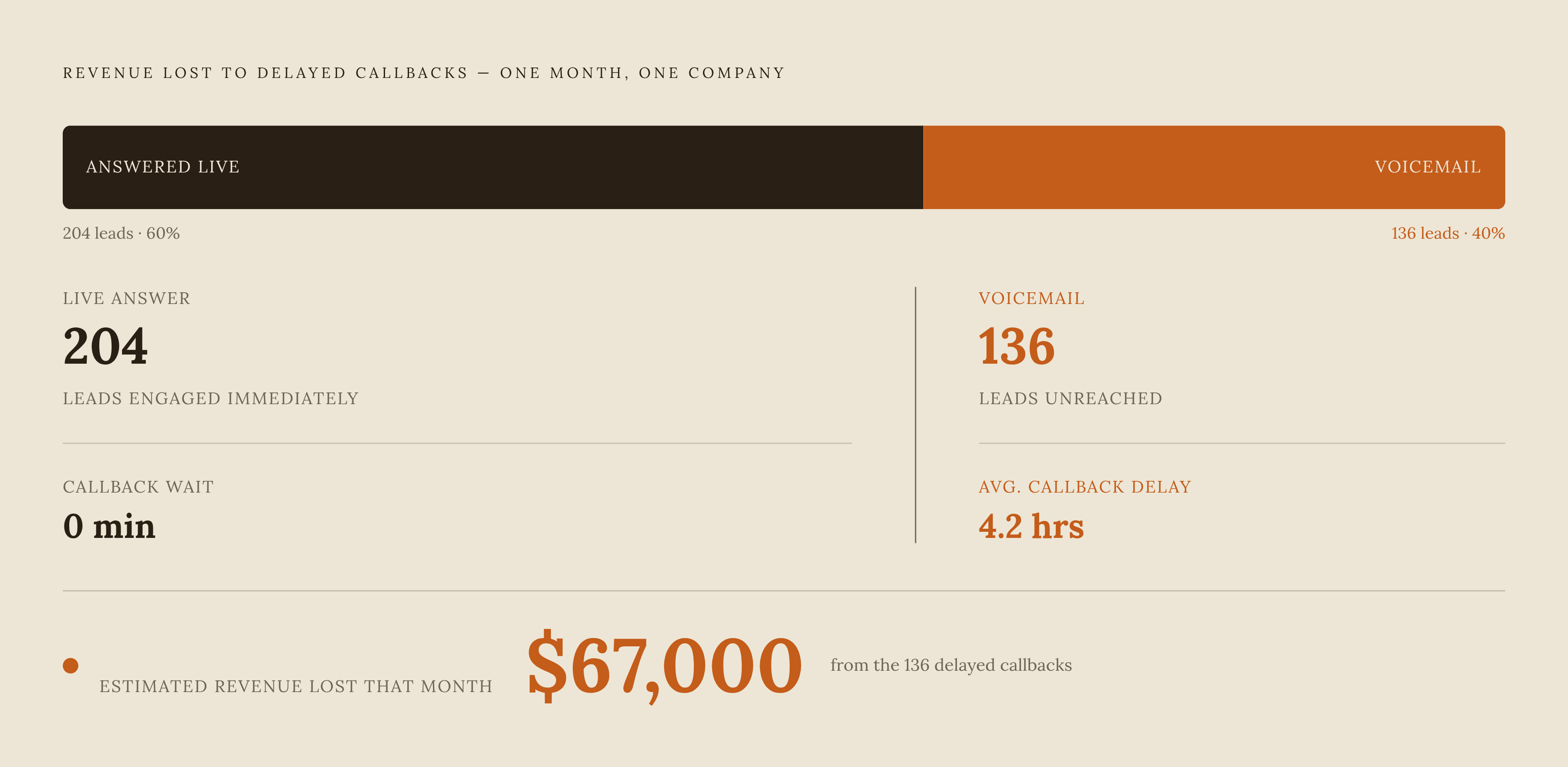
One Phoenix HVAC company generating 340 leads over a single month answered 60% of calls live. The other 40% went to voicemail, with an average callback time of 4.2 hours, and the case data behind that figure put the estimated revenue lost from that gap at around $67,000 for the month. That's the cost of treating speed-to-lead as a metric to review later instead of a trigger built into the system.
A working threshold setup looks something like this: a high score paired with an urgency flag fires immediate automated outreach plus a dispatcher alert. A medium score triggers an automated text within 60 seconds and reaches the dispatcher queue within two hours. A low score, or one carrying negative signals, goes straight into an automated nurture sequence and never reaches a dispatcher.
Purpose-built voice AI tools made for the trades, AgentVoice and LeadTruffle among them, can answer the call, qualify the lead, and book the job directly, feeding scored data straight into the CRM instead of creating a lag where someone has to enter it by hand later. General-purpose voice AI platforms like Synthflow can also be adapted for contractor use, though they weren't built around trades workflows specifically.
How to configure lead source weighting in your CRM
Source scoring should reflect how each channel actually performs in a business's own CRM data first, then get calibrated against broader industry benchmarks.
A working tier structure, based on the conversion data above, looks roughly like this:
Tier 4, negative score or auto-nurture: cold outbound lists, unsolicited social DMs, and any source with a documented pattern of low close rates in the business's own history
Source scoring has to be paired with recency, since a top-tier referral from three weeks ago that never got a callback isn't the same lead as one that just came in. And about 22% of homeowners now use AI tools like ChatGPT to research and find recommendations for contractors. A growing share of inquiries will lack a clean channel tag. Worth building a catch-and-score protocol for "unknown source" leads that still show clear urgency or property signals, so they don't fall through simply because the CRM can't label where they came from.
Building a property and project fit score alongside behavioral scoring
Urgency and behavior tell a business how ready someone is to move. Property and project fit tell it whether winning that job is actually worth the crew's time.
On the property side, a few signals do most of the work: confirmed homeownership as a binary qualifier, property age (older homes tend to mean larger-scope work and messier site conditions), estimated home value or neighborhood tier as a rough budget proxy, and prior project history with the company, which signals fit and intent at the same time.
On the project side, worth weighting whether the request matches the business's highest-margin service category more heavily than a plain "inquiry received" flag. Scope language in the initial message affects how the lead is prioritized: "full backyard" or "replace the entire patio" reads very differently from "just need a quote" with no other detail. Timeline cues, like "before summer" or "we're planning to sell," layer real urgency on top of whatever the fit score already shows.
Putting property fit and intent together is what produces a usable routing matrix. A high-value property with a vague, low-detail inquiry needs a different follow-up sequence than a modest property with an urgent, specific request. Both are legitimate leads. They just don't deserve the same sales resources or the same cadence. For hardscape contractors specifically, homeowner segments like the practical backyard upgrader, the retired homeowner focused on quality of life, and the new or legacy homeowner planning a renovation each carry distinct fit and urgency signatures, and once a lead gets tagged to one of those segments, scoring can encode the difference automatically.
CRM platforms that support this kind of configuration for home service businesses
Platform choice comes down to company size, lead volume, and whether the business needs full field operations, dispatch and invoicing included, or mainly needs lead automation.
ServiceTitan is the dominant all-in-one platform at the enterprise end, widely used by large contracting operations across the industry. Pricing is quoted based on operation size and tier, with enterprise pricing available separately and AI features included at that level. The platform launched Atlas, its AI sidekick, and now carries a growing suite of enterprise AI features. It fits operations running 20 or more technicians where dispatch, billing, and CRM all need to sit on one system, though lead scoring configuration at that scale takes real setup investment upfront.
Jobber is built for easier use among smaller teams, with its AI tools grouped under "Jobber AI" across several named capabilities including Automations, Rewrite, Receptionist, Voice, and Chat. Receptionist is available as an add-on or included depending on the plan tier selected. The AI capabilities are designed to reduce manual steps between a new inquiry and an initial response, which makes it a reasonable fit for smaller operations that want lead automation without the full weight of an enterprise dispatch system.