Missed Call Recovery Sequences for Contractor Phone Lines
Turn missed contractor calls into booked jobs with timed follow-up sequences.
Missed call recovery sequences for contractor phone lines turn unanswered calls into a path toward a booked job. An immediate reply buys attention, while the sequence of timed follow-up, qualification, and booking turns that attention into recovered revenue.
Why a missed call is gone in under a minute — and why a single text-back alone doesn't fix that
A contractor on a roof, under a sink, or inside an electrical panel cannot always answer the phone. The conditions that create the most demand also make answering hardest. That is a structural gap between doing the work and catching the next job.
The homeowner, meanwhile, has no reason to wait. Most callers who reach voicemail leave no message and move on to the next result to call another contractor. For someone dealing with a burst pipe or failed AC unit, responsiveness matters before a price discussion can even begin. Velocify research from c. 2013 found that responding within 60 seconds improves lead conversion rates by up to 391%. That finding explains the urgency, though it is not a promise of the same gain for every contractor.
Missing a call about roofing can cost the whole project, and missing a repair call can also cost work and referrals down the road. Unanswered calls can damage the business’s reputation for responsiveness, making the leak larger than the jobs that can be counted today. Automation is needed because this gap is predictable, but its job cannot end at acknowledging the missed call.
What a single text-back actually does — and where it stops
A basic text-back system detects an unanswered call and sends a pre-written SMS to the caller’s mobile number, typically within five to fifteen seconds. That message gives the homeowner a way to respond before dialing another number. Unlike voicemail, which asks the caller to leave a message and wait, SMS opens a two-way exchange. It is the right first layer because it makes the business reachable while the contractor is occupied.
The limit appears as soon as the homeowner answers. A text-back alone does not qualify the job, check the calendar, or book an appointment. Plura AI’s September 2026 playbook makes this distinction clear through the homeowner whose AC is out, who replies to a text and then gets no answer.
The objection that customers prefer calls does not make text-back pointless. AdvAI says customers may call because Google puts a call button in front of them, then be happy to keep talking by text once the business replies. Texting can spare both sides phone tag. What matters is whether the next exchange moves the job forward.
What the first message must do — and exactly how to write it
The first message has to make the caller’s next move obvious. It should contain four elements, namely the business name, a direct acknowledgment of the missed call, a request for the address and issue, and a clear response timeframe. The name identifies the sender, the acknowledgment connects the message to the call, and the request gives the homeowner something useful to do.
A clear timeframe then tells the homeowner what happens after replying. “We'll be right back with you within 10 minutes” sets a more useful expectation than an open-ended promise. Even a text that arrives fast needs to tell the caller clearly what to do next. The aim is a short exchange that feels like a dispatcher responding.
AdvAI gives a compact example. “Hi, this is [Name] at [Business]. That version identifies the sender, acknowledges the miss, and invites a reply. For a workflow that needs an address and issue before scheduling, those details belong in the first request or the next exchange.
Keep the text to one or two lines and ask one question. AdvAI also advises against selling anything in the automatic reply. Consent rules are stricter for promotional texts than for a text that responds directly to what an inbound caller needs, so the reply should leave out any upsell.
The full recovery sequence — what happens at each step after the first text
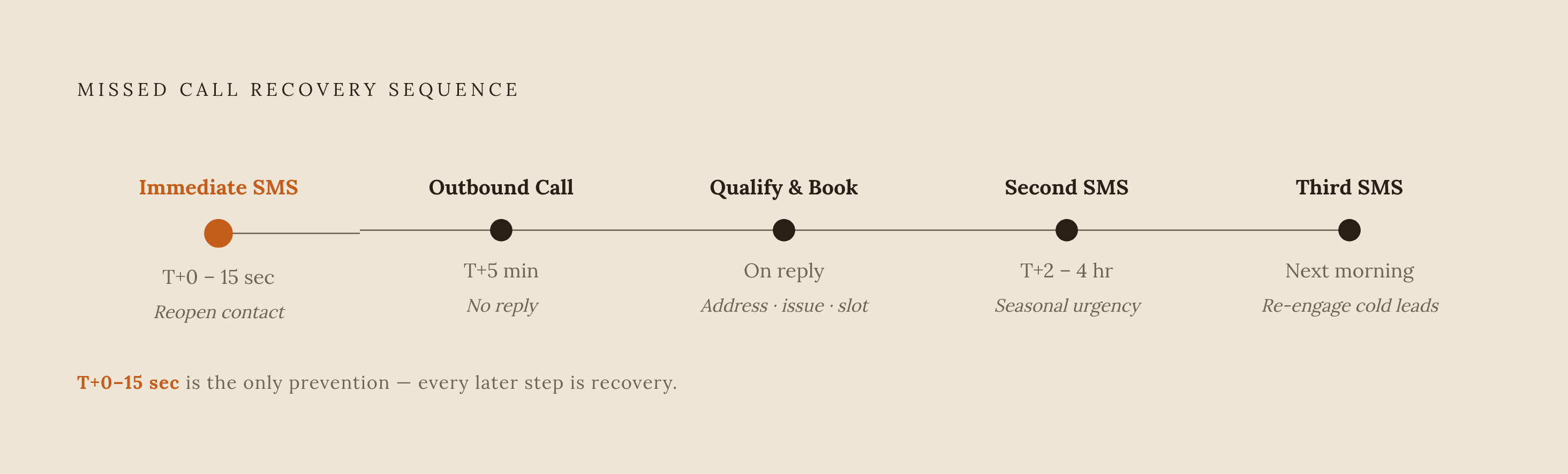
The immediate SMS is the first step, with a target of T+0 to T+15 seconds after missed-call detection. Its only job is to reopen contact before the homeowner calls a competitor. Actual timing depends on the phone setup. GoHighLevel’s official help article recommends an incoming call timeout of 10 to 20 seconds and explains that a long timeout delays the text-back. The system cannot respond to a missed call until the ring timeout has elapsed.
At T+5 minutes, the next step depends on whether the homeowner replied. If there is a reply, a human or AI picks up the thread. If there is no reply, an outbound call attempt gives a voice-preferring caller another way to connect. This touchpoint serves a different purpose from the first text, so it is not simply a repeated acknowledgment.
Qualification starts as soon as the homeowner engages. The exchange should get the service address, find out what is wrong, and check how urgent it is. Those details make the lead schedulable instead of leaving the next person to start from scratch. Plura AI distinguishes a text-back from an AI voice agent on precisely this point. The agent can carry the interaction through greeting, qualification, scheduling, and confirmation.
At T+2 to T+4 hours, a second SMS goes to non-responders. An HVAC message can bring up urgent needs tied to the season, while a plumbing message can cover the price of a service call and whether same-day service is available. The purpose is to make the next exchange useful to someone who did not act on the first one.
The next morning, a third SMS closes the sequence for leads that went cold overnight. It gives distracted homeowners, or those who decided to sleep on the decision, another opening. Restoration and emergency trade messages can reference insurance coordination at this stage. After-hours and weekend coverage matters throughout this sequence because demand does not stop when the office closes. Plura AI’s September 2026 playbook names after-hours and weekend coverage as a main use for AI voice agents that handle the full call flow 24/7.
How the sequence connects to qualification, booking, and the CRM — not just conversation
Once the homeowner has supplied the job details, the workflow needs to check the calendar, offer an appointment, and confirm it. The caller also needs to enter the CRM as a missed-call lead. Without that connection, a caller who replies by text stays outside the job pipeline. A replied message is useful progress, but it is not recovered revenue.
GoHighLevel splits these jobs between its built-in text-back feature and its workflow builder. The simple toggle sends the message. The workflow builder can add the caller as a contact, apply a missed-call lead tag, and move the contact into a pipeline. Conditional logic and follow-up sequences extend the response beyond the first notification.
The conversation also needs continuity when it moves between channels. Plura AI describes a shared conversation database that lets AI voice, SMS, and other channels retain what the homeowner has already said. That helps with hardscaping and remodeling inquiries when the homeowner may already have talked about scope, materials, or budget. Asking the caller to go over those details again gives them more work when the business should be working toward an appointment.
The offer to book should come in the same SMS thread so the caller can keep going there. Housecall Pro’s native missed-call text-back goes out within 60 seconds, and a lead who replies can get a booking link in that thread with no human help needed until confirmation. Routine intake, repeat customers, and after-hours bookings can go through AI. Human customer service staff should handle estimate negotiations, complex multi-day project scoping, and insurance coordination, while emergency keyword detection should escalate immediately.
Three tiers of recovery infrastructure and which contractors each fits
The first tier is native text-back in the platform the contractor already uses. It fits businesses on Housecall Pro, ServiceTitan, or GoHighLevel that have not activated the available feature. Housecall Pro connects the reply to a booking link, while GoHighLevel’s workflow builder supports a fuller follow-up chain. ServiceTitan has automated follow-up messaging in its Marketing Pro add-on, which ties it to call tracking, missed-call logging, and dispatch data. Before buying another tool, check what the existing platform can already do.
The second tier is a standalone AI text-back or receptionist platform. It fits contractors who have no major field service management platform or whose text-back does too little to qualify the job. Rosie is designed for single-trade contractors and can use the business’s services and pricing to handle calls and book into a connected calendar. My AI Front Desk combines phone, SMS, chatbot, and outbound calling, making it an option for high-volume or multi-trade operations. It can take any number of inbound calls at once, but outbound calling has a limit of 20 per day.
Smith.ai combines AI for routine calls with trained humans for escalation, including complex inquiries involving insurance and general contracting work. It also screens spam and qualifies leads. QuoteIQ’s Virtual Call Team answers through AI, qualifies the service need, and books appointments. With live answering and automated text-back, it can both keep calls from being missed and follow up on those that are.
The third tier is a full AI voice agent stack for mid-size and scaling operations. It fits businesses that get calls after hours on a regular basis, have busy seasons, or have several incoming lines ringing at once. Plura AI’s September 2026 playbook describes how voice takes the call from greeting through confirmation, how AI SMS and AI RCS share what has been said, and how a unified inbox brings the channels together. It connects to 30+ CRMs for HVAC, plumbing, roofing, and electrical businesses.
At this level, coverage and capacity guide the decision. A mid-size business that takes hundreds of calls a month can usually spend far less on AI than on a live answering service staffed by people. AI also removes the simultaneous-call bottleneck that becomes painful during seasonal surges. The right tier depends on how many calls come in, what is needed to qualify them, the budget, and which jobs still need a person.
What recovered revenue actually looks like when the sequence runs correctly
Aire Serv provides an example of what fuller after-hours call handling can produce. The national HVAC franchise increased after-hours bookings from 58 to 208 in a single period and achieved a 90% after-hours booking rate. AI-handled calls also produced a 41% maintenance plan sign-up rate, adding recurring revenue. The AI took over all the work of a live answering service, handling the interaction through booking.
HL Bowman, an HVAC and plumbing business in Pennsylvania, reached a 100% call answer rate and a 93% AI satisfaction score, meaning customers were willing to work with the AI agent. Revenue grew significantly year over year, while cost per conversion dropped materially. These cases are illustrative.
Check whether the existing field service platform has native text-back and activate it today. Then audit the past 30 days of missed calls using call tracking data and match the volume and trade to the appropriate tier. Build qualification and booking into the workflow before launch, ahead of any Phase 2. The leads are already arriving, and recovery works when the sequence gives them a route all the way to a confirmed appointment.