AI Appointment Setting in Remodeling Sales Workflows
Fast AI responses to weekend leads beat human-staffed competitors to the sale.
A homeowner fills out a form on a Saturday afternoon, or sends a text after seeing an ad for a kitchen remodel, and starts waiting. In that moment, they're usually doing the same thing on three or four other contractor sites, building a mental shortlist that will collapse the instant someone calls back. The contractor who closes that gap first doesn't just get a head start. In remodeling sales, speed to lead is the whole game: the homeowner comparison-shopping a kitchen or bath job hires the first contractor who responds most of the time, regardless of price or portfolio. That's a structural fact about how people make high-stakes home purchase decisions, and it means every minute a lead sits unanswered is a minute closer to losing the job to someone else's phone call.
Where the remodeling sales workflow breaks down
The work that happens before a sales consultation ever gets booked is where most remodeling companies lose the race. A rep has to qualify project type and timing, write a first reply, check a calendar, book the consultation, send reminders, and update the pipeline, and all of it happens one step at a time, by hand. Bigfoot 360's 2026 guide on AI sales automation estimates this administrative chain eats up the majority of a sales rep's working hours, time that isn't spent selling.
Every step in that chain is a place where a lead can stall. A form submission sits in an inbox until someone notices it. A callback turns into a phone tag cycle that drags on for days. A consultation gets scheduled a week out because that's the next open slot on the calendar. Reminder texts don't go out, so homeowners forget or reconsider. The CRM doesn't get touched until the end of the week, so nobody actually knows where a lead stands until it's too late to act. None of this points to any one person falling down on the job. It's what happens when response speed depends on a human being available, reachable, and not already juggling five other things, which in a small remodeling shop is most of the time.
What AI appointment setting does inside this workflow
AI appointment setting replaces that manual chain with a sequence that runs on its own from the moment an inquiry comes in to the moment a consultation lands on the calendar. It's an orchestrated handoff: capture the inquiry, qualify the lead, respond immediately, book the appointment, send the reminders, and sync the pipeline, without a human touching any of those steps.
Contractors evaluating these tools should know there are three distinct tiers of automation behind the marketing language. Rule-based automation fires a predefined action off a trigger, like an auto-reply when a form is submitted. Predictive AI uses historical data to forecast something, like which leads are likeliest to close. Agentic automation takes autonomous, multi-step action toward a goal, qualifying a lead, booking a slot, and updating a record without a person directing each move. Bigfoot 360's 2026 guide draws this distinction clearly, and cites IBM's point that agentic systems still need human oversight even as they operate independently.
For a remodeling company, that agentic sequence plays out in a specific order. A homeowner submits a form, sends a chat message, or replies to an ad. The AI engages in a real conversation to qualify project type, timing, and basic scope. A response goes out immediately, at any hour, including evenings and weekends when most remodeling inquiries actually arrive. The calendar syncs automatically to book an in-home or virtual consultation, and confirmation and reminder messages go out without anyone drafting them. The CRM updates itself, so the pipeline stays current without a dispatcher keying anything in.
The Desert Air HVAC case shows the payoff of just the after-hours piece clearly. Over a 90-day period, 66% of the after-hours leads captured booked through the automated sequence before a customer service rep ever touched them, a conversion rate on leads that previously had zero chance of converting at all, because nobody was there to answer.
None of this replaces the sales rep. It moves the rep's job. The AI handles qualification and booking, and the human runs the actual consultation, which is exactly where human judgment, rapport, and design sense still decide whether a homeowner signs.
Why AI closes the response gap when hiring more staff cannot
The obvious objection is to just hire more people to answer leads faster. The economics don't support it. Bigfoot 360's 2026 guide puts AI-powered first response at a small fraction of the cost per engagement of a human rep, a gap wide enough that it multiplies across every volume tier a contractor might scale into.
Staffing also can't solve the hardest part of the problem, which is coverage. The leads that come in at 9 PM on a Saturday are exactly the ones a competitor's AI system is qualifying and booking before any human CSR walks into the office Monday morning. No reasonable staffing schedule for a small remodeling company puts a live rep at a desk at 9 PM on a Saturday, and AI doesn't need one to.
The contracting firm behind the "Owned and Operated" case shows what this looks like at scale. Pushing toward a revenue target orders of magnitude above where the firm started meant defaulting to offshore or AI support for admin work and automating or outsourcing anything repetitive, while reserving in-office hires strictly for roles where human judgment couldn't be replaced. It's a story about putting human hours where they actually move a deal forward, and letting AI absorb the intake work that was never a good use of a skilled rep's time anyway.
AI Coaching at the Consultation Stage Compounds the Intake Gains
Fixing the front door creates a new problem if the back end can't keep up. Booking more consultations only turns into more signed jobs if the close rate holds, and for most remodeling companies it doesn't, because in-home consultation skills get little structured training and even less consistent coaching.
SalesAsk's 2026 guide on AI sales training for kitchen and bath remodeling names the mechanism behind that gap directly: the feedback loop is broken. A rep runs a consultation on Tuesday, a manager reviews the recording on Friday, and by then the homeowner has already signed with a competitor who followed up on Wednesday. Remodeling consultations also carry more complexity than a typical HVAC or roofing sales call, because the rep is often managing several decision-makers with different priorities in the same room: the homeowner focused on design, the partner focused on ROI, the couple who can't agree on either. A single generic script can't flex to all three.
AI coaching closes that loop in real time rather than days later. The system listens during the consultation itself, flags coaching moments as they happen, a missed budget qualification, a value-framing opening when a homeowner says a price "seems expensive", and delivers a scorecard after the call without needing a manager to sit in on it. Kitchen Tune-Up put this to work across more than 80 franchise locations without flying a coach to every market, so reps in Phoenix and reps in Pittsburgh got the same consistent feedback on every consultation, not just the ones a manager happened to be watching.
A Full AI-Assisted Remodeling Sales Stack in Practice
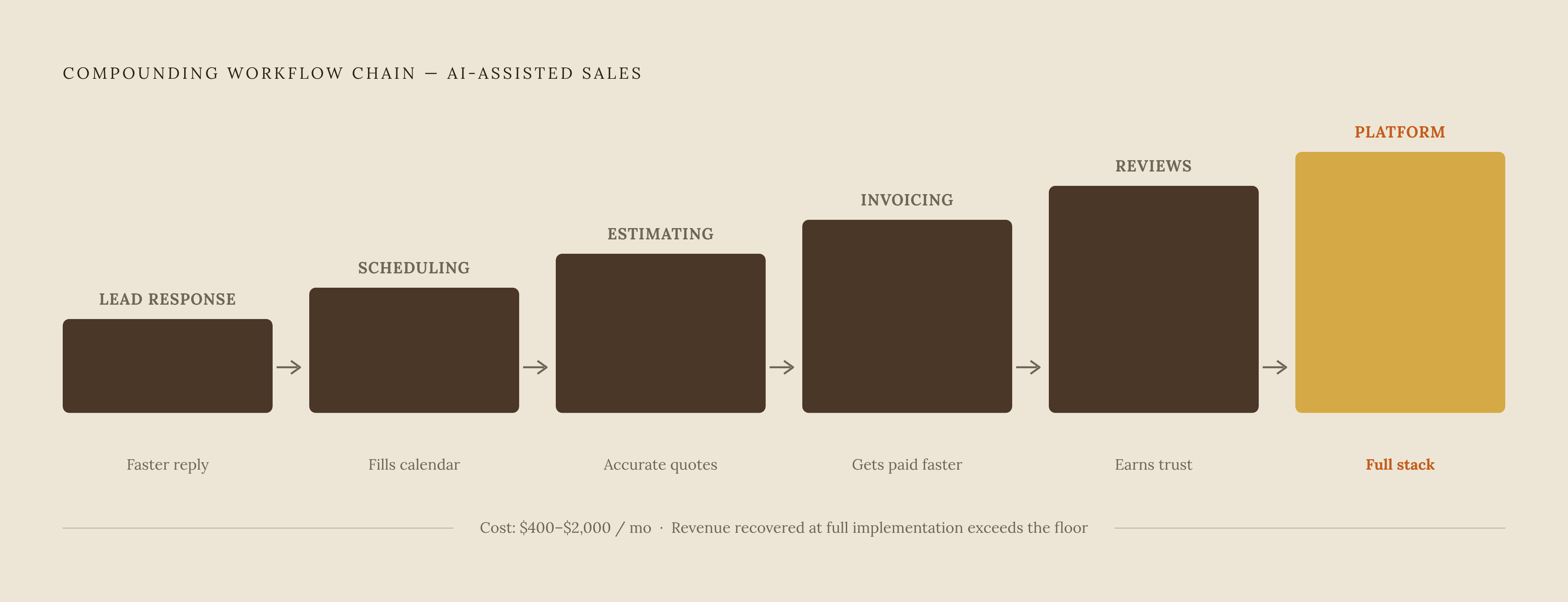
Intake automation and consultation coaching are two pieces of a larger system, not standalone fixes. A complete small-contractor revenue stack runs on six connected workflows: lead response, scheduling, estimating, invoicing, review requests, and the platform choice that ties them together. Each workflow compounds the one before it, since a faster response is wasted if scheduling lags, and a well-run consultation is wasted if invoicing and follow-up never happen.
A complete implementation at small-contractor scale runs $400 to $2,000 a month depending on crew size and call volume, and the research behind these figures puts monthly revenue recovered at full implementation well above that floor. That gap is the argument for building the full stack rather than bolting on one tool and calling it done. Disconnected point tools, a scheduler here, a CRM there, follow-up handled somewhere else entirely, create data gaps that no AI scoring model can see across, which is the real case for a unified system over a patchwork of integrations.
Choosing a platform comes down to where the leak actually is. BIGFOOT360 is built specifically for home improvement companies, with multi-channel capture across funnels, chat, SMS, and forms, AI-led or team-led qualification, automated messaging, calendar booking with reminders, visual pipeline reporting, and CRM sync with HubSpot, Salesforce, Zoho, Zapier, and more. It offers four published tiers plus a custom plan, with no-code onboarding, making it a credible starting point for a contractor who wants the intake-to-pipeline chain handled in one place rather than stitched together.
HubSpot Breeze sits on top of HubSpot's own CRM and inherits HubSpot's four-tier structure: Free, Starter, Professional, and Enterprise. The core Breeze Copilot is available on the free tier, but the AI Agents that actually automate qualification and outreach require a Professional or Enterprise subscription, and the Prospecting Agent charges per recommended lead on top of the tier price using HubSpot Credits. That makes it a stronger fit for a contractor already committed to the HubSpot ecosystem than for one starting from scratch.
For companies doing a lot of business through direct messages, SetSmart is built specifically for DM-based qualification and booking across Instagram, WhatsApp, and Messenger. Setter AI focuses on fast lead response through WhatsApp, SMS, and the website, with per-lead pricing tiers. Appointwise runs on GoHighLevel and suits agencies and lead-gen operations working SMS, WhatsApp, Instagram, and Messenger through that platform, with Business, Agency Pro, and Agency VIP plans. CloseBot offers agentic AI inside GoHighLevel, HubSpot, LeadConnector, or a custom CRM, handling text channels only, with a free plan and paid tiers above it.
None of these is the right answer in isolation. The right starting point depends on where a contractor's leads actually come in, whether that's web forms, Instagram DMs, or an existing CRM that just needs an AI layer, and on how much of the six-workflow stack still needs to be built versus connected to something already in place.