PPC Landing Page Requirements for Contractor Lead Campaigns
Dedicated landing pages convert contractor leads at three times the rate of homepages.
A PPC landing page for a contractor is a conversion system.
PPC landing pages as conversion systems
Most wasted contractor ad spend traces back to a single confusion: treating the homepage and the landing page as interchangeable. They're not built for the same job. A homepage has to serve everyone who shows up (employees checking a job posting, past clients looking for a phone number, job seekers, vendors, a curious neighbor), while a landing page exists to serve exactly one person: the homeowner who just clicked a specific ad for a specific service.
That's the whole difference, and it explains why loading up a landing page with navigation backfires. Giving a visitor too many navigation options and links causes most of them to take the easiest exit, which is the back button. Psychologists call this the paradox of choice, and it plays out on a landing page in a very literal way: menus, blog links, "about us" tabs, they all function as exit ramps away from the one action the page was built to drive.
There's a cost dimension too, and it's steeper than most contractors realize. Sending paid traffic to a homepage doesn't just underperform, it actively raises what you pay per click. Google Ads and Meta both run relevance diagnostics (Quality Ranking, Engagement Rate Ranking, Conversion Rate Ranking) that feed into cost per click, and a mismatched destination page drags down Quality Score, which drives CPC up at the auction level, before a single lead is ever won or lost.
That's not branding language, it's an operating spec. Instapage ran a branded-search A/B test comparing a dedicated landing page against a homepage for identical paid traffic, and the landing page converted at close to three times the rate. That number is one case study, not an industry average, but the direction it points in is consistent with everything else in this piece: a page built for one visitor and one action beats a page built for everyone and nothing in particular.
Every section that follows breaks down one requirement of that system. None of them are optional, and skipping any one of them means the other four are working against a leak somewhere else on the page. Single-purpose design means one offer, one audience, and one action, following Unbounce's definition of what a PPC landing page is.
The financial stakes of an under-optimized page at contractor CPCs
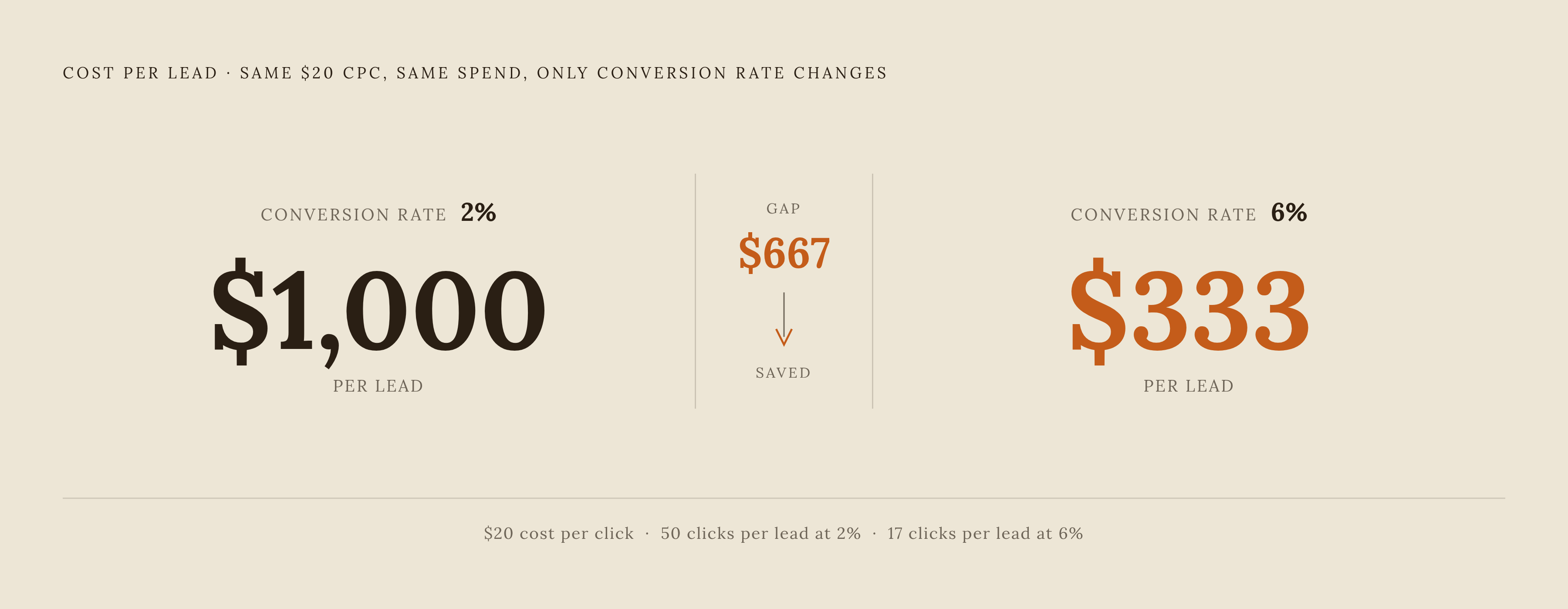
The math here is blunt enough to change how a contractor thinks about page design. At $20 cost per click, a landing page converting at 2% produces leads at $1,000 apiece. Pushing that same traffic through a page converting at 6% drops the cost per lead to $333. Same ad spend, same clicks, same targeting. The only variable that moved is the page, and at $20 cost per click, a 2% conversion rate produces leads at $1,000 each while a 6% conversion rate produces leads at $333 each, with zero change in ad spend.
That gap matters more in some trades than others, because contractor cost-per-lead benchmarks vary widely by category. Pest control advertising runs $35–$50 CPL for search.
The backdrop makes this more urgent, not less. WordStream's 2025 data, pulled from more than 16,000 U.S. Google Search campaigns, put median CPC at $5.26, up 12.88% year over year, with close to 87% of industries seeing costs climb. Roofing advertising runs $85–$120 CPL for search. Landscaping advertising runs $30–$45 CPL for search.
And most pages have real room to improve. Unbounce's benchmark study, covering 41,000 landing pages and more than 464 million pageviews, found a median conversion rate of just 6.6% across industries. Home services broadly convert around 7.8%, with plumbing, water treatment, and outdoor services running strongest at 12% to 16%, while HVAC, roofing, and remodeling are in a mid-tier band of 3% to 7%. Contractors sitting in that lower band, hardscaping and remodeling especially, have the most ground to gain, and for them the landing page is arguably a bigger lever on ROI than bid strategy or audience targeting. HVAC advertising runs $45–$65 CPL for search and $100–$160 for display. Plumbing advertising runs $40–$55 CPL for search.
Message match: making the ad and the landing page say the same thing
Message match means the landing page headline, the offer, and the keyword language mirror the ad that earned the click, as close to word for word as the copy allows. Marketers sometimes call the underlying idea "ad scent": a visitor should feel, visually and verbally, like they're still following the same trail they started on. Break that scent and the brain registers a mismatch almost instantly, bounce rates climb, and conversion drops before the visitor has even read the offer.
A concrete failure looks like the ad promises "Free Patio Quote, Same Week." The landing page headline reads "Welcome to [Company] Outdoor Living. Nowhere does the visitor see the specific promise that got them to click, so they leave. That's not a copywriting nitpick but a broken handoff, and it costs money twice: once in the bounce, and once in Google's Quality Score, which ties ad relevance and landing page experience directly to CPC and ad rank. Poor message match gets penalized at the auction, before it ever costs a conversion.
There's a practical way to check this: the five-second test. A visitor should understand what's being offered and how to get it within five seconds of the page loading. Message match is the mechanism that makes that possible, because it tells the visitor this is the right page.
Mixing service audiences into a single campaign and a single page tends to muddy tracking and drag down conversion rates across the board. A homeowner who clicked a retaining wall ad wants to see retaining walls immediately, without having to hunt through a general capabilities page.
Headline and above-the-fold copy: what the first screen must accomplish
Nothing else on the page gets a fair chance if the first screen doesn't land.
Three headline formulas hold up consistently for paid contractor traffic. Outcome-first headlines state the result directly: "Get a Firm Patio Quote in 24 Hours". Problem-articulator headlines name the pain point directly: "Tired of Contractors Who Never Show Up for the Estimate?". Persona-specific headlines call out the exact customer and situation: "For Homeowners in [City] Ready to Add Outdoor Living Space This Season". Outcome-first headlines tend to beat clever or category-based headlines by a meaningful margin on average, so cleverness should lose every time it competes against clarity.
The subheadline's only job is to add one specific supporting detail that deepens the promise, not to restate the headline and not to open into a company history. Visual hierarchy does quiet work here too: the gaze of a person in a hero photo, a subtle arrow, anything that points the eye toward the form. Video earns its place on this real estate as well, video on a landing page can lift conversions by as much as 86%, and for contractors specifically, real project footage builds a kind of trust a stock photo never will. Research by Lindgaard et al. The Nielsen Norman Group finds that visitors decide within 5–20 seconds whether to stay, a decision driven almost entirely by the headline and visual hierarchy above the fold.
Single offer, no navigation: stripping the page to one path
Every link on the page that isn't the CTA is an exit ramp.
The same logic applies to the offer itself. The page should make one ask: a quote request, a phone call, or a form fill. Stack a second offer next to it (call us, or download this brochure, or browse the gallery) and all three options convert worse, because attention that should be concentrated gets split three ways. This extends to the CTA button too: one button, one destination. A contractor who wants both calls and form submissions should pick a primary channel for the campaign and make that one dominant, letting the secondary exist quietly in the background rather than competing for the click.
The instinct to showcase full service range ("we also do driveways, fire pits, outdoor kitchens") belongs on the website, not on a landing page built for one campaign. That portfolio impulse feels like good marketing, but on a single-offer page it dilutes the ask the entire page exists to make. Site navigation should be removed entirely, since every link that isn't the CTA is an exit ramp (menus, sidebars, "latest news" widgets, and footer links all give the visitor a reason to drift away from the one action the page exists to drive).
Mobile speed: the technical floor every contractor page must clear
Speed isn't a nice-to-have on mobile, it's closer to a pass/fail gate. Mobile conversion rates already sit low industry-wide, around 2.8%, and a slow-loading page makes an already tough job harder.
For contractors this matters more than most categories, because a homeowner searching "patio contractor near me" is very often doing it standing outside, mid-decision, on a phone, with no patience for a spinner. A few fixes move the needle reliably: serving assets through a CDN so files load from somewhere closer to the visitor, and sizing CTA buttons for thumbs instead of cursors, since a button that's easy to hit on a desktop can be nearly unusable on mobile.
Google's Core Web Vitals feed into this too. They're not just an SEO ranking signal, they also factor into the paid landing page experience score that shapes Quality Score and therefore CPC. And on mobile specifically, form placement needs to shift: put the form after the value proposition rather than before it. A form placed before the visitor understands the offer creates friction instead of removing it, an effect visible in landing page conversion data. Google Ads research on 900,000 mobile ad landing pages across 126 countries found that a 1-second delay on mobile can affect conversions by up to 20%, that average full load time reached 22 seconds, and that bounce probability jumps 113% as load time stretches from 1 to 7 seconds.
Form design: field count, field selection, and arrangement
HubSpot's analysis of more than 40,000 landing pages found conversion rates slipped as field count climbed, and the worst offenders were dropdown menus and open text boxes, the fields that ask a visitor to think instead of just tap. But shorter isn't automatically better. Fewer fields raise submission volume, sure, but they often lower lead quality, so the right length depends on what's being sold. A quote request needs almost nothing: name, a way to reach them, one qualifying question. A custom outdoor kitchen build or a full backyard renovation can justify a longer form, because the extra friction filters out browsers before they ever reach a salesperson's calendar.
Dynamic forms can do that filtering automatically. A question like "Are you the homeowner?" or "Approximate square footage?" screens out non-buyers before anyone on the sales team spends time on the lead. Multi-step forms help too, presenting one question at a time feels lighter than a wall of fields, and a progress indicator like "Step 2 of 3" cuts down on abandonment right before the finish line.
Button copy matters more than it should. "Get My Free Patio Quote" beats a generic "Submit" by a wide margin in split testing, and a button that visually contrasts with the page (not gray text on a white background) pulls more clicks than one that blends in. On low-intent offers, dropping the phone number field tends to raise submissions meaningfully, phone numbers should only be required where the sales process genuinely needs to move that fast.
Trust signals: what moves a skeptical homeowner to submit
Every homeowner staring at a form is silently asking one question: why should this company get the visitor's phone number? Trust signals are the answer to that question, laid out in a form the visitor doesn't have to think about.
Some trust elements carry more weight than others. Third-party review platform ratings, such as a Google Reviews badge with a star rating, carry particular weight for contractors specifically.
Placement carries as much weight as the signal itself. A single testimonial placed directly next to the form, ideally from a homeowner whose situation mirrors the visitor's, reduces abandonment right at the moment it matters most. For hardscaping and remodeling work specifically, before-and-after photos do double duty: they're proof the work gets done, and they answer "can this contractor actually pull this off" in a way no paragraph of copy can match.
A broader pattern lies behind all this: a rev... A G2 survey of more than 1,900 B2B software buyers found 31% lean on review sites more than any other source before buying. Homeowners aren't buying software, but the instinct is the same: a review badge signals that somebody outside the company already checked, so the homeowner doesn't have to be the first one to find out.
Lead validation: why raw form submissions are not leads
A conversion is any form fill or call, and that bucket includes job seekers, vendors, complaints, spam, and DIYers asking price questions. A sales lead is the subset of that pile who represent a genuine buyer.
Picture 10,000 visitors landing on a page, 500 of them submitting the form, and only 300 turning out to be real buyers once someone actually reviews them, making the validated conversion rate 3% rather than 5%. The raw conversion rate reads as 5%. The validated rate, the number that should actually drive budget decisions, is 3%.
Most reporting dashboards don't make that distinction, they just report the raw submission count and call it "leads." That inflates apparent performance and leads contractors to two opposite mistakes at once: pulling budget from campaigns that are actually working, and continuing to fund campaigns that are quietly wasting money on the same broken math. Without a validation layer sitting between the form and the reporting dashboard, every other requirement in this piece, message match, speed, form design, trust signals, gets judged against a number that was never accurate to begin with.
Sources
- Landing Page Best Practices for Lead Generation: The 2026 ROI Guide
- PPC Landing Page Optimization: Best Practices Guide 2026
- Lead validation
- Landing Page Optimization for Lead Generation: Best Practices That Convert in 2026 | LeadsuiteNow
- 12 Need-to-Know Contractor Marketing Ideas for 2026 - WebFX
- PPC landing page optimization best practices (2025 guide)