
Meta Advertising Creative Strategy for Remodeling Projects
Before-and-after visuals and tight targeting turn Facebook scrollers into remodeling consultations.
Meta advertising works for remodeling contractors because the platform's ad account, the pixel, and the creative itself all point at one outcome: getting a homeowner who's spending tens of thousands of dollars to trust a stranger with their house. This piece breaks down the creative strategy, the targeting, and the lead-handling mechanics that turn a scrolling homeowner into a booked consultation.
Why Meta advertising suits remodeling contractors specifically
Remodeling isn't an impulse buy. Homeowners spend weeks, sometimes months, comparing contractors, reading reviews, and picturing what their kitchen or bathroom could look like before they ever pick up the phone. Meta's feed format is built for that research window.
A before-and-after photo does something a headline can't: it shows the transformation in under two seconds. No copywriting trick beats a wall coming down and an island going up.
Facebook and Instagram also happen to reach the people who own the homes that need remodeling. The 35 to 65 age range lines up closely with the buyers who fund additions, full kitchen tear-outs, and whole-home renovations, making it a natural fit for Meta's targeting tools.
Compare that to Google search ads, which only catch someone already typing "kitchen remodel near me." Meta gets there earlier. It puts the idea in front of someone who wasn't shopping yet, but who owns a 25-year-old house with a floor plan from another era. That's demand creation, not demand capture, and for a purchase this considered, getting there first matters.
Which remodeling project types convert best on Meta
Not every service performs the same on this platform. The projects that do well share one thing: the change is obvious to the eye and can be shown in 15 to 30 seconds of footage.
Kitchen remodels sit at the top. A dated 1990s galley kitchen next to a new island with waterfall countertops stops a thumb mid-scroll. The mistake most contractors make here is letting the ad copy stay vague, which pulls in people looking for a small cabinet paint job instead of a full-scale renovation many times the cost. Fix that by naming the scope directly in the ad: full renovation.
Bathroom remodels cover a wider price spread, from a vanity swap to a full spa-style buildout, so the qualification step in the lead form has to do more work here than anywhere else. A carousel of before-and-after shots performs well, and pairing it with a short video of the contractor speaking to camera adds the trust layer that a five-figure bathroom project needs.
Whole-home renovations and additions run on a longer clock. These aren't afternoon decisions, and retargeting over 60 to 90 days isn't a nice-to-have; it's the mechanism that keeps the contractor visible through a decision process that can stretch for weeks. Video case studies of structural work (moved walls, new second stories, full-footprint additions) pull in the affluent property owners who can fund this kind of project, and tight geographic targeting keeps spend inside neighborhoods where that budget actually exists.
The creative formats that stop the scroll and build purchase intent
Every format decision comes back to one job: make the homeowner feel safe handing over a large sum of money before they've even spoken to anyone. Visual proof does that work.
Reels and short-form video pull in 2 to 3 times the reach of a static image, which makes the 15 to 30 second project video a baseline requirement now, not an extra. The finished result needs to show up in the first two seconds. No slow builds, no logo intros. Shoot it mobile-first, cut it fast, and keep it looking like a real job site instead of a polished commercial.
Before-and-after video edits are among the most consistently effective formats for contractor campaigns on Meta. The structure that works: open on demolition or the starting condition, spend a few seconds explaining one real decision (why the wall came down, why that tile got picked), then reveal the finish. Videos landing between 30 and 60 seconds hold completion rates well on mobile, long enough to tell the story, short enough that people don't bail.
Owner-led video rounds this out. A 30 to 60 second clip of the contractor walking through a finished job, talking straight to the camera, builds a kind of trust that stock photography just can't touch. People hire people they recognize.
Building the audience so the creative reaches the right homeowners
A wide radius wastes money fast. It puts the ad in front of apartment renters, homes outside the crew's actual service area, and neighborhoods where the project size doesn't match the budget. Geographic precision isn't optional here.
Build the targeting around specific zip codes or neighborhood pins known for older housing stock and floor plans that are due for an update. Single-family homes at least twenty years old tend to be a natural target, since that's where structural and layout problems are more likely to appear. Cut out anything beyond a realistic driving radius for the crew, since miles outside that range add travel time and logistical friction that can pressure job economics.
Layer demographics on top of geography. Filtering for homeowner status keeps renters out of the funnel before a dollar gets spent. Home value filters matter too: a contractor specializing in high-end kitchen work should concentrate spend where home values actually support that price tag. A regional contractor, for example, might target homeowners aged 35 to 65 within 15 miles, in homes valued above $400,000, a setup that keeps spend inside a realistic buyer pool instead of scattering it across the metro.
Manual interest targeting, picking categories like "Home Depot" or "Zillow", has mostly stopped working well and tends to drive costs up. Meta's Advantage+ system has taken over that job: it studies who's engaging with the ads and submitting forms, then finds more local users who behave the same way. The contractor's real job shifts to setting the geographic fence and basic demographics, then feeding the algorithm clean data through the pixel, the Conversions API, and creative strong enough to generate real signal.
Structuring the lead form to filter out price shoppers before they reach your phone
A form that only asks for name and phone number invites trouble. It picks up accidental taps, curiosity clicks, and inquiries for a minor repair job from someone who has no plan to remodel anything.
Add a short set of qualifying questions inside the Meta Instant Form: what project they want done, their estimated budget range, whether they own the home, and when they plan to start. Each of those questions adds a small amount of friction, and that friction is the point.
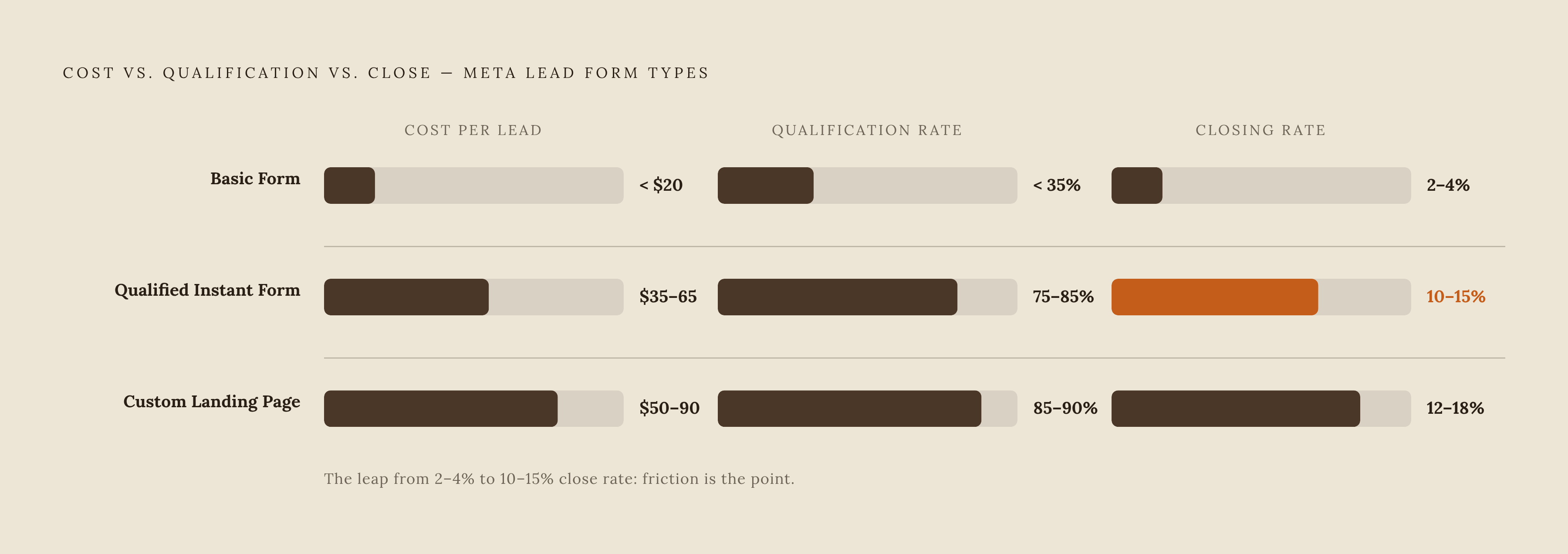
The numbers make the trade-off clear. A basic form with just name and email costs a lower cost per lead than the qualified alternative, but qualification rate stays under 35% and closing rate runs around 2% to 4%. A qualified Instant Form with budget and scope questions costs more per lead ($35 to $65), but qualification climbs to 75% to 85% and closing rate jumps to 10% to 15%. An external custom landing page costs the most per lead ($50 to $90), pushes qualification up to 85% to 90%, and closes at 12% to 18%.
Instant Forms have one big advantage here: they keep the homeowner inside the Meta app. That means the qualifying questions add friction without the drop-off penalty that comes from sending someone to an outside website.
The retargeting sequence that converts high-ticket prospects over weeks, not hours
Nobody books a major kitchen renovation costing tens of thousands of dollars the same afternoon they see the ad. They look at the company, scroll the photo gallery, check reviews, maybe watch a video, then come back three days later, or ten.
That's what retargeting is for. It re-engages the people who clicked but never filled out a form, keeps the contractor visible while the homeowner compares two or three other companies, and shifts the message from "look what's possible" to "here's why you can trust this crew." Testimonials, process walkthroughs, and local proof points belong in this stage.
Build the retargeting audience from three groups: website visitors who didn't convert, video viewers who watched a meaningful chunk of a project video but didn't click through, and people who opened the lead form but never submitted it.
Sequence the creative across three touches. The first re-engagement should show a different project than the original ad, proving range rather than repeating the same pitch. The second touch brings in an owner-led video or a homeowner testimonial, which actually builds trust. The third touch adds local social proof or a specific offer tied to a deadline, the nudge that moves someone from still-thinking to booked.
Tracking infrastructure that gives Meta's algorithm the data it needs to optimize
The pixel alone doesn't cut it anymore. Browser privacy settings and ad blockers strip out a growing share of that data before it ever reaches Meta.
The Conversions API fixes that gap by having the website talk to Meta's servers directly, which gives a fuller, more accurate read on what's actually happening after someone clicks the ad. More complete data means the algorithm has more to work with, and that lowers cost per lead over time.
Set up conversion events around the things that actually matter: form submissions as the main event, since that's what the algorithm should be chasing; phone call completions if click-to-call is part of the funnel; and landing page views as a mid-funnel signal that feeds the retargeting audiences described above.
Meta's platform now lets advertisers optimize for lead quality instead of raw volume. Getting that to work means feeding information back into the system: flagging which submitted leads actually turned into a consultation, and which ones closed into a signed job. Without that feedback loop, the algorithm keeps optimizing for people who fill out a form, regardless of whether they were ever going to hire anyone.