Google Ads Bidding Strategies for Home Improvement Lead Generation
Match your bidding strategy to account maturity, not dashboard sophistication.
Choosing a Google Ads bidding strategy for home improvement leads is a decision tied to where your account actually stands. It's a decision tied to where your account actually stands: how much conversion data you've got, how clean that data is, and what stage the business is in. A plumber closing a $400 repair the same afternoon runs on a completely different clock than a design-build remodeler chasing a $150,000 signature. Match the strategy to the account's real maturity, not to whatever tab looks most sophisticated in the dashboard, and that's what separates profitable lead flow from money burned on autopilot.
How Google's auction and Smart Bidding work in 2026
Bid is one piece of the puzzle in Google's auction, not the whole thing. Ad quality, landing page relevance, location, device, time of day, even the exact wording of the search query, all of that feeds into Ad Rank. Most contractors think Quality Score wins them the auction. Quality Score does not win the auction for contractors. Quality Score is a report card Google hands you after the fact, explaining what's dragging the account down. It never gets plugged into the auction directly.
Smart Bidding changes the mechanics of the auction directly: instead of setting one static bid for a keyword and walking away, Google adjusts the bid in real time. Instead of setting one static bid for a keyword and walking away, Google adjusts the bid in real time, auction by auction, reading signals in that exact moment. A search for "emergency water heater replacement" at 11pm on a Tuesday gets bid differently than the same phrase typed in at 2pm on a Saturday, because the algorithm is reading intent signals most advertisers never see.
Google relabeled its bidding strategies in June. Target CPA and Target ROAS now show up again as standalone options, split back out from Maximize Conversions and Maximize Conversion Value, where they'd been folded in. That's a labeling change and nothing more. The bidding behavior underneath hasn't moved, and nothing already built or running breaks because of it. Don't rebuild campaigns over this one. Just know the names shifted.
The data threshold that determines which strategy is available to you
Smart Bidding runs on data, and for lead-gen accounts, the number that matters is 30 conversions in a rolling 30-day window. That's the point where Maximize Conversions with a Target CPA turns into a strategy worth trusting.
Below that line, the algorithm doesn't have enough completed auctions to learn from inside whatever cost constraint has been set. Setting a Target CPA too early doesn't buy efficiency, it buys underspend. The system starts rejecting auctions it can't confidently predict will hit the target, so the budget sits there unused while the phone stays quiet. Setting the CPA target below what the account has actually been achieving historically makes the machine starve itself chasing a number it has no evidence it can reach.
This hits remodelers hardest of all. A design-build shop running a healthy $3,000 to $5,000 monthly budget might get somewhere between six and twelve qualified leads a month. That account is nowhere near 30 conversions in 30 days, and it won't get there on its own. Reaching that threshold takes either a much longer learning window stretched across several months, or a decision to count earlier-funnel actions (a form fill for a free guide, a click on a "book a consultation" button) as micro-conversions that fill out the data faster.
Manual and Maximize Conversions bidding for accounts that haven't hit the threshold yet
Accounts under the threshold need a bridge strategy. Maximize Conversions without a Target CPA attached is usually the right one: it spends the full daily budget and optimizes for volume, without forcing a commitment to a cost figure the account has no track record to support.
Manual CPC still has a place, mainly for brand-new accounts or advertisers on tight budgets who want to watch how the auction behaves before handing control to an algorithm. It works, but it's labor-intensive. Someone has to check bids and performance daily, or the account drifts.
One rule here is firm: stay away from Maximize Clicks. It's built to drive traffic volume, full stop, which makes sense for a brand awareness play and makes no sense for lead generation. Pointed at a home improvement campaign, it happily drains the budget on curious clickers who have zero intent to hire anyone.
Through this entire pre-threshold phase, the real job is feeding the algorithm clean conversion data. It's feeding the algorithm clean conversion data. Phone calls need to be tracked and tagged correctly. Form submissions need to fire the right conversion action. None of the bidding decisions downstream matter if the tracking underneath them is broken, so get that airtight before scaling spend.
Campaign structure decisions that determine whether any bidding strategy can work
No bidding strategy survives bad campaign structure, no matter how well it's matched to the account's data stage. Segment by project type and profit margin. A homeowner searching for a custom basement buildout should never land on an ad written for kitchen cabinet refacing. That mismatch tanks relevance, relevance drags down Quality Score, and a lower Quality Score quietly raises costs across the whole account, regardless of which bidding strategy sits on top of it.
Separate campaigns also let you set Target CPA goals that reflect actual project economics. A whole-home addition and a basement finish are different businesses, financially speaking, so lumping them into one campaign with one bidding target forces the algorithm to average two very different jobs into a number that fits neither.
Match type discipline matters just as much. Broad match only earns its keep once Smart Bidding has matured on the account. At that point, broad match paired with Smart Bidding can pull in 25 to 35% more conversions at the same cost. Without that maturity, broad match turns into a magnet for DIY researchers, budget shoppers, and repair queries with nothing to do with the job being sold.
Framing matters at the keyword level too. Generic terms like "kitchen remodel" or "bathroom renovation" are dominated by people doing research or comparing prices, not people ready to hire. High-intent traffic appears in searches with transactional modifiers, words like contractor, estimate, or builder, or in scope-specific phrasing such as "kitchen wall removal contractor" or "master bathroom expansion." Those cost more per click. They also convert at a rate that makes the higher cost worth paying.
What CPL benchmarks look like across home improvement trades in 2025–2026
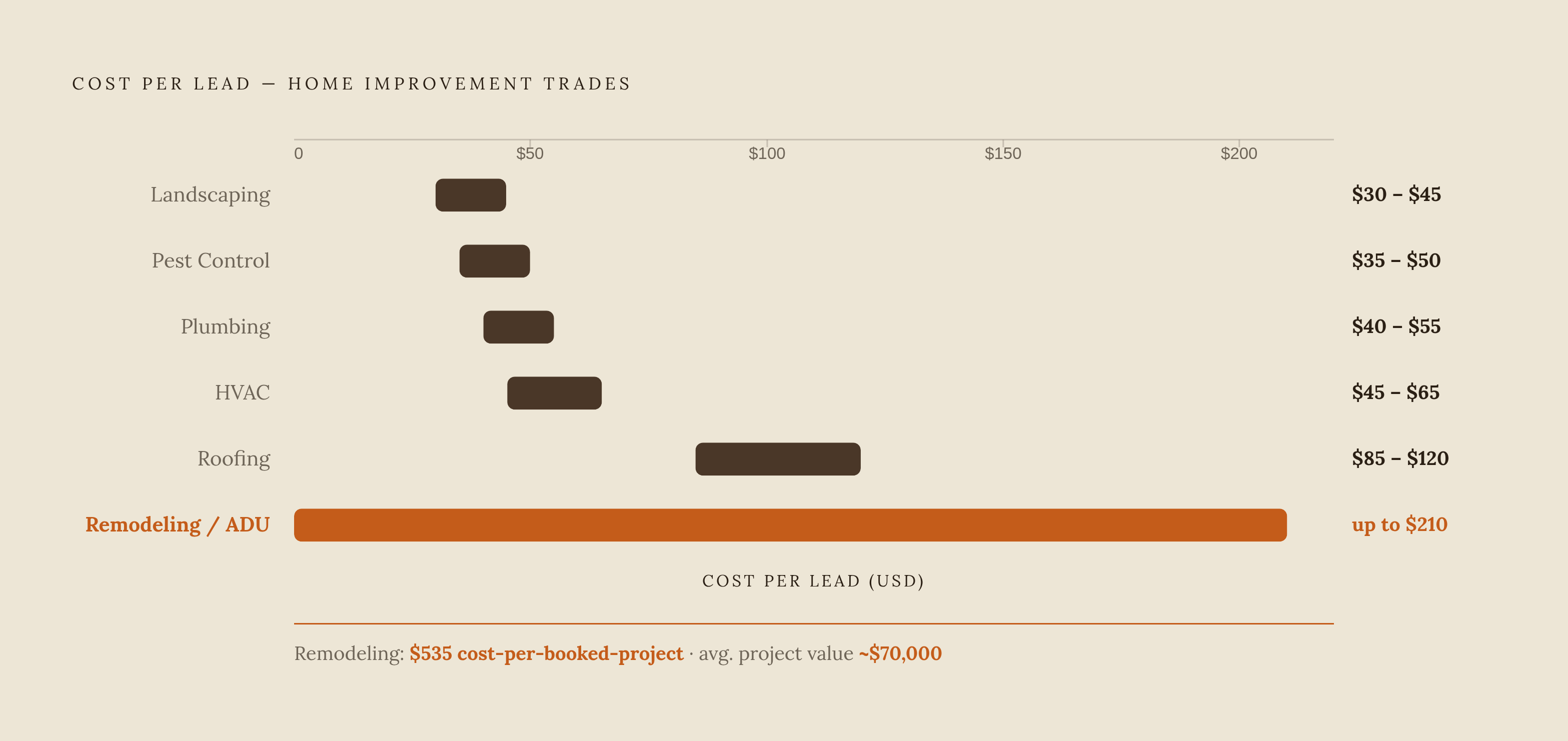
Live account data from BG Collective, pulled from non-brand search campaigns across remodeling, addition, and ADU accounts managed from February through July 2026, gives a useful anchor point. Cost per lead ran up to $210 depending on the account, with a blended average around $160. Click-to-lead conversion rates on non-brand search sat between 5% and 8.5%. Factoring in a 30% close rate, cost per booked project landed around $535 in ad spend, against average project values near $70,000.
That last number is the one that actually matters. CPL by itself is an incomplete way to judge a high-ticket category like this one. Spending $535 to land a $70,000 contract is the entire argument for running the channel.
Other trades run at very different price points. HVAC typically falls between $45 and $65 per lead. Plumbing runs $40 to $55. Roofing is noticeably more expensive at $85 to $120. Landscaping sits lowest at $30 to $45, with pest control close behind at $35 to $50.
On a broader benchmark set, roofing CPL runs around $124, landing between HVAC at $149 and electrical at $128, and below plumbing's $183, but branded search for roofing companies runs dramatically cheaper, and that nuance matters when separating roofing from the rest. On a broader benchmark set, roofing CPL runs around $124, landing between HVAC at $149 and electrical at $128, and below plumbing's $183. But branded search for roofing companies runs dramatically cheaper, around $44, a discount of roughly 65%. That gap tracks with intent: someone typing a company's name into the search bar already knows who they want, and the auction prices that certainty accordingly.
Google LSAs Alongside Search Campaigns in the Bidding Picture
Local Services Ads run on a different model, with no keyword bidding and no Quality Score in the traditional sense, because LSAs charge per lead, not per click. There's no keyword bidding and no Quality Score in the traditional sense, because LSAs charge per lead, not per click. That's a structurally different environment, and it changes how a contractor should think about splitting budget across the two products.
LSAs pull real weight on the results page. When they appear, the format captures 13.8% of all clicks on that page, and 29% of searchers say they'd rather click an LSA result than a standard search ad, against just 11% who prefer the traditional format.
LSAs work best for emergency and service trades, the plumbers and HVAC techs handling short sales cycles measured in hours or days. Remodeling doesn't fit that mold. A design-build sales cycle running several weeks to months doesn't map cleanly onto a pay-per-lead product built for fast-turnaround service calls.
The LSA platform went through a string of changes recently. As of October 20, 2025, Google collapsed the old Google Guaranteed, Google Screened, and License Verified badges into one single "Google Verified" badge. The consumer money-back guarantee that used to back LSA leads has since been discontinued. The standalone LSA app has been retired, so management now happens entirely through the web platform at ads.google.com/localservices. And the old manual dispute process for bad leads got replaced by an AI-automated credit system.
The Effect of Channel Mix Around Google Ads on Bidding Strategy Outcomes
Google Ads is not the highest-return channel available to a contractor. Google Ads returns roughly $8 for every dollar spent, local SEO returns around $13, and email marketing returns somewhere between $36 and $42. What Google Ads delivers instead is the highest-intent traffic of the group: people actively searching for the exact service, at the exact moment they need it.
That's why leaning on Google Ads alone, even with a perfectly tuned bidding strategy, leaves money sitting on the table. A mix of paid search, organic search, and reputation management consistently beats any single channel run in isolation. A large share of homeowners read reviews before picking a contractor, and businesses holding strong ratings consistently outperform lower-rated competitors on revenue.
Local SEO forms the base everything else depends on. It's a requirement, not an optional add-on. Most leads trace back to a business listing profile in some form, so keeping that profile active and accurate is a foundational dependency. GBP and LSA profiles must match exactly, so keeping those details consistent is a basic requirement for staying in good standing.
A newer layer sits on top of traditional SEO now: answer engine optimization and generative engine optimization, tuned for how AI search actually surfaces answers. AI search crossed 25% market share for informational queries in 2025, and 51% of all searches now end without the user clicking through to a website at all, a pattern generally called zero-click search. Early adopters of AEO report 3 to 5 times more qualified inbound leads from AI channels than traditional SEO alone produces, and businesses running SEO, AEO, and GEO together see 60 to 80% more organic reach than businesses sticking to SEO by itself.
The operational systems that determine whether leads from any strategy convert to revenue
None of the bidding strategy work matters if a lead sits in an inbox for three hours before anyone calls back. Speed to lead is the single biggest lever on conversion, full stop. 78% of consumers buy from whichever business responds first, not the cheapest option, not the one with the best reviews, just whoever picks up the phone or replies first. Responding within one minute produces conversion rates 391% higher than slower response times.
Budget expectations need to account for how long the home improvement sales cycle actually runs. Campaigns typically start generating calls and consultation requests within the first few days after launch, that part moves fast. Turning those calls into signed contracts runs on a different timeline entirely, usually 30 to 90 days once design meetings and estimation cycles factor in. Smart Bidding needs that same patience. Give it consistent optimization over the first three months rather than judging it against a 30-day window, because a strategy that looks like it's underperforming in week two might just be an algorithm that hasn't finished learning yet.
Sources
- Google Ads Bidding Strategies: Where To Spend Your Time In 2026
- The Complete Guide to Google Local Services Ads for Home Service Contractors in 2026 | LeadTruffle | 24/7 AI Lead Qualification Tools for Home Service Contractors
- Google Ads for Remodelers: Real Costs From Live Accounts [2026]
- webtonic.io
- location3.com