Retargeting Campaigns for Unconverted Estimate Requesters
Competitors respond faster—retargeting keeps your estimate requests from walking to them.
An unconverted estimate request is still a live lead worth pursuing. It's the closest thing a hardscaping contractor has to a signed contract that hasn't been signed yet, and the way to close that gap is a retargeting campaign built specifically around that one audience, sequenced to match where the prospect actually sits in their decision. Retargeting Campaigns for Unconverted Estimate Requesters.
Why estimate requesters are a contractor's highest-value unconverted audience
Someone who fills out an estimate request has already done the hard part. They know they want the patio, the driveway, the retaining wall. They have a rough sense of what it costs, and they've taken the extra step of typing in their name, address, and phone number to ask a stranger to come look at their yard. That's not casual browsing.
Compare that to the average site visitor, only 2% of whom convert on a first visit leapingai.com. The estimate requester already cleared that bar and kept going. Treating that person the same as a cold display audience wastes the single highest-intent signal a contractor gets short of a signed contract.
Home renovation buyers aren't collecting one or two bids anymore. Six or more competitive quotes for a single job is becoming the norm. That changes the math entirely: a quote that sits in an inbox unanswered is actively losing ground. It's actively losing ground to whichever competitor responds first, follows up more consistently, or simply stays visible while the homeowner keeps comparing. Every dollar spent generating that estimate request gets wasted the moment the follow-up stops, and that waste happens quietly, without anyone flagging it, because the lead still technically "exists" in a spreadsheet somewhere. It just never turns into a job.
The competitive pressure making systematic follow-up non-negotiable
The home services market is expanding at a healthy clip, somewhere in the 7% to 9% annual range, but growth at the market level doesn't translate into safety for any one contractor valveandmeter.com. If anything, it raises the stakes. More homeowners requesting more estimates means more competitors chasing the same jobs, and private equity has noticed.
An independent contractor running follow-up by memory, a callback when there's a free minute, an email sent a few days late, is not competing on equal footing. Speed affects lead conversion more than most contractors assume: LeadConnect's data shows 78% of leads go to whoever responds first. There's a widely circulated figure, not independently verified, claiming that businesses without a proper CRM lose about 18% of inbound leads purely to follow-up failures. Leads decay when nobody owns the follow-up. For estimate requesters specifically, that decay is pure revenue leaving through the back door.
None of this makes retargeting an optional line item to test and cut if it underperforms for a quarter. It's the infrastructure that keeps work a contractor already earned from quietly walking to someone else. As of Q1 2026, private equity's strategy has shifted toward local geographic density and technological integration, with these buyers building logistical density and operational scale through add-on acquisitions within tight geographic footprints.
Retargeting performance, in numbers contractors can act on
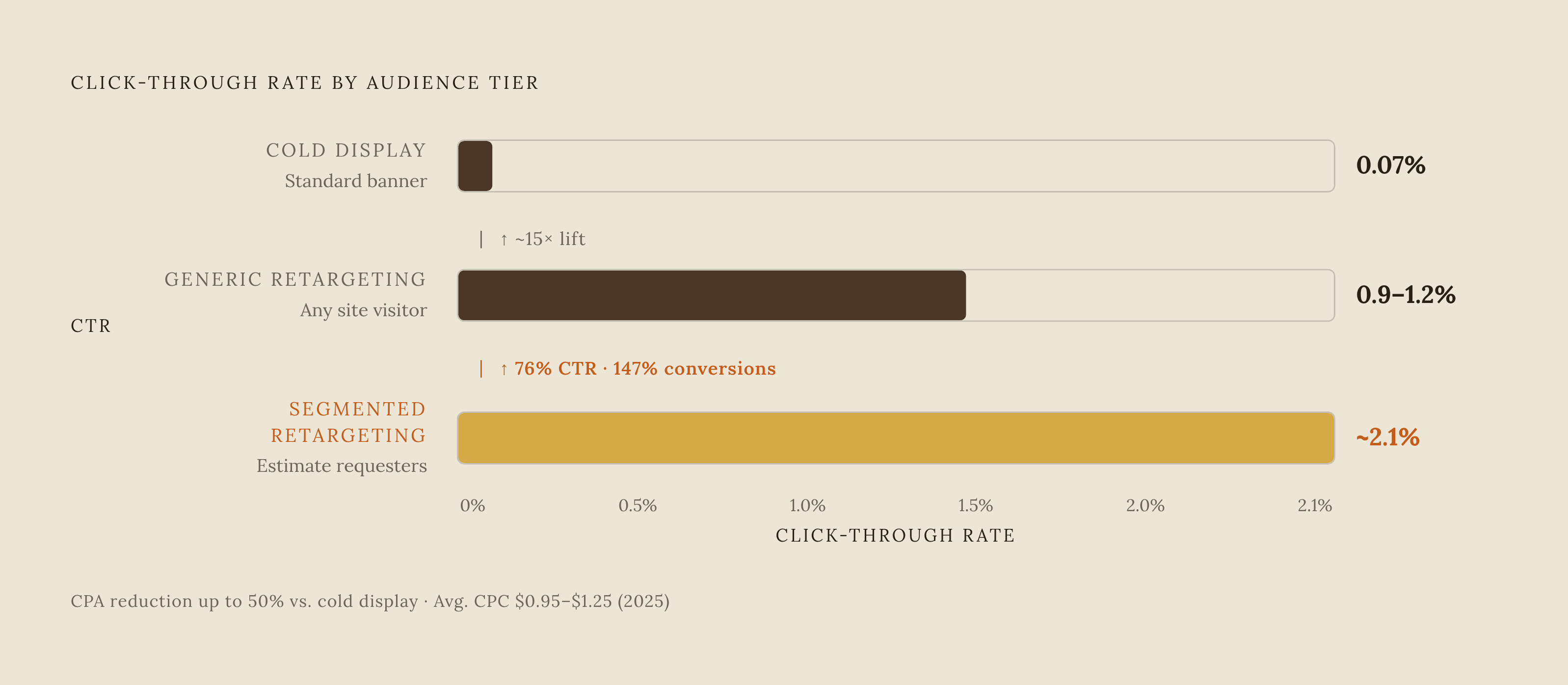
Start with the gap between warm and cold audiences, because it's larger than most people expect. Standard display advertising averages a 0.07% click-through rate 49 Retargeting Statistics You Need to Know (2026 Update) tested.media. That's not a rounding difference; it's a different category of ad performance, and it comes purely from targeting people who already know who you are.
Current benchmarks put average retargeting CTR somewhere between 0.9% and 1.2% for 2025 into 2026, up from about 0.8% the year before leapingai.com Retargeting Ad Performance Statistics 2026: ROI Data Now tested.media. Timing sharpens that further: ads shown within 24 hours of a site visit tend to be at the high end of that range, often over 1.2% leapingai.com Retargeting Ad Performance Statistics 2026: ROI Data Now tested.media. Cost has moved in the contractor's favor too.
The number that actually matters for how you build the campaign, though, is this. Segmented retargeting, meaning campaigns built around a specific defined audience rather than "everyone who visited the site," increases click-through by 76% and conversions by 147% compared to generic retargeting. That's the entire argument for treating estimate requesters as their own audience instead of folding them into a general remarketing pool. The lift doesn't come from spending more. It comes from building the audience correctly.
Frequency has a ceiling before scaling any of this up. Gartner data shows 53% of consumers find once-a-week retargeting acceptable, but only 5% tolerate six or more exposures a week. Getting the targeting right and then blasting the same person daily undoes the benefit. Average CPC for retargeting dropped to $0.95–$1.25 in 2025 from roughly $1.30 the prior year, and retargeting delivers CPA reductions of up to 50% compared with campaigns targeting cold audiences Retargeting Ad Performance Statistics 2026: ROI Data Now. Retargeting campaigns deliver an average ROAS of about 4.2×, up from 4.0× in 2024 Retargeting Ad Performance Statistics 2026: ROI Data Now.
Audience setup: separating estimate requesters from general site traffic before running a single ad
Most contractors who run retargeting are retargeting everyone. Every site visitor gets thrown into one pool and shown one set of ads. That's generic retargeting, and it's exactly the setup the 147% conversion gap above is measuring against. Fixing it starts with the pixel.
A tracking pixel, whether that's a Meta Pixel or a Google Tag, needs to fire on the confirmation page, the one that only loads after someone submits the estimate form, not the form page itself. That distinction sounds small but it isn't. Firing the pixel on the form page catches people who started filling it out and abandoned halfway through. Firing it on the confirmation page catches only the people who actually finished and hit submit, the self-qualified group who raised their hand all the way.
For contractors with a CRM already in place, list-based retargeting fills in the gaps a pixel can miss. Unconverted estimate contacts can be uploaded directly to Meta or Google and matched against platform users, which works even for estimates that are weeks or months old and never touched the pixel. Given how browser and platform privacy rules keep shifting, first-party CRM data is more durable than pixel data and probably deserves to be the primary audience source, with the pixel as backup.
Exclusions matter just as much as inclusions. Anyone who's already booked needs to come out of the audience immediately, since showing a booked customer "haven't heard from you" messaging reads as sloppy at best and untrustworthy at worst. Beyond that, segmenting by recency changes what the ad should even say: someone who requested an estimate yesterday is in a completely different headspace than someone who went quiet a month ago, and lumping them together means writing copy that fits neither one well. Contractors in smaller markets who don't have enough estimate requesters to hit a platform's minimum audience threshold can widen the pool by including pricing-page visitors alongside form completions, without losing the core intent-based logic.
Sequencing the campaign: matching the message to where the prospect is in their decision
An estimate requester who hasn't booked is still deciding. They're still deciding, and the job of a well-built sequence is to give them a reason to decide in your favor at the right moment, not to repeat the same ad on a loop until they either convert or get annoyed enough to block you.
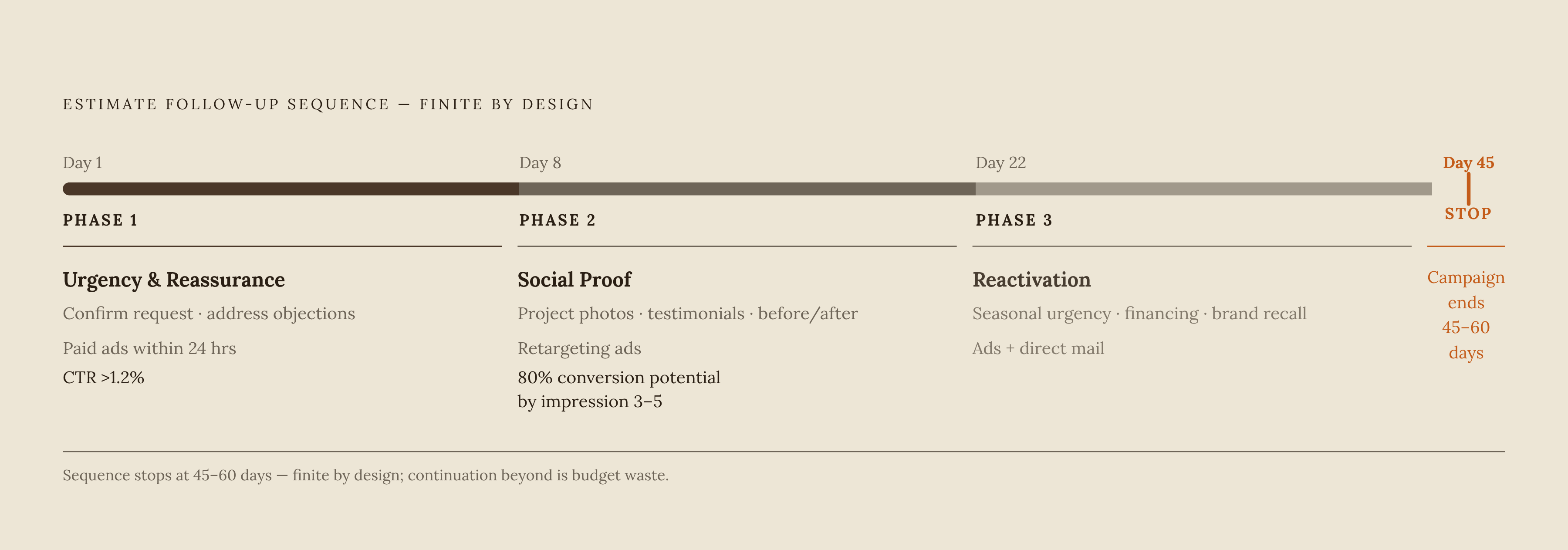
The first seven days call for urgency and reassurance. This window carries the highest intent and the best click-through numbers of the whole campaign, with ads shown in the first 24 hours often clearing 1.2% CTR leapingai.com. Copy here should confirm the request landed and spell out what happens next, while quietly addressing the hesitations that stopped someone from booking on the spot: worry about how disruptive the project will be, uncertainty about quality, questions about timeline. Calls to action need to be specific, "Schedule your site visit" or "Complete your consultation request," not something vague like "Learn more". Meta and Google Display are the right channels for this phase, since together they account for more than 80% of global retargeting spend and carry the deepest local audience data. Certifications, warranty terms, response-time commitments, all of it belongs in the copy here, because trust and craftsmanship concerns are universal across homeowners at this stage.
Days eight through 21 shift the message toward social proof and specifics. By now the prospect is very likely comparing bids, given how common six-plus quote requests have become. Project photography that matches what they actually asked about, testimonials from similar jobs, before-and-after imagery, all of it does more work here than another "we'd love to help" message. If the form captured the project type, route the creative accordingly: someone who requested a patio quote sees patio work, someone who checked pricing on a retaining wall sees a case study or a direct prompt to confirm their quote. Frequency needs watching here too. The first three to five impressions generate roughly 80% of the total conversion potential a campaign is going to get, so running the same creative past that point without rotating it is mostly wasted spend.
The final stretch, days 22 through 45, is reactivation. A prospect who's gone silent this long hasn't necessarily walked away. Financing, a spouse's input, or simply the wrong season could all be holding things up. Seasonal urgency, financing options, and a softer reintroduction to the brand fit better here than another hard sell. AI-driven sequences can handle a lot of this reactivation automatically, sending a timely prompt like a note about booking spring installs and asking if the patio project is still on, without a human running a manual campaign. If Meta and Google haven't converted the prospect by this point, address-matched direct mail adds a physical touchpoint that can break through where digital ads have gone stale.
And then it needs to stop. Running retargeting indefinitely against someone who isn't converting burns budget and risks turning mild disinterest into real annoyance. Somewhere between 45 and 60 days is a reasonable outer limit for most hardscaping project timelines.
Creative and copy decisions that move estimate requesters specifically
The most common mistake here is running the same top-of-funnel creative that introduces the company, its story, its founding, its mission. An estimate requester already knows who you are.
Short, direct calls to action beat brand storytelling at this stage. "Complete your estimate request," "Schedule your site visit," "Get your free quote" all work because they remove the friction of figuring out what to do next. Copy should speak to the real objections that keep hardscaping projects stalled: how much the work will disrupt daily life, how the crew's finished work looks in comparable neighborhoods, how firm the quoted price is, and how reviews from real customers back up the pitch.
Imagery should match the project type captured at form fill. Generic "we do hardscaping" photography underperforms against a photo of the specific patio style, driveway material, or retaining wall type someone actually asked about. Video tends to do well too, whether that's a short walkthrough of a finished project or a brief customer testimonial, since it anchors the prospect to a real, finished outcome instead of an abstract service category.
Fatigue is a real cost. Invesp data shows that seeing the same ad too often drops engagement by 37%, so rotating two to three creative variants within each phase keeps the campaign from working against itself. And none of the creative work matters if the landing page doesn't match the promise. An ad that says "schedule your visit" needs to land on a simple booking form, not a homepage full of distractions, because that mismatch is where a lot of otherwise well-built campaigns quietly lose conversions.
Where AI automation fits into the estimate-requester follow-up stack
Retargeting brings someone back. It doesn't answer the phone when they call, or respond to the form they just filled out a second time. If nobody's ready the moment a retargeted prospect re-engages, the whole cycle just repeats itself with an extra ad spend attached.
This is where speed-to-lead AI closes the loop. When a retargeting ad pulls someone back to refill a form, AI calling tools can start contact within 60 seconds, qualify the lead, and get a site visit on the calendar. Home service companies using AI voice agents for inbound response typically see booked service calls rise 30% to 50% within a month, and a re-engaged retargeted prospect deserves that same urgency as a fresh inbound lead, arguably more, given how much has already been spent getting them back to the site.
Unconverted estimate contacts should live in a CRM that can both feed retargeting audiences through list uploads and trigger automated follow-up sequences the moment someone re-engages. Companies that adopt AI-native CRM platforms see lead-to-close rates improve by 31% within the first six months. Without CRM integration, retargeting and manual follow-up run in parallel but don't reinforce each other: the prospect gets an ad and then silence, or a call and then no ad reinforcement.
AI systems also extend retargeting into seasons where paid campaigns have gone quiet. Outbound calls or texts to stale estimate contacts, checking in about a summer install or asking if a retaining wall project is still on the table, function as a form of retargeting that runs entirely outside paid channels. A fragmented stack, a separate pixel tool, a separate CRM, a separate email platform, a separate calling tool, creates exactly the gaps where estimate requesters fall through and disappear. The question worth asking isn't whether retargeting is running. The retargeting audience updates automatically from the CRM, and a re-engaged prospect triggers immediate follow-up on the other end. If both are true, the system holds together. If either isn't, leads are leaking somewhere nobody's watching.
Measuring whether the campaign is working
The numbers to track are the same ones that justified building the campaign in the first place: click-through rate against the segmented benchmark rather than a generic industry average, cost-per-click trending down as the audience narrows, and return on ad spend measured specifically against estimate requesters rather than blended across all traffic. If segmented retargeting isn't outperforming a generic remarketing pool by a wide margin, the audience setup is the first place to check.
Frequency deserves a regular look too. Dropping engagement mid-campaign shows the fatigue ceiling appearing before the sunset date arrives, and it's a signal to rotate creative rather than cut spend. Whatever the campaign shows, the fix is rarely more ad spend. It's almost always a targeting, sequencing, or follow-up gap, and those are the ones to close first.