
Ad Budget Allocation Across Google, Meta, and LSA for Contractors
Home services contractors need clear channel strategies as LSA adoption saturates the market.
Valve+Meter puts the U.S. home services market above $600 billion in 2024, growing 7 to 9% a year, while a separate projection from Exotica IT Solutions puts North American home services at roughly $425 billion in 2025, climbing toward $463 billion in 2026 GoHighLevel for Home Services HSMPro. Both point the same direction: more dollars, more competition, more noise.
Sentiment backs that up. Jobber and Conjointly surveyed 1,050 business owners in December 2025 and found nearly 40% expecting significant revenue growth in the year ahead, 75% expecting revenue to rise at all, and one in five forecasting a genuinely big jump Jobber/Conjointly HSMPro. Optimistic contractors spend simply because owners feel good about where the business is headed.
That's a channel going from niche to default in under five years Jobber/Conjointly HSMPro. Undifferentiated spending, throwing money at three channels evenly and hoping something sticks, produces worse and worse returns as more operators pile into the same auctions. Clarity about what each channel does is now essential to a functioning marketing budget. It's the difference between a marketing budget that compounds and one that just evaporates into rising cost-per-lead. LSA adoption grew from roughly 28% of contractors in 2021 to approximately 70% by late 2025, and the market is maturing fast, which changes how each channel performs HSMPro.
Sizing the total marketing budget before splitting it across channels
Before touching the question of Google versus Meta versus LSA, the total number needs to be right, and the industry has landed on a fairly narrow band. RankContractors and WatsonCo both point to 7 to 10% of gross revenue as the baseline for home service businesses, with aggressive growth phases justifying up to 15%, and brand-new businesses under two years old sometimes needing 15 to 20% just to get noticed Rank Contractors Watson Co. Marketing Greenbaum Stiers Strategic Marketing Group Cube Creative HSMPro Valve+Meter. WatsonCo's own 2026 guidance runs slightly higher across the board: successful home service companies typically spend 8 to 15% of gross revenue on marketing, leaning toward 12 to 15% when actively growing and settling to 8 to 10% once the schedule is already full Rank Contractors Watson Co. Marketing Greenbaum Stiers Strategic Marketing Group Cube Creative HSMPro Valve+Meter.
That's the anchor figure to keep in mind for everything that follows, because every channel-level percentage in this piece is a slice of that number, not some abstract industry average.
Skeptics might reasonably ask whether these percentages actually produce results or just sound tidy on a slide deck. That's not a theoretical range. That's a business that spent inside the recommended band and got a return that justified it.
One more distinction before moving to channels: "marketing budget" and "digital budget" aren't the same denominator. WordStream's 2026 data shows 72% of overall marketing budgets now going to digital channels, with traditional tactics, direct mail, truck wraps, yard signs, making up 15 to 25% of the total, not the majority Watson Co. Marketing WordStream / Cube Creative HSMPro Valve+Meter. Every split discussed from here forward, LSA versus Google Ads versus Meta, is a fraction of that digital slice, not of the whole marketing number. Using a concrete anchor at $1M revenue, annual marketing spend of $80K–$150K, or roughly $6,500–$12,500 per month, gives a usable reference point for the channel-level math that follows Watson Co. Marketing Cube Creative HSMPro Valve+Meter. A practitioner case study from Greenbaum Stiers Strategic Marketing Group offers a real-world proof point: total marketing promotion at 13.8% of revenue produced a return on ad dollars above 10×, with cost per lead blending to roughly $265 for the year, showing the range is achievable HSMPro.
The structural difference between intent-based and interruption-based channels
Google Search and LSA work because the homeowner already has a problem and is actively looking for someone to fix it. Nobody has to convince that homeowner they need a contractor. The entire job of an intent-based channel is to be visible at the exact moment that search happens and to convert the click into a call.
Meta doesn't work like that, and pretending it does is where a lot of budgets quietly go to waste. Nobody opens Instagram looking for a roofer Jobber/Conjointly Rank Contractors Watson Co. Marketing Cube Creative HSMPro Valve+Meter. The ad has to interrupt a scroll and create interest in a project the homeowner hasn't committed to yet, sometimes hasn't even fully imagined yet. That's a fundamentally different kind of work, and it happens on a completely different timeline than a phone ringing five minutes after a Google search.
The reason contractors mix these up so often comes down to the dashboards. Both channels report in cost-per-lead, same kind of spreadsheet, same kind of optimization target. But judging a Meta campaign by how fast it closes today's job is measuring the wrong thing entirely, because that's not the job Meta is built to do. The framework that actually holds up: size LSA for emergency and ready-to-hire demand, size Google Search for the broader intent search doesn't fully capture through LSA alone, and size Meta for awareness and the kind of planned, high-ticket project that takes weeks to decide on.
LSA's function, cost, and benchmark sources
LSA runs on a pay-per-verified-lead model, a call or a message, not a click, and it sits above standard Google Ads, above the map pack, above every organic result on the page. There's no keyword bidding involved. Google matches the ad to a service category and a service area, and the contractor either shows up or doesn't based on responsiveness, reviews, and proximity.
Compare that $53 figure against LocaliQ's 2025 benchmark of over 3,000 home service search campaigns, where traditional Google Ads PPC averaged $91 per lead in the Home and Home Improvement category HSMPro SearchLight Digital. LSA's cost advantage over standard search ads isn't a rounding error, it's close to half. SearchLight's May 2026 snapshot also shows real variation by trade: HVAC repair tends to run cheaper per lead, while roofing and general remodeling run higher, since both job values and competition for those categories are at the top end HSMPro. Metro markets generally run at the top of whatever range applies, or above it HSMPro.
There's a placement advantage worth noting too. LSA units capture 13.8% of all clicks on a search results page when they appear, and LeadTruffle's 2026 guide finds that searchers click LSA listings at a higher rate than they click standard Google Ads Greenbaum Stiers Strategic Marketing Group HSMPro. None of that matters, though, if the contractor answers the phone slowly. Speed to lead is the single biggest lever inside the whole LSA system, because the ranking algorithm itself rewards fast response, which means operational discipline, answering fast, disputing bad leads promptly, carries as much weight as anything happening in the ad account. On that note, Service Scalers reports that disciplined dispute habits recover a meaningful share of total LSA spend. Treat that as money that's recoverable with the right process, not a cost that's simply fixed and unavoidable.
The 2026 LSA platform changes every contractor needs to understand before spending
LSA looked different a year ago, and it's about to look different again. In October 2025, Google replaced the Google Guaranteed, Google Screened, and License Verified badges with a single unified "Google Verified" blue checkmark; the consumer money-back guarantee that defined Google Guaranteed was permanently discontinued November 7, 2025 HSMPro. That's a real change to what homeowners see when they're comparing contractors, not a cosmetic tweak.
The bigger shift lands in 2026 GoHighLevel for Home Services Valve+Meter HSMPro. Google announced on July 19, 2026 that it's folding LSA entirely into the main Google Ads platform, with the first migration wave beginning that August for U.S. home service businesses, plumbing, HVAC, electrical, roofing, appliance repair, house cleaning, lawn care, pest control, and moving HSMPro. International accounts follow in 2027 HSMPro.
What stays the same is actually reassuring: top-of-page placement, the Google Verified badge, keywordless targeting, the pay-per-lead pricing model, and lead history that carries over into the new Google Ads Lead Manager. The product a homeowner sees on the search results page stays the same. What changes is entirely on the contractor's side of the screen. Weekly budgets become daily budgets. The standalone LSA dashboard goes away. Disputes now run through the Google Ads interface instead of a separate system. And performance reports don't carry over automatically, so anything historical needs to be exported before migration day arrives.
Google also replaced manual lead disputes with an AI-automated credit system, and contractors who relied on the old manual process for recovering bad-lead spend are voicing real frustration about how the automated version handles the same disputes. Layer on top of that a lead-quality concern flagged in Marketing Code's 2026 analysis: a majority of contractors report LSA lead quality is worse now than it was 18 months ago, more spam, more out-of-area contacts, more people who were never going to hire anyone HSMPro. None of that is a reason to abandon LSA, the SearchLight numbers above still hold up HSMPro SearchLight Digital. It's a reason to budget for some inefficiency and stay on top of the dispute process rather than assuming it runs itself. Every contractor should export performance report data before the migration notice arrives, confirm the new daily budget math matches the old weekly intent, and verify the team knows where the new Lead Manager inbox lives on day one.
Splitting the paid budget between LSA and Google Search Ads
LSA and Google Search Ads aren't competing for the same dollar, they're doing two different jobs inside the same intent-based category. LSA captures homeowners ready to hire right now, at pay-per-lead pricing with no keyword control. Google Search Ads capture the broader universe of keyword-driven searches and give the contractor actual control over messaging, landing pages, and bid strategy, control that LSA's keywordless system simply doesn't offer.
For contractors running both, the common allocation is around 60% of paid budget to LSA and 40% to traditional Google Ads Jobber/Conjointly HSMPro. A 2025 ServiceTitan study cited by GeekPoweredStudios found that contractors running both channels together produced a meaningfully lower cost per acquisition than operators relying on just one Jobber/Conjointly HSMPro. Treat that as a starting point, not gospel. Trade, market density, and local competition all push that ratio around.
There's a real case for running both at once beyond the math. Search Engine Land's 2025 local search coverage, cited in PushLeads, found businesses appearing in both the LSA slots and the organic map pack saw substantially higher click-through rates than businesses showing up in just one placement HSMPro. Showing up twice on the same page compounds trust in a way neither placement achieves alone.
Lead volume isn't always the bottleneck. A roofing case study circulating on r/Roofing described a contractor capping LSA daily budget specifically because dispatch capacity, not demand, was the constraint. Before raising spend anywhere, ask whether the crews on the ground can actually absorb more leads. For contractors at $1M revenue using WatsonCo's monthly budget example, the allocation suggests roughly $3,500 toward Google Ads and $1,500 toward LSA per month, though this is a starting point, not a fixed formula, since trade, market, and competition shift the ratio Watson Co. Marketing. HSMPro's 2026 benchmark for $1M–$5M companies puts paid search + LSA combined at 35–45% of total digital spend, the largest single allocation in the digital mix Valve+Meter.
What Meta ads do for contractors and who they work best for
Meta earns its place in the budget on higher-ticket, planned work, roof replacements, full outdoor living builds, significant hardscape or remodel projects, the kind of decision a homeowner researches over several weeks rather than deciding on the spot Greenbaum Stiers Strategic Marketing Group HSMPro. HSMPro's 2026 guidance puts Meta at 10 to 20% of digital spend for this category, and that's the right size for what the channel actually does: plant the seed that turns into a later search Greenbaum Stiers Strategic Marketing Group.
Cost-wise, Meta's 2026 home services benchmark runs roughly $34 to $45 per lead depending on the source, AdAmigo puts it at $34, Elev8 Operations puts it at $45, up meaningfully from the year before HSMPro. CPMs have climbed enough that Meta isn't the cheap awareness play it once was. Planned-project categories like roofing and full remodels push toward the higher end of that range, while routine service trades tend to run lower.
Homeowners who convert on Meta tend to fit a consistent profile: the practical backyard upgrader planning a $20K–$30K project, the retired life-quality improver with equity to invest, and the new-home or legacy-home upgrader wanting the property finished for family and entertaining, and these buyers respond to visual creative showing finished work, not urgency messaging HSMPro.
That means the funnel behind Meta has to look different too. A lead from Meta almost never signs on the first call, it needs a real follow-up sequence, email, SMS, retargeting, something that keeps the conversation alive over weeks. Skip that nurture step and the same ad spend that could've built a strong pipeline just produces a list of names that went cold. Meta cannot replace LSA or Search for emergency or ready-to-hire demand. Running it as a primary channel for urgent repair work is the single most common misapplication of the platform, and it's an expensive one.
Allocating across all three channels at different revenue stages
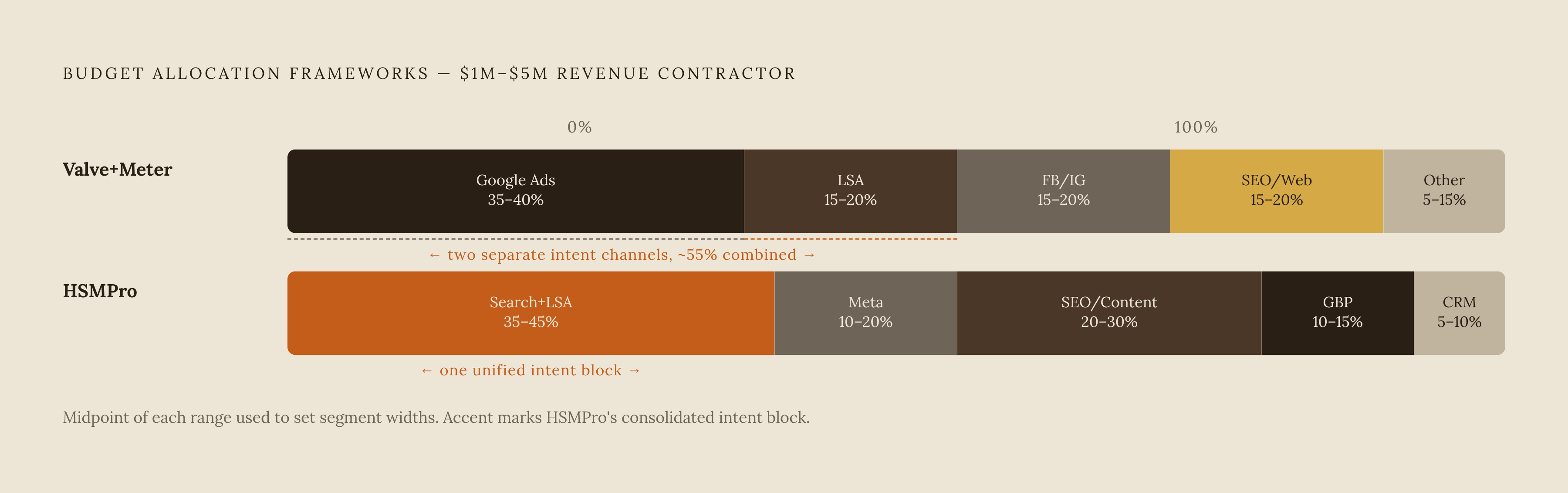
Early on, when the schedule isn't full, weight heavily toward LSA and Google Search, since that's the fastest route to a booked job, and treat Meta as optional. There's no upside in building a pipeline of future planned projects if a single crew can't even service current demand.
Valve+Meter's 2025-2026 data offers a model: Google Ads at 35 to 40% of digital spend, Google LSA at 15 to 20%, Facebook and Instagram at 15 to 20%, local SEO and website at 15 to 20%, and other channels at 5 to 15% Jobber/Conjointly Rank Contractors Watson Co. Marketing Cube Creative HSMPro. The difference between the two models matters: HSMPro treats paid search and LSA as one combined block that dwarfs everything else, while Valve+Meter gives LSA and Google Ads roughly equal footing as separate lines Rank Contractors Watson Co. Marketing Greenbaum Stiers Strategic Marketing Group Cube Creative SearchLight Digital. Either framework is defensible. The HSMPro model fits a contractor who wants intent channels to dominate the budget outright GoHighLevel for Home Services Valve+Meter.
As a business scales into multiple crews and starts running into real capacity constraints, Meta becomes more valuable, not less Greenbaum Stiers Strategic Marketing Group HSMPro. Building a pipeline of planned projects that can get scheduled weeks in advance smooths out revenue in a way emergency-only demand never can, and that's exactly the point where the 10 to 20% Meta allocation starts earning its keep Greenbaum Stiers Strategic Marketing Group HSMPro. None of these splits are formulas to copy blindly. Trade, geography, competition density, average ticket size, and the operational capacity to actually convert and fulfill leads all shift the right mix. The right allocation is the one that matches lead volume to what the business can actually handle, not the one that looks cleanest on a spreadsheet. For the growth stage of $1M–$5M revenue, HSMPro's 2026 benchmarks suggest 35–45% of digital budget on paid search + LSA combined, 10–20% on Meta, 20–30% on SEO and content, 10–15% on reputation/GBP management, and 5–10% on automation and CRM Rank Contractors Watson Co. Marketing Greenbaum Stiers Strategic Marketing Group Cube Creative Valve+Meter.
The operational layer that determines whether channel allocation produces revenue
None of the percentages above matter if the operational system behind them can't keep up. Speed to lead remains the single biggest lever inside LSA specifically, because the platform's own ranking mechanism rewards fast response, and the business case for answering the phone quickly isn't about being polite, it's structural to how the algorithm decides who gets shown.
Meta leads need an entirely different kind of follow-up than LSA leads get. An LSA caller is ready to hire, right now, today. A Meta lead is still in research mode, still comparing options, still weeks from deciding. Treating both the same way, one call, no follow-up, move on, is exactly where Meta budgets quietly fail even when the ad creative and targeting were both solid.
AI-driven lead handling and quoting tools, the kind increasingly available through platforms built specifically for home service contractors, can stretch the value of any given budget by making sure LSA leads get answered fast, Meta leads get a real nurture sequence instead of a single missed call, and paid leads generally don't sit untouched until they go cold. Budget allocation is the strategy. The operational system behind it, who answers the phone, how fast, and what happens to a lead that doesn't convert on day one, decides whether that strategy shows up as revenue.
Sources
- The Complete Guide to Google Local Services Ads for Home Service Contractors in 2026 | LeadTruffle | 24/7 AI Lead Qualification Tools for Home Service Contractors
- Google Local Service Ads Cost Per Lead by Trade (2026)
- getjobber.com
- valveandmeter.com
- hsmpro.com
- watsonco.marketing
- marketingcode.com
- pushleads.com