
First-Contact Resolution Rates in Home Service Lead Handling
Missed calls cost contractors entire jobs, not just follow-ups.
First-contact resolution in home service lead handling is not a call-center abstraction. A lead that misses a live response on the first attempt is almost never recovered, so this metric is a revenue number, not a service quality score. The piece below names the failure points, the cost of each, and the fix sequence.
Why FCR is the wrong name for the right contractor problem
SQM Group's 2026 FCR benchmark guide defines first-call resolution as resolving a customer interaction on the first call or contact, eliminating any follow-up need. Fast resolution is the number-one expectation customers hold of a call center. That definition works for support desks, where a repeat contact costs agent time. A contractor's repeat contact costs the job itself.
Home service FCR has three parts that must all succeed. The call or inquiry is received, meaning it is answered and not missed. The person or system on the line has the authority and information to move the lead forward. When any one of those three fails, the first contact is not resolved.
The call-center framing makes this sound like an efficiency problem. In home services it is a revenue problem. The next business that answers first gets the job, so a missed first contact is not a deferred lead. It is a lost one.
How far the home service industry actually falls from first-contact resolution
The home service industry's FCR problem starts before any skill or process question. It starts with whether anyone answers at all, and the industry's answer rate is structurally low. Invoca's 2026 home services lead conversion benchmarks establish that phone leads dominate conversion, and that the initial conversation is often where the job is won or lost. A meaningful share of leads close on the first call when that call is handled. The problem is that many calls are not handled.
Cross-industry benchmarks put the size of the gap in context. WebTonic's 2026 FCR data sets the average first-call resolution rate at 69%, with a good rate at 70 to 79% and world-class at 80% or higher. Home service businesses are not competing against that floor on resolution quality. They are falling before the interaction begins, because the call goes unanswered.
The after-hours gap compounds the in-hours problem. A substantial share of home service inquiries arrive outside standard business hours, when a homeowner discovers an emergency or finally has time to plan a project. Most contractors have no live coverage for those contacts. The vast majority of callers sent to voicemail do not leave a message, and those who do almost never receive a callback.
The booking gap inside answered calls adds a third layer. EstateHub's 2026 benchmarks document a disconnect between customer expectations and agent behavior. About 61% of callers prefer speaking to a real person, yet only 35 to 44% of agents ask for a booking during the initial call. An answered call that does not end with a booked appointment is not a resolved first contact. It is a warm lead that now requires follow-up the industry rarely delivers.
Why these gaps persist: the structural causes behind low FCR
Low FCR in home services is not primarily a training or effort problem. It is a structural mismatch between how field-based businesses operate and what inbound lead handling requires. The person most likely to answer a new lead, the owner or a senior technician, is the same person on a job site, under a crawlspace, or driving between calls. That is not negligence. It is the nature of field work. The single-point-of-failure design of most small contractor operations guarantees missed calls at scale.
Peak demand makes it worse. Call volumes spike sharply during weather events and seasonal transitions precisely when every available person is in the field. The moments when homeowners are most likely to reach out are the moments when contractors are least able to pick up. This is not a scheduling oversight. It is built into the structure of the business.
System-access gaps prevent resolution even when someone answers. SQM Group's research identifies five root causes of repeat contacts across industries. The customer needed to verify the status of an unresolved issue. The customer was disconnected while on hold. The agent lacked the knowledge or resources to resolve the issue. The customer's requested action was not completed. The customer was redirected to a third party.
The contractor equivalent is an office person who can answer the phone but cannot see the schedule, pull a past estimate, confirm crew availability, or commit to a date. The call ends with a promise to get back in touch, which functionally means the lead is lost. The homeowner interprets that promise as uncertainty, and uncertainty sends comparison shoppers to the next name on the list.
No systematic follow-up process turns missed first contacts into permanent losses. SQM Group flags the customer's need to verify an unresolved issue as a leading cause of repeat contacts. The small fraction of callers who reach voicemail and ever receive a callback is the exception, not the rule.
The speed problem is geometric, not linear. EstateHub's 2026 benchmarks document a sharp drop in conversion as response time extends. Businesses that respond within 60 seconds convert a substantially higher share of inbound leads than those operating at the industry average, with conversions improving by up to 391%. The gap between a contractor who answers quickly and one who calls back later in the day is not a small conversion difference. It is a compounding structural disadvantage.
What the conversion data reveals about speed and first-contact behavior
The revenue consequence of low FCR becomes clear when you connect conversion data to first-contact behavior. EstateHub's 2026 benchmarks show phone leads dominate home service conversion rates, and a meaningful share of those close on the first call. That makes first-contact handling the single highest-leverage moment in the sales process. The same marketing spend produces different revenue depending on how many first contacts end in progress.
Project type shapes how much FCR matters. EstateHub's data shows emergency services close quickly and at higher rates. High-cost planned projects, such as HVAC replacement, roofing, and landscaping overhauls, involve longer consideration cycles and multiple bids. The homeowner is comparing options, and whoever provides the first confident, responsive experience shapes the evaluation frame.
That makes FCR especially high-stakes for the $20,000 to $30,000 and above projects that form the core of a hardscaping contractor's business. A contractor who misses that first interaction is not absent from a single call. They are absent from the consideration set.
Marketing spend amplifies the gap rather than closing it. A contractor spending aggressively on lead generation while running a low FCR rate is paying full price for leads they hand to competitors who answer faster. The cost-per-lead equation is not complete until the first-contact outcome is factored in.
What top-performing contractors actually do differently at first contact
Contractors with high FCR share a common design. They treat first-contact resolution as an operational system, not a staffing outcome. They separate call answering from field deployment rather than relying on the same person to run jobs and answer new leads. High-FCR contractors have a dedicated function, whether a person, a virtual receptionist, or an automated system, that handles inbound contacts regardless of what the field team is doing. That design removes the single point of failure that causes most missed calls in field-based businesses.
They also give whoever answers the tools to move the lead forward immediately. The person or system on the line needs to see the calendar, have a rough pricing range or estimate logic, and hold authority to book. Without those three things, every call ends in a callback promise. The agent can be friendly, knowledgeable, and prompt, and the lead still goes unresolved because the system behind the voice cannot commit to anything.
They ask for the booking on the first call. Top performers make that ask a standard close, not an afterthought. Treating every answered call as an opportunity to book rather than an opportunity to gather information is a measurable FCR lever that requires no technology investment.
They track FCR explicitly. The number to watch is simple: what percentage of this week's new inquiries resulted in a booked appointment on the first interaction? Tracked weekly, that figure is a contractor's FCR rate and their most actionable lead conversion metric. It turns the abstract call-center concept into a number that changes behavior.
After-hours coverage is non-negotiable for planned projects. A substantial share of home service inquiries arrive outside business hours, and for hardscaping specifically, the homeowner may be browsing and deciding in the evening. Contractors who treat after-hours contacts as voicemail candidates are structurally unable to achieve high FCR on their highest-value leads. The timing of the inquiry is about the homeowner's schedule, not a reflection of the lead's quality.
How AI automation closes the FCR gaps that human systems leave open
AI automation does not replace the operational principles of high FCR. It makes those principles achievable at the scale and hours a field-based business actually operates. The gaps AI closes are the same ones identified earlier in this piece. After-hours coverage is the first. Speed to lead is the second. The booking ask is the third. AI that routes every contact toward scheduling closes the behavioral gap that prevents human agents from asking for the appointment on the first call.
The strongest outcomes come from hybrid routing. Lorikeet's 2026 FCR analysis draws a distinction between AI that deflects and AI that resolves. Deflecting systems route customers to FAQ pages until they give up. The practical model for contractors is clear. Human escalation happens only when a lead requires judgment the AI cannot provide, such as a complex scope discussion or an on-site estimate negotiation.
The knowledge base problem applies to AI exactly as it applies to human agents. SQM Group's research shows that a VoC performance management system is the strongest driver of agent FCR improvement, with knowledge management playing a supporting role. The same principle holds for AI. A system that cannot access the contractor's schedule, service area, pricing logic, and job history cannot resolve contacts. A standalone chatbot without back-end integration produces abandonment, not resolution.
Adoption barriers are operational, not philosophical. Most contractors who have not adopted AI-assisted lead handling cite lack of training and integration complexity as the leading obstacles, not skepticism about whether the technology works. That framing matters. Six workflows carry the clearest FCR payoff in home services, each tackling a gap named earlier. Immediate lead response with sub-60-second acknowledgment regardless of channel addresses the speed gap. After-hours inquiry capture converts contacts that currently go to voicemail and die. CRM routing and contact logging ensures every lead is tracked so follow-up is systematic, not accidental.
Why fragmented tool stacks prevent FCR gains from sticking
Contractors who improve FCR through a single point tool often see short-term gains that erode. A new phone system, a standalone chatbot, or an answering service may raise answer rates for a quarter. The integration problem is the same one SQM Group identifies in enterprise call centers. The FCR gap does not close. It moves downstream.
Fragmented stacks create data silos that break the FCR chain. If the call answering system, the CRM, the scheduling tool, and the estimating software do not share data, a lead that enters through one channel can be invisible to the person handling the next contact. These handoff failures look like FCR successes because the lead was answered. They function as FCR failures because the lead was not resolved.
A unified platform is the precondition for measuring FCR at all. SQM Group emphasizes that companies not tracking FCR cannot improve it. A unified system surfaces the rate automatically. Every lead that enters, every first contact made, and every booking completed or missed sits in one place and is measurable. Without that visibility, FCR remains a concept rather than a number a contractor can manage.
A practical FCR audit for hardscaping and remodeling contractors
The first step for a contractor who understands FCR as a revenue metric is measuring the current rate and identifying which failure mode is most costly. Start with one week of data. Count how many received a live response on the first attempt. That ratio is the FCR starting point. Segment the results by time of day. If the drop-off concentrates after 5 PM or during peak crew hours, the fix is coverage, not process.
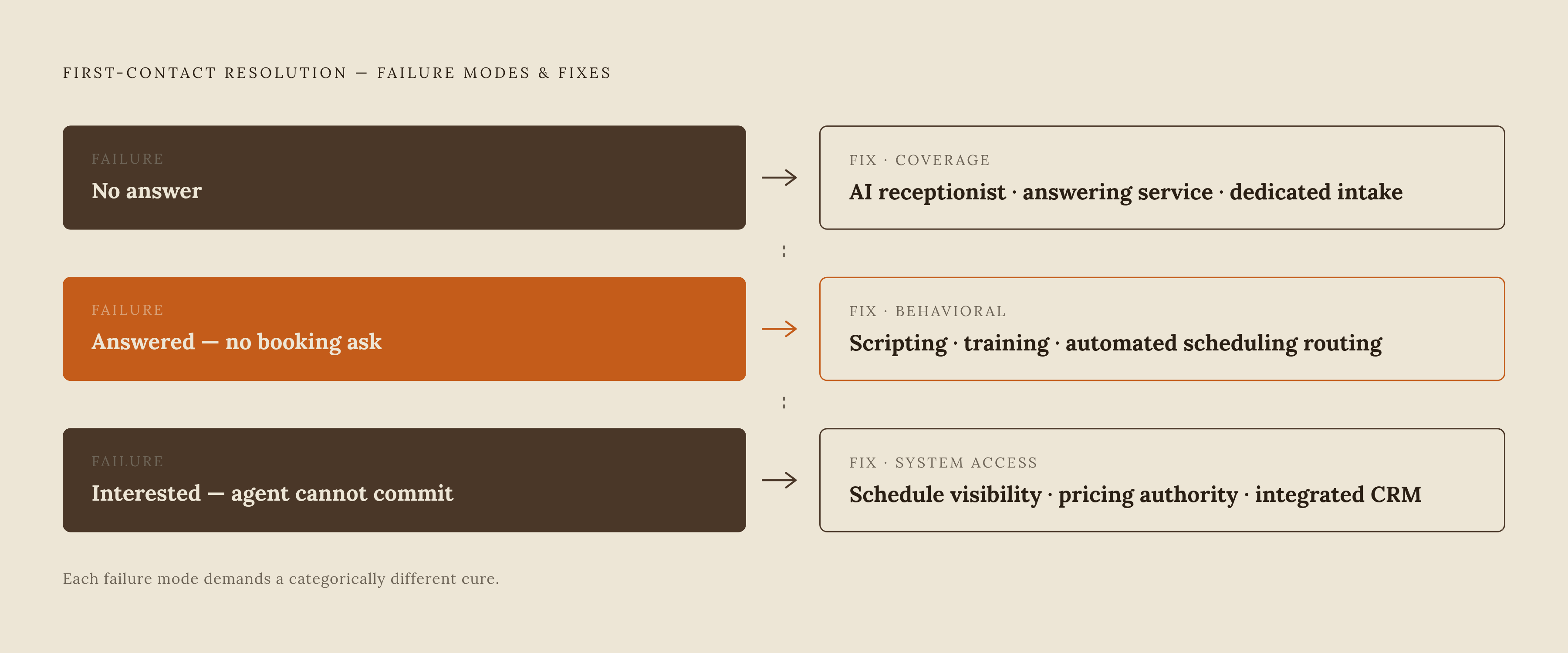
Step two is locating where in the first contact the lead is lost. Three failure modes require different fixes. No answer calls for a coverage fix, such as an AI receptionist, an answering service, or a dedicated intake role. Answered but no booking ask calls for a behavioral fix, through scripting, training, or automated routing to scheduling. Answered and interested but agent cannot commit calls for a system-access fix, meaning schedule visibility, pricing authority, or an integrated CRM.
Step three is pricing the gap before choosing a fix. Use the contractor's average job value and current lead volume to calculate what the FCR gap costs per month. A contractor missing a meaningful share of inbound leads on a $25,000 average project is losing a quantifiable amount of gross revenue monthly, not a vague opportunity cost. EstateHub's 2026 conversion benchmarks and LocaliQ's 2025 cost-per-lead data together give a contractor the value per converted lead and a sense of what they are spending to generate leads they then fail to capture.
Step four is sequencing fixes in order of impact. Add the booking-ask discipline or automation second. Integrate scheduling and CRM access third. That fix makes FCR gains permanent rather than episodic.
The metric to track going forward is the share of new inbound contacts that resulted in a booked appointment or estimate on the first interaction. WebTonic's 2026 data puts a good rate at 70 to 79% and world-class at 80% or higher. A contractor currently at 40 to 50%, below the industry bottom quartile of roughly 55%, has a clear improvement trajectory with compounding revenue impact at every step. The number is not abstract. It is the measure of whether marketing spend turns into signed jobs.