
Speed-to-Quote Workflows for Remodeling Estimate Requests
Responding first to estimate requests, not last, determines who wins the job.
A homeowner who fills out an estimate request form has almost never filled out just one. In most remodeling categories, the same person is sitting with three or four browser tabs open, submitting the same project details to every contractor whose site looked credible enough to trust with a phone number. That means the real competition for the job doesn't start at the bid comparison. It starts the moment the form gets submitted, and it's decided by whoever responds first, not whoever eventually shows the best portfolio.
Weeks of research usually precede that moment. The homeowner has already looked at styles, priced out materials in their head, and talked themselves into moving forward. By the time they hit submit, they're ready to commit to someone. The contractor who reaches them while that readiness is still fresh gets the advantage, and the one who reaches them three days later is competing against a decision that's already been made.
This is a workflow problem, not a sales problem. No amount of better ad creative or sharper branding changes what happens after the lead lands in an inbox or a missed call log. The fix lives in how fast and how well the business responds once the request comes in, and that's a question of process, not persuasion.
How slow response erases the value of every marketing dollar spent to get the lead
A slow response to an inbound request doesn't just cost that one job. It wastes the money that was spent generating the lead in the first place, because the marketing did its job and the follow-through didn't.
Paid search, Meta ads, referrals, organic traffic: every one of these channels pours leads into the same response process. If that process is slow, it doesn't matter which channel produced the lead or how much it cost to generate. A contractor spending more to get better leads from a better channel is still losing those leads at the same rate if the bottleneck sits downstream, in how fast someone actually picks up the phone or sends a reply.
Top-performing remodeling operators convert a higher share of the same traffic than their competitors, and the difference comes from compressing the time between request and first contact, not from buying more clicks. Fixing response speed produces more booked jobs from the exact same marketing budget already being spent.
The structural reason this breaks down is simple: the person fielding new inquiries is usually the owner or the lead estimator, and that's the same person running active jobs, doing site visits, and standing in line at the supply house. New requests get answered in whatever gaps are left in an already full day. That means response time is inconsistent by design. Some leads get a callback in twenty minutes because the owner happened to be between tasks. Others sit for two days because the week got busy. A business that treats lead response as something squeezed in rather than something built as a system will always produce that kind of unpredictable, leaky result.
The three stages where the window between request and commitment can be compressed
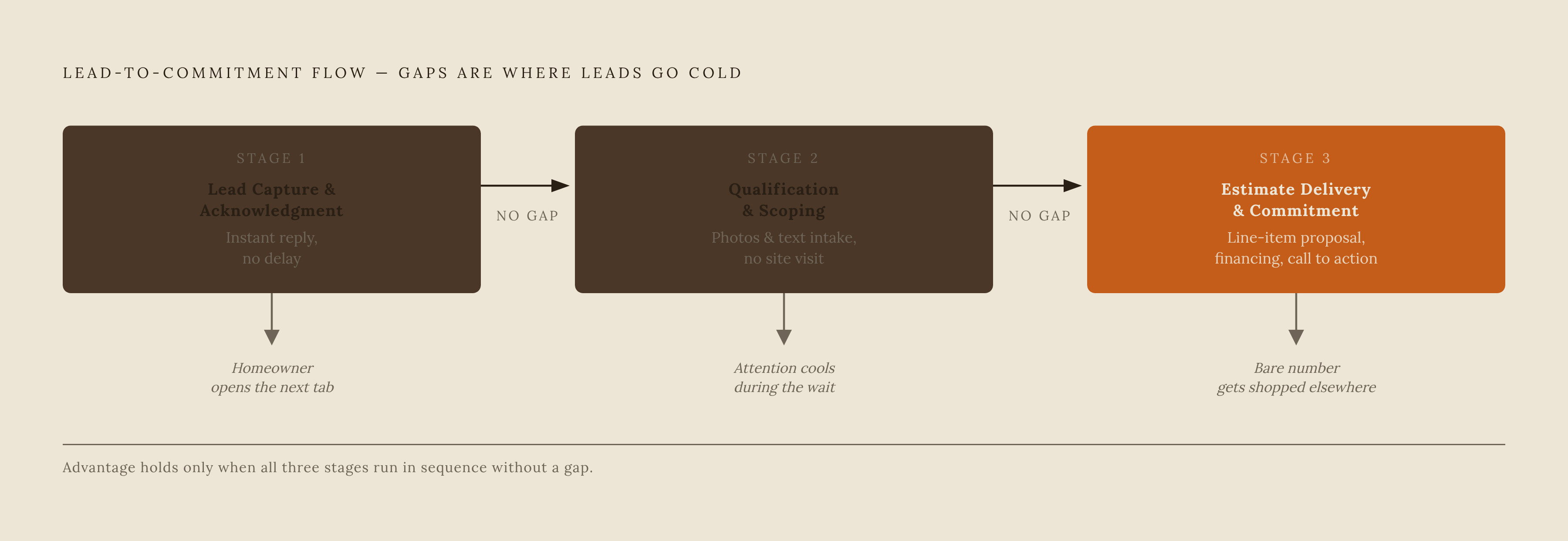
Closing the gap between an estimate request and a signed job comes down to three stages, each with its own job to do and its own way of failing. The first is lead capture and instant acknowledgment: making contact with the homeowner before they move on to the next tab. The second is qualification and scoping: turning a vague request into enough real information to produce a credible number without needing to step on-site first. The third is estimate delivery and commitment: getting a clear, professional proposal in front of the homeowner while the conversation is still warm, ideally before a competitor's walkthrough even gets scheduled.
Each stage depends on the one before it holding up. A fast first response followed by a sluggish scoping process still loses ground, because the homeowner's attention cools while they wait for someone to ask the right questions. A fast scope that leads to a slow, bare-bones estimate loses ground too, because speed without a complete proposal just produces a number the homeowner can shop around. The advantage appears only when all three stages run in sequence without a gap.
Stage 1: Getting to the homeowner before they stop expecting your call
The first-response problem is a design problem, and for a contractor already running active jobs, the only workable fix is an automated acknowledgment that fires the instant a form gets submitted.
An automated SMS or email response does two things at once. It tells the homeowner the business is organized and paying attention, and it holds that lead in place while a real person gets around to following up. That message should do three specific things: confirm the request was received, give a concrete window for when a person will reach out, and ask one simple qualifying question that quietly starts the scoping process before anyone has picked up the phone.
The leads most often lost are the ones that come in after hours or on weekends, when the owner is off the clock and the business isn't technically open. Those leads go cold fast. By Monday morning, the homeowner has usually heard back from someone else. Automation is the only realistic way to catch that window, because it doesn't depend on a person being available at the exact moment the form comes in.
Handoff is built around this idea directly: an AI teammate manages client communication and follow-through starting from the first point of contact, so the response doesn't depend on the owner sitting at a desk. Treating instant acknowledgment as basic infrastructure, the same way a working phone number or a functioning website is infrastructure, changes how a business performs under load. It's the baseline that keeps a lead from going to whoever responds first, not an upgrade reserved for larger operations.
Stage 2: Scoping over text and photos before anyone drives to the site
Requiring a site visit before producing any number at all is the single biggest source of delay in the remodeling estimate process, and for most project types, that visit doesn't need to happen first.
A structured intake sequence, sent by text or a short form right after the first response, can collect project type, rough scope, photos of the space, and timing. For most residential remodeling categories, that's enough to put together a credible range estimate without anyone leaving the office. Photos combined with a short voice or text description of the project are now enough input for AI estimating tools to generate a structured, line-item draft that the contractor reviews and adjusts.
Handoff takes photos, blueprints, or scope descriptions and returns a complete estimate built from AI takeoff or site-walkthrough input, with the contractor's own pricing already applied. That turns the gap between scope and proposal into minutes.
The site visit still matters, but its role changes. It is no longer the required first step before any number exists; it becomes a confirmation and relationship visit that happens after the homeowner has already seen a credible proposal and is close to deciding. That reordering is what saves the days a traditional workflow loses waiting for a calendar to line up.
The concern that early estimates might be inaccurate is a fair one, but it's manageable. A clearly labeled preliminary range, with defined exclusions and a prompt to schedule a walkthrough for final numbers, is standard practice in the industry and doesn't damage credibility. The objection that homeowners will hold a contractor to that first number doesn't hold up either: a professionally presented range with clear scope language trains the homeowner to expect revisions as part of the process. A vague number given over the phone, with no structure behind it, is what actually creates that risk.
Stage 3: What a fast, defensible estimate contains
Speed alone doesn't close a job. An estimate that arrives quickly but lacks clear scope language, defined exclusions, and a specific next step is just a number, and a bare number invites the homeowner to shop it against someone else's bare number.
The estimate document functions as a sales document first and a price sheet second. It needs to confirm exactly what's included, state plainly what's excluded, explain the basis for the price in terms of labor, materials, and scope assumptions, and end with a specific call to action rather than a passive "let me know if you have questions." For higher-ticket projects especially, homeowners want to see where their money is going. A single lump-sum number without a breakdown invites skepticism and opens the door to negotiation that a line-item structure avoids.
Buildxact notes that AI estimating tools scan every line item, flag errors, and sync with dealer pricing databases in real time. In practice, that means a contractor using these tools can produce an estimate that's both more complete and more accurate, in less time than it takes to build one by hand. QuoteGoat's 2026 analysis names proposal defensibility, the ability to explain what's included, what's excluded, and why the price lands where it does, as one of the four outcomes contractors most need from estimating software.
Financing built directly into the estimate document also lowers the affordability friction that stops homeowners from signing. The question shifts from whether they can afford the project outright to whether they can afford the monthly payment, which is a much easier yes for a lot of homeowners. Handoff includes consumer financing as part of its estimate-to-payment flow, a feature that matters most at the higher end of the remodeling range, where sticker shock is the most common reason a homeowner stalls before signing.
Manual Estimating as a Bottleneck
Even a contractor with a fast, automated first-response system will stall out at the estimate stage if the estimating process itself is still manual. Manual estimating takes focused, uninterrupted time, and that kind of time is rare for a working contractor.
The traditional process, site visit, measurement, write-up, pricing lookup, proposal formatting, demands a block of attention that competes directly with running active jobs. It usually loses that competition and gets pushed to evenings or weekends, which is how a three-to-five-day turnaround becomes normal.
AI estimating tools shorten that timeline by automating the repetitive parts: reading photos, plans, or scope descriptions and returning a line-item draft for the contractor to review and adjust. Buildxact reports that users complete estimates up to seven times faster than manual methods, driven by automating the repetitive measurement and pricing lookup steps while leaving the contractor's judgment in place. QuoteGoat's 2026 framework draws a distinction between tools that handle writing and formatting and tools that handle the actual estimating structure, meaning line items, assemblies, and labor modeling. The strongest tools do both.
The accuracy concern around AI-generated estimates is legitimate, and it's addressed directly in how these tools are built. Handoff trains on residential project data and applies contractor-specific pricing rules, so the output reflects actual job costs. A contractor who can hand over a reviewed, professional estimate the same day as the walkthrough, or the same day as the scoping intake, is operating in a different category than one still delivering proposals three to five days later. Manual estimating is structurally incompatible with a fast-response workflow. Something in that process has to give. Increasingly, it's the manual part.
Following up on sent estimates before the homeowner goes quiet
Sending the estimate is the start of a follow-up sequence, and most contractors don't have one, so they lose jobs they'd already half-won.
Homeowners in the middle of a remodeling decision rarely respond to a proposal right away. They show it to a spouse, compare it against another bid, or simply get pulled into the rest of their week. A contractor who reads silence as a no and moves on is walking away from jobs that were still winnable.
A structured follow-up sequence fixes that. It should include a check-in on any questions the homeowner might have, a note on real calendar availability that creates honest urgency without fabricating scarcity, and a prompt to schedule the walkthrough or confirmation visit. The messages should reference the specific project rather than reading as a generic "just checking in," spaced out over several days so the contractor stays present without becoming a nuisance.
Handoff notifies the contractor the moment a client opens, views, or signs anything, whether that's a document, an approval, or an invoice. Follow-up can be timed to the moment of highest engagement, right after the homeowner reopens the proposal. The objection that persistent follow-up feels pushy misreads what the homeowner actually wants. Follow-up framed around their own questions, what happens next, when work could start, what the scope includes, reads as service, not pressure. They submitted the request in the first place because they want to move forward.
A simple three-touch sequence covers most of this ground: a message the day after the estimate goes out confirming it arrived and offering to answer questions, a mid-week check-in tied to calendar availability, and a final nudge toward scheduling the walkthrough before the window closes.
What the full workflow looks like when each stage is connected
The real advantage in speed-to-quote doesn't come from any single stage performing well. It comes from eliminating the dead time between stages, which requires lead capture, response, scoping, estimating, and follow-up to run as one connected system rather than as separate tools stitched together by memory.
A disconnected stack, a web form in one place, a CRM in another, estimates built in a spreadsheet, proposals sent by hand, follow-up tracked in someone's head, creates a gap at every handoff. Those gaps are exactly where leads go cold. An automated response should arrive within minutes of the form being submitted, followed by a human follow-up within the same business day, a preliminary estimate delivered rapidly after the scoping intake, and a walkthrough scheduled before a competitor even returns the homeowner's first call.
Handoff is built as a single connected system, CRM, AI estimating, proposals, client portals, scheduling, and follow-up all in one place, so the stages described here run in sequence without manual handoffs between separate tools. For contractors already using AI for estimating, the remaining gap is usually first response and follow-up. Those are the easiest pieces to automate, and they tend to produce the fastest visible jump in contact rates and booked jobs.
Most remodeling contractors are still responding in hours or days. A contractor who responds in minutes and delivers a professional estimate quickly isn't just faster. They read to the homeowner as more organized, more trustworthy, and more serious about the job. Craft, reputation, and portfolio still carry real weight in this industry, and they always will. But none of that gets a chance to matter if the contractor isn't still in the conversation by the time the homeowner decides. Speed is what keeps a contractor in that conversation long enough for the craft to speak for itself.