
Replacing a Marketing Agency With an In-House Automated Stack
Automating marketing moves lead response from agencies to contractors.
Replacing a marketing agency with an in-house automated stack changes who owns and produces the work. For contractors, automation can now handle much of the execution that once justified a retainer. The stronger reason to switch is operational. A connected system can respond to leads, follow up on estimates, and show what produces booked jobs without waiting for a monthly report.
Why contractors are reconsidering agency retainers right now
The agency retainer solved a real problem when small contractors could not produce specialist work internally. Agencies had the tools, headcount, and knowledge to write ads, build landing pages, produce SEO content, and report on results. Contractors had jobs to deliver and neither the time nor the skills to replicate that output.
That gap is narrowing at the task level, though not at the strategy level. Automated tools can now execute much of the production work that contractors previously had to outsource. For hardscaping and remodeling contractors, more demand for outdoor living upgrades, legacy-home renovations, and high-value backyard projects means more money is at stake. An unconverted lead or slow follow-up can carry a larger dollar consequence than it did five years ago.
Which agency tasks automation actually replaces
The scope of replacement is specific, including ad copy variations, landing page creation, SEO content drafts, monthly performance reporting, lead follow-up sequences, and review generation. These are deliverables a contractor can compare directly with an agency’s scope of work. They are not the same as deciding what the business should stand for or which customers it should pursue. That distinction keeps the comparison honest.
For ads, AI text generation tools write and test copy variations so that someone no longer has to write each version by hand. Landing page tools build pages just for those ads. The distinction between a landing page and a general website matters because dedicated landing pages can convert more of the traffic into leads. WebRunner Media’s case study of an unnamed roofing client describes higher conversion and lower cost per lead after that switch.
SEO drafting tools also cut the work it takes to write service-page content. The contractor’s trade knowledge still shapes the brief, while the tool produces the draft at a lower per-page cost. Reporting changes even more because a unified platform can show channel-level cost per lead, conversion by source, and booking rate as soon as the data is available. Instead of assembling a monthly PDF, the system makes performance visible during the period when decisions are being made. The replacement is both a deliverable and the delay attached to it.
Follow-up and review requests are more clearly defined tasks. Email and SMS sequences can run from CRM events, including a quote being sent, an estimate remaining open, or a job being completed. Post-job triggers can also send review requests so that someone no longer has to send each one. The business still has to make decisions about market positioning, brand differentiation, creative direction, and channel mix when it enters a new territory. Those choices still need someone who knows how the contractor compares with its competitors.
Why lead response speed matters more than creative output
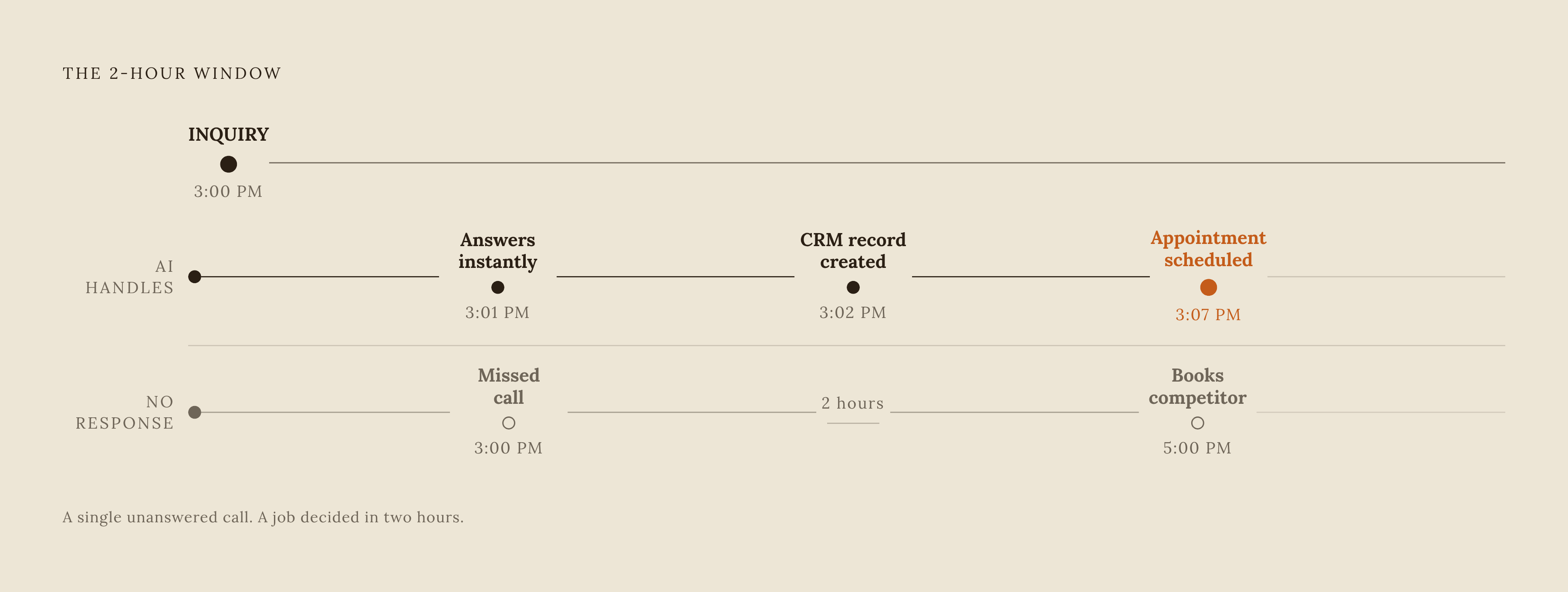
The deeper problem begins after an ad has done its job. A homeowner calls, but nobody answers quickly or follows up while the homeowner is still choosing a contractor. The money lost at that point can make the marketing look weak even though it brought in someone who wanted to buy. A missed call at 3 PM can become a competitor’s job by 5 PM.
This is why speed to lead is the strongest operational argument for bringing the system in-house. An agency retainer focused on campaigns and deliverables is not designed to manage the contractor’s internal response workflow. The bottleneck is between the inquiry and the answer or follow-up. Unless that handoff changes, more leads can get caught in the same slow process.
An AI call-handling system can answer after-hours calls and collect the customer’s name, address, service need, urgency, and preferred appointment window. It can then create a CRM record and offer a scheduling path before a person touches the lead. The homeowner is no longer waiting for the business to notice the call.
A homeowner planning a high-ticket patio or outdoor kitchen may be comparing two or three contractors at once. The first accurate, professional response frequently wins the job, even when another contractor has a stronger portfolio. Accuracy matters here as much as speed because a fast but unhelpful response does not provide a useful path forward. The advantage comes from connecting the first conversation to the contractor’s actual workflow.
What an integrated automated stack actually does, function by function
An integrated stack brings together work that previously sat with an agency, an answering service, a standalone estimating tool, a manual follow-up process, and a review management tool. Its value is reducing the handoffs between those functions. When intake, customer history, outreach, and reporting share a system, the contractor can manage the path from inquiry to completed job as one process. A collection of separate tools does not automatically provide that continuity.
Lead intake is the entry point. AI can capture inquiries from phone calls, web forms, SMS, social media messages, and chat widgets, then route them into a single queue using automated rules. That reduces the chance that an inquiry goes unnoticed because someone forgot to check a channel. For hardscaping estimates, uploaded property photos and material specifications can also inform the scope. AI image analysis tools that assess surface conditions and scope from photos are directly relevant to that work, though that is a distinct function from answering a call.
Housecall Pro has tools for call answering, marketing, and analytics/reporting for small and mid-size businesses. ServiceTitan has tools for call answering, marketing, scheduling, and dispatch for mid-size to large businesses. Jobber covers call answering, marketing, and estimating.
Standalone options serve narrower needs. Avoca, Smith.ai, and Goodcall provide call handling, while QuoteIQ and Roofr serve estimating. The important distinction is between obtaining a function and connecting it to the rest of the business. A fragmented stack stitched together with automation connectors can still lack unified customer history, a single reporting view, and the trigger logic that links service history to outreach timing. That missing context is where manual handoffs remain.
After intake and estimating, automated follow-up keeps open opportunities from depending entirely on someone remembering to chase them. Completed jobs can trigger review requests, making outreach repeatable. A unified dashboard then shows attribution by channel, cost per lead, conversion rate by source, and booking rate. The contractor can see more than whether an ad attracted attention.
What the transition actually requires from the contractor
The strongest objection to bringing this work in-house is not about whether the tools can produce it. An agency also takes on the job of paying attention to and managing the work. That relief has value to an owner already responsible for estimates, crews, and customers. Someone must own its setup and periodic tuning.
Getting started thus takes time from the owner and work to set up the system. Someone who understands the business has to shape the briefs, configure the workflows, and decide what the system should accomplish. The right sequence is to build ownership of the system before handing execution to it. Simply firing the agency and turning on software leaves the most important role unfilled.
The distinction is that setup has a defined scope and endpoint, while a retainer creates an ongoing management relationship. Even outsourced execution still requires briefing, approvals, feedback cycles, and monthly review calls. Once configured, an automated stack can require substantially less ongoing coordination, although periodic tuning remains necessary. The cost comparison rests on that difference over time. It does not depend on pretending the transition is effortless or that software costs nothing.
Onboarding support and pre-built workflow templates can reduce the burden for contractors who are not ready to configure everything themselves. A unified platform can also remove much of the integration tax of connecting separate tools and dealing with failures when those connections break. Business size still affects the right arrangement. At lower revenue levels, building internal capability first makes sense, while a dedicated marketing hire can be the better fit at a mid-range revenue band. At higher revenue levels, agencies can again help carry out the work, as long as someone inside the business is in charge of the strategy.
What contractors should expect on the other side of the transition
The first gains are operational. Calls can be answered outside working hours, inquiries can go into the same queue, and open estimates can get follow-up without someone having to prompt it. Those changes make the business less dependent on someone remembering every next step. They also give the contractor a clearer view of where inquiries become bookings. These outcomes depend on a well-configured system.
The longer-term gains come from processes that repeat after the initial setup. Automated post-job review requests can build review volume, which can contribute to stronger local rankings and reduce dependence on paid acquisition. That accumulated history is harder for a competitor to shortcut than a new ad campaign. For homeowners comparing contractors, it becomes part of the evidence available before they call. Building that advantage takes completed work and steady follow-through as well as automation.
Content also has a broader role as generative AI tools become part of how homeowners research contractors before opening a search engine. GEO and AEO are now part of that channel mix, with content structured to answer specific questions about project types, timelines, and costs beginning to appear in AI-generated recommendations. Those answers help practical backyard upgraders and legacy-home renovators take care over what they buy and find someone they trust. Clear information, a substantial review history, and a prompt response support different stages of the same comparison. More pages need trade knowledge that answers those questions to help homeowners in the same way.
The system must still be maintained for those gains to compound. The workflows need to fit the business at setup, while feedback over time shows where they need to change. Real-time attribution helps contractors shift spending toward channels that bring in booked jobs and away from those that bring only clicks. That is the central advantage of the transition. The contractor owns the data and can act on it immediately, avoiding a wait of four weeks.