Franchise Lead Management Playbook Applied to Independent Remodeling Contractors
Three connected systems replace scattered lead tactics with a repeatable path to booked jobs.
Independent remodeling contractors can use the franchise lead management playbook without buying into a franchise. The advantage comes from three connected systems: a unified channel mix brings homeowners in, speed-to-lead automation catches their interest, and a single routing CRM keeps the job on track toward a signed estimate. Together, they replace scattered tactics with a repeatable way to win work.
Why independent remodelers keep losing leads that franchise operations routinely close
A homeowner submits a remodeling inquiry on Saturday evening. The contractor sees it Monday morning, between taking calls, writing quotes, and getting a crew out the door. By then, the homeowner may already have an appointment with someone else. The lead was there, but the response was not. No amount of money spent getting that inquiry fixes what happened after it arrived.
That delay usually starts with disconnected tools. Ads go to one inbox, calls go to a phone, estimates sit somewhere else, and someone has to remember to follow up. An inquiry can get stuck each time it moves between these tools. A warm homeowner becomes an unfinished task. Franchise operations are built to prevent those gaps through a common way of capturing, assigning, and following up on leads.
The practical backyard upgrader, the retired life-quality improver, and the new- or legacy-home upgrader all research projects outside business hours. A business that answers only when the owner is available misses those inquiries systematically. That makes feast-or-famine demand partly an infrastructure problem. More advertising cannot repair a broken handoff. The franchise comparison is useful because it points to operating discipline that an independent can copy.
What the franchise lead playbook actually consists of — and why it is not out of reach
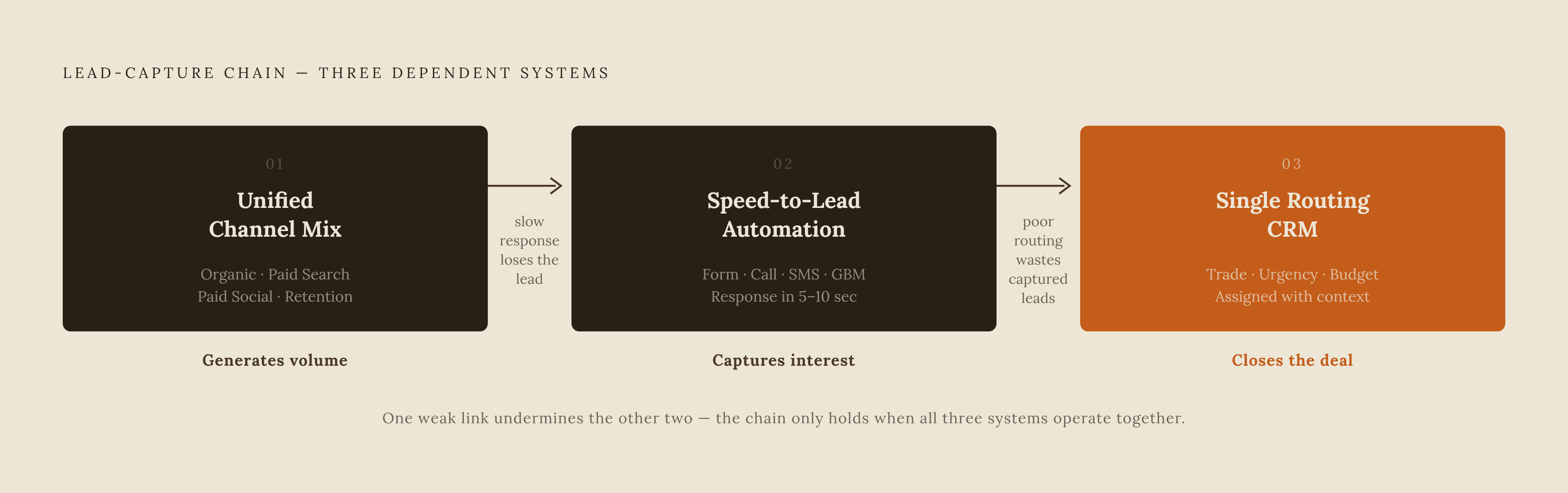
The first system is a unified channel mix. Organic search, paid search, paid social, and retention marketing follow one strategy, with a clear view of where leads originate. The second is speed-to-lead automation, which brings forms, calls, texts, Google Business messages, and Facebook leads into a pipeline that responds within seconds. The third is a single routing CRM. It classifies leads by trade, urgency, and budget signal, then assigns them to the right person with the project context attached.
These systems do different jobs, but they depend on one another. The channel mix generates volume, the response system captures interest before it fades, and the CRM keeps qualified opportunities from disappearing between conversations. One weak link undermines the other two. Fast acknowledgment is not enough if nobody receives the lead, just as careful routing cannot rescue an inquiry that went unanswered all weekend.
A three-truck business can now get AI-powered phone answering, automated CRM routing, and integrated quoting tools without the enterprise contracts these tools once needed. Franchise royalties are typically 6–8% of gross sales. The independent does not need the corporate structure to adopt the operating method. Connect the tools around the lead journey.
Building the unified channel mix: what sources to run, in what order, and how they reinforce each other
For an independent putting this into practice, the channel sequence starts with local SEO, Google Business Profile, and service-area pages. These establish the credibility that paid campaigns depend on. Reviews and a verified license also support the contractor’s presence in Local Services Ads. When a business pays to send homeowners to a weak local presence, its ads have to do work that its business profile should already have done.
Next come Google Search Ads and Facebook/Instagram Ads to bring in more leads. These channels amplify the organic presence and can be adjusted to smooth seasonal swings. The useful comparison is cost per signed job. Exclusive leads can cost more upfront than shared aggregator leads but close at higher rates, making owned channels more efficient at scale. Judging campaigns only by cheap inquiries misses the cost of competing for the same homeowner.
Permit-triggered direct mail is another way to bring in leads. For additions and major remodels, recent building permits in the service area identify homeowners already making project decisions who may not yet be searching broadly. Targeted mail reaches that group without another click on a search result. The fourth layer is retention and referral through email follow-up, automated review requests, and past-client reactivation. Many independents skip this layer despite its potential for strong returns.
The layers reinforce each other after the job ends. An automated review request strengthens the Google Business Profile that supports the next homeowner’s search. Past-client follow-up gives past customers another way back into the pipeline. Generative engine optimization and answer engine optimization, often shortened to GEO and AEO, extend that thinking to AI-generated search answers, with consistent business name, address, and phone details providing local groundwork, while citation remains uncertain.
Connect these sources. A homeowner might find the contractor in a Google AI Overview, click through to a landing page, and submit a form at 11 p.m. on Sunday. That journey should feed the same response pipeline as a paid-search inquiry or referral. That investment needs the next system to get a chance to pay off.
Speed-to-lead automation: the single most measurable gap between franchise and independent close rates
Still, it identifies a clear operational gap to address. After-hours capture depends on whether the homeowner gets a response or reaches voicemail. For a remodeler whose prospects research in the evening, that gap sits directly between marketing spend and an appointment.
The recommended automation begins with acknowledgment within five to ten seconds of a form submission, call, or Google Business message. A response tailored to the homeowner goes out through the channel they prefer, such as SMS, email, or web chat. Qualification then gathers urgency, scope, and budget signal. For a kitchen inquiry, that can mean square footage, timeline, and budget range. The estimator begins with a project brief.
Smart routing assigns the qualified lead by trade, location, and availability. Automated nurture then follows up through text, email, or voice when the homeowner does not book immediately. This is where speed becomes more than a greeting. The first response opens the conversation, while later touches keep an undecided prospect from vanishing after an estimate.
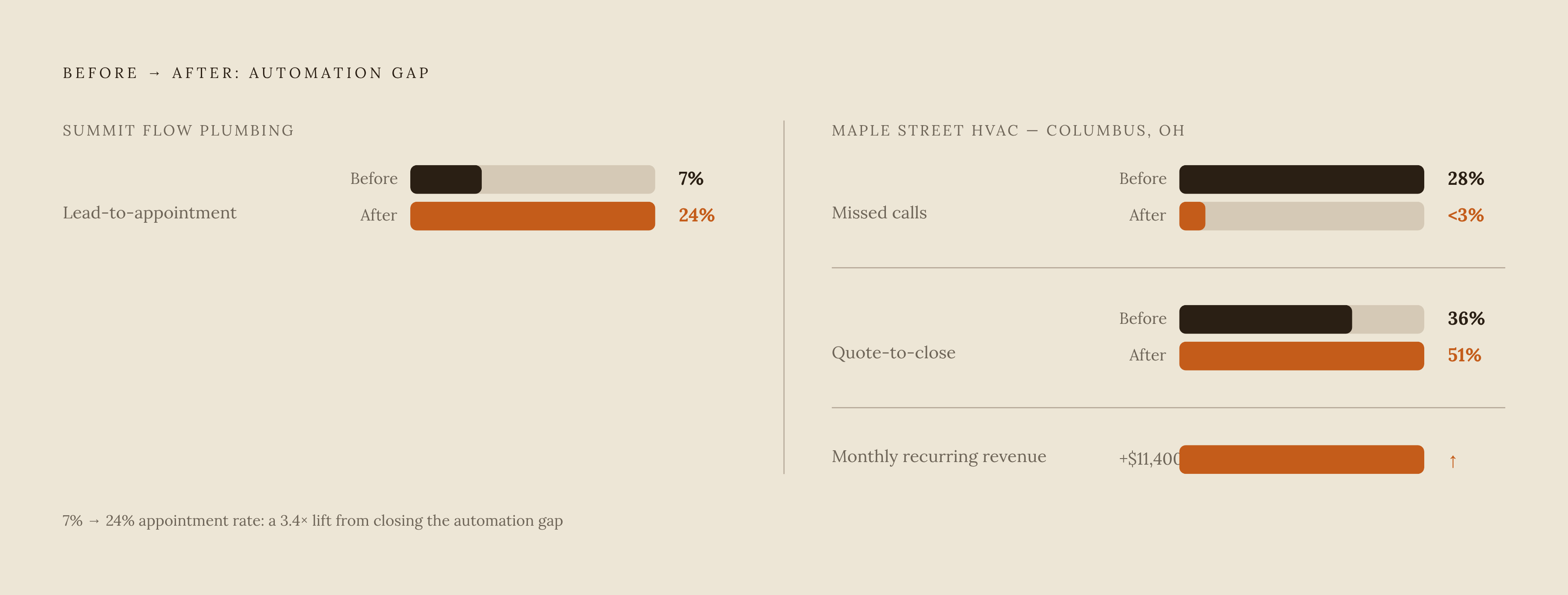
Summit Flow Plumbing illustrates that combined approach. It reported that its lead-to-appointment rate rose from 7 percent to 24 percent after it began using instant SMS acknowledgment, AI qualification, missed call text-back, and automated calendar booking. It also recovered a meaningful share of missed calls. The evidence is specific to plumbing. Its relevance lies in the mechanism, which connects an unanswered inquiry to qualification and booking.
The concern that AI feels impersonal overlooks the alternative. A prompt acknowledgment gives the homeowner a response when silence would leave them waiting. But automation should not replace the human consultation for a $40K remodeling project. Fix slow or generic landing pages, preserve the human handoff, and keep review requests working with lead capture. Once the first exchange is handled, the next risk is whether anyone owns what happens afterward.
The single routing CRM: how AI-powered lead management ends the hand-off failures that kill pipeline
A routing CRM does more than store contact details. It joins lead capture, assignment, estimate follow-up, and reactivation in one workflow. Intelligent dispatch can weigh availability, travel time, skill certification, and location when assigning an estimator or technician. Context moves with the assignment. Without that connection, the homeowner can answer qualification questions quickly and still wait while someone manually works out who should call.
The same record supports follow-up after a quote is sent. Instead of leaving the estimate in an outbox, the system schedules further contact at planned intervals. Warranty dates, project anniversaries, and times for seasonal maintenance can also prompt the system to reach out later. The owner no longer has to remember to make that contact. For a remodeler, the CRM’s value is the continuity between an inquiry, a signed job, and a past customer who may return or refer someone else.
How well a platform fits the business needs a closer look than its AI label. ServiceTitan offers advanced lead scoring, dispatch, and automated follow-up, with its clearest fit in multi-technician HVAC, plumbing, and electrical operations and a weaker fit in project-based remodeling. ServiceTitan’s official 2024 Year in Review reports that Blanton & Sons increased profit margin from 5 percent in 2023 to 20 percent using Sales Pro in 2024. That is useful specialty-trade evidence. It is not a reason to assume the same platform fits every remodeling business.
Smaller tools make different trade-offs. Service Fusion offers call transcription and sentiment analysis but no AI lead scoring or dispatch assignment. Housecall Pro with an AI layer has strong automated follow-up and basic help with scheduling, but it lacks dedicated dispatch AI. Jobber with Route Optimization costs less to get started with and has strong scheduling automation, though its lead scoring is limited. FieldEdge has no native AI features as of 2026, so its capabilities should not be confused with those of an AI-native routing system.
Implementation can defeat a good platform choice. Turning on everything at once invites team resistance and data errors, while importing incomplete customer records can skew AI predictions. The recommended approach is to clean the list, train field staff on the mobile interface, and introduce automation in phases. Treat it as a revenue tool. Capture and phone answering come first, followed by follow-up, then broader scheduling, reputation, and marketing automation.
Maple Street HVAC in Columbus, Ohio, is another business with reported results from the combined workflow. Missed calls fell from roughly 28 percent to under 3 percent, and the quote-to-close rate rose from 36 percent to 51 percent. Monthly recurring revenue grew by $11,400, primarily from recovered after-hours leads and better follow-up conversion. The improvements reached beyond the initial response. That distinction is important for remodeling, where capturing an inquiry and winning the project are separate steps.
Putting the three systems together: what the full playbook looks like in operation for a remodeling contractor
Consider a legacy-home upgrader searching “whole-home remodel contractor near me” on Sunday evening. The contractor has a Google Business Profile with 25 reviews and a verified license, supporting its local credibility. The homeowner reaches the project inquiry form and submits it at 9:43 p.m. Within eight seconds, an AI acknowledgment arrives by SMS and asks about scope and timeline. This is an illustrative workflow.
The answers now have somewhere to go. The automation scores the inquiry as high-priority using the property value signal and project scope, routes it into the CRM for a next-morning first call, and loads the estimator’s brief. If the homeowner does not book, follow-up runs at 24 hours, 72 hours, and seven days. After the job is won and completed, a review request goes out within 24 hours. That review strengthens the local presence that began the journey.
For a contractor starting from scratch, the rollout should begin with capture and response. AI phone answering, missed call text-back, and instant form acknowledgment can win back leads while leaving the current quoting or CRM workflow in place. Follow-up automation comes next through quote nurture, review requests, and past-client reactivation. Field operations need not be rebuilt at this stage. Full CRM routing, dispatch optimization, and channel-level attribution follow once the team has seen results and is ready to use the data.
That sequence tackles the point where the team starts to struggle with handling more leads by hand. Buying more leads before repairing capture and follow-up only adds pressure to the weak spots. A connected workflow instead gives each new inquiry a response, an owner, and a next step. This is what the franchise royalty comparison comes down to. The independent who builds the playbook owns the infrastructure and keeps the margin rather than paying a corporate parent to supply the operating discipline.