
Lead Quality Scoring by Source for Contractor Sales Teams
Source scoring separates true buying signals from click activity and wait time.
Lead quality scoring by source gives contractor sales teams a better order of pursuit than a queue built around arrival time or email clicks. A lead’s origin helps predict whether it will become revenue, so source should shape the score, the response speed, and the follow-up. More leads will not fix a sales process that keeps the best prospects waiting.
Why contractor sales teams lose deals they should be winning
A rep works a cold aggregator lead while a referral from a past customer waits for a callback. Both went into the same queue, so both got the same priority. Yet the referral arrived with trust and context that the aggregator lead did not. The queue erased a useful difference before the rep even picked up the phone.
That is a routing failure. Scoring email clicks instead of buying probability makes it worse because the busiest contact can outrank the likeliest buyer. A prospect who opens everything may never sign, while a homeowner who asks for one quote may be ready to move. When those signals get confused, reps spend their time where it is least likely to pay.
What source-aware scoring actually measures — and what it doesn't
Lead quality scoring estimates revenue probability. Think of hospital triage, which prioritizes predicted severity. A reliable score separates fit, intent, and data quality so that attention alone does not look like readiness to buy.
Fit shows whether the project meets the contractor’s requirements for geography, property type, project scale, and ownership. Intent describes active evaluation, including a quote request, a pricing-page visit, or a question about availability. Data quality answers a more basic question. Can anyone actually reach this person? An invalid phone number or incorrect contact record must be corrected before an otherwise attractive score can guide pursuit.
Source modifies how fit and intent are interpreted. A referral and a marketplace inquiry can contain similar project details without having the same buying probability. The channel’s history supplies that missing context. This replaces the old habit of rewarding repeated activity, which can push students, competitors, and tire-kickers above serious prospects who visit once and request a quote.
How channel origin predicts close rate before a rep makes a single call
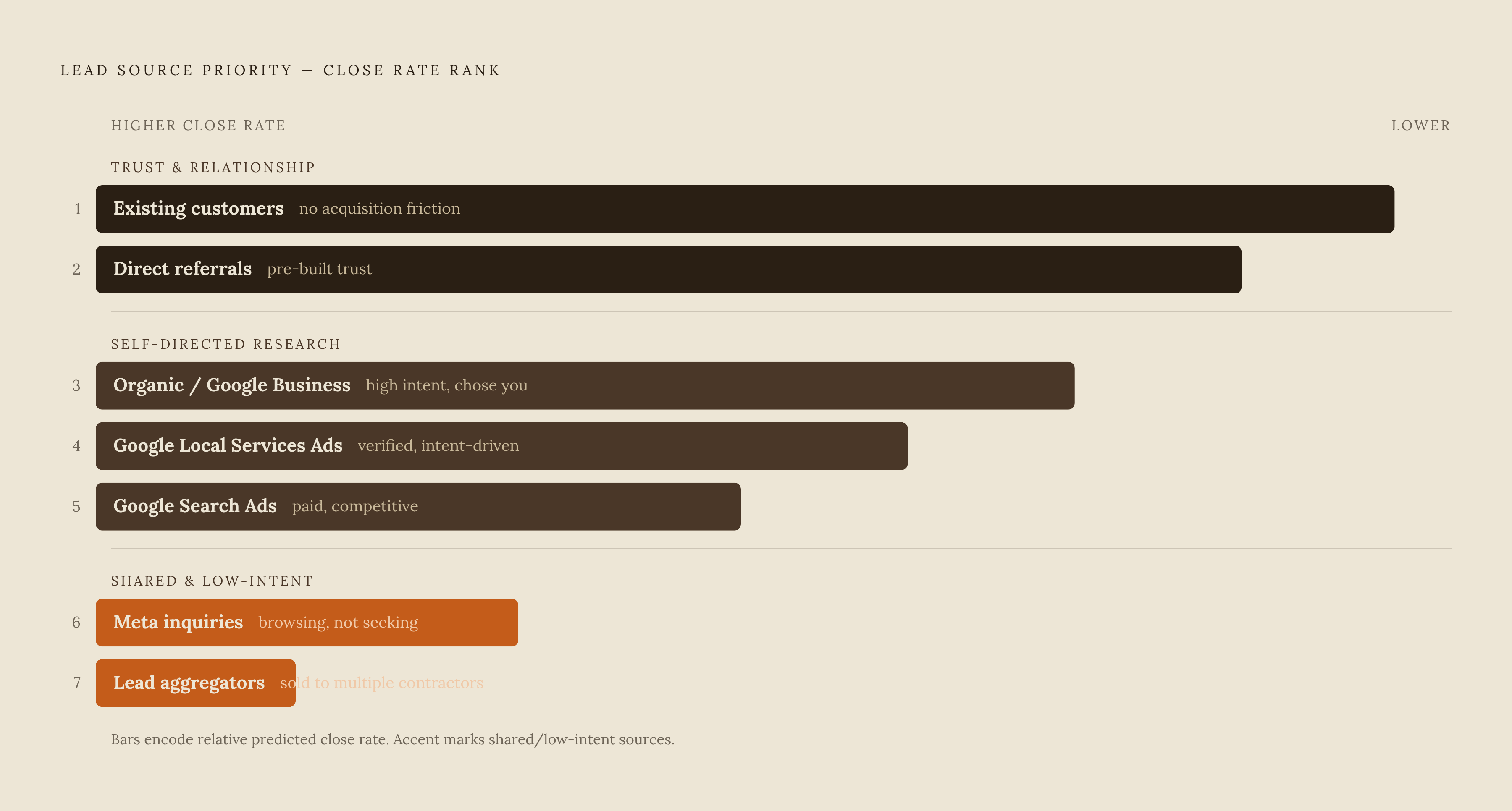
For hardscaping and field service contractors, the starting hierarchy runs from established relationships to shared marketplace leads. These channels produce different kinds of buyers. The model should use this order before a rep starts qualification, though the contractor’s own results must guide the weights over time.
Existing customers rank highest because an established relationship reduces acquisition friction and the need for heavy qualification. Direct referrals from past clients follow because a trusted third party has supplied context about the contractor’s work. Organic search and Google Business Profile inbound come next because the homeowner initiated the search and found the contractor. Those first three sources begin with either trust or self-directed research.
Google Local Services Ads follow because Google’s verification gives these inquiries a stronger starting point than general paid clicks. Google Search Ads signal search intent but offer no pre-qualification, and the homeowner may still be early in evaluation. Lead aggregators and marketplaces rank last because the same inquiries are sold to more than one contractor and buying intent can vary widely. Shared access makes the sales contest different from the outset.
Building the scoring model: assigning points to source, fit, intent, and timing
The starting framework should allocate points across fit, intent, engagement quality, and timing. Fit covers geography, project type, ownership, and estimated project scale. Intent covers quote requests, pricing-page visits, inbound calls versus form fills, and the specificity of the project description. Engagement quality reflects responsiveness, complete information, and a matched communication preference. Timing captures a stated start date, a permit already pulled, or competing bids mentioned.
Exact point allocations should come from the contractor’s closed-won data. Source belongs inside the fit and intent layers as a modifier, with each signal counted once. An existing customer or referral starts with full fit and intent points unless project details contradict that starting assumption.
Organic and Google Business Profile inquiries start with more intent credit than paid channels. Local Services Ads get standard points on the assumption that contact data is verified, while Google Search Ads earn intent points only when the homeowner specifically asked for a quote. Meta inquiries lose intent points unless the homeowner reached out with a detailed question about the project. Aggregator leads need their own fit and intent checks before they get full credit, and the data-quality gate must be applied strictly.
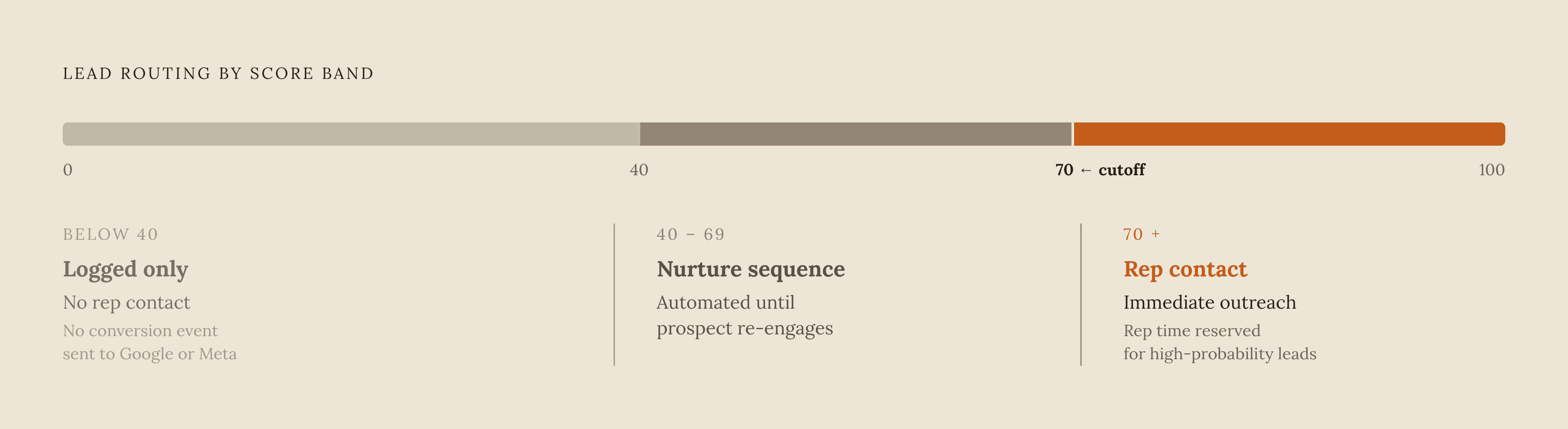
Reps contact leads at 70-plus right away, those at 40–69 enter automated nurture, and those below 40 are logged but are not actively pursued. Sub-40 leads should not return to Google or Meta as conversion events because that feedback trains the platforms to find more low-quality leads. Intent points also need scheduled decay, since a quote request from six months ago is weaker evidence than one from this week.
Why the model must be built from closed deals, not assumptions
Sales opinions are not a sound calibration dataset. A model built around what reps believe about each source can preserve the same biases that left the best prospects waiting. Closed-won and closed-lost records, compared by source and project fit, provide a practical starting point.
The review should cover win rate, average project value, time-to-close, and cancellation or dispute rate. A channel with fewer wins may deserve more attention if its projects are larger, while slow-closing leads can absorb more rep capacity. For example, closed-lost records might show that aggregator leads cancel so often that getting more of them is less of an advantage than it seems. That is a reason to revise their weight.
Weights should be rebuilt from these results every quarter. Test the weights against win rate within each score band. Early disqualification also frees up reps by keeping poor-fit prospects from taking up too much of their time.
How response time interacts with source score — and why speed determines whether the model pays off
A score identifies priority, but the team must respond quickly to act on it. A 90-point lead left waiting is not a sales advantage. Homeowners who are comparing contractors may choose one before a slow team gets around to calling. The scoring model therefore depends on routing and response working together, rather than treating fast contact as a separate sales initiative.
The combinations make the problem clear enough. A high-score lead contacted quickly gives the team its best opportunity, while the same lead contacted slowly may already have chosen a competitor. Fast contact with a low-score prospect creates a different failure by spending rep time on a weak opportunity.
This creates an execution problem for human teams. Reps cannot respond right away around the clock while also qualifying prospects and working on proposals. After-hours inquiries and bursts of inbound demand leave gaps even when the scoring logic is sound. Automation is useful here because it can act on priority while the opportunity is still open.
Where AI fits into a source-aware scoring operation
AI helps enforce the rules fast enough and at enough volume for the scoring model to work. Voice agents and chat tools can respond within seconds, including after hours and on weekends.
Pre-qualification gives that response a second practical purpose. AI can collect service type, property details, urgency, project scope, and availability before a rep speaks with the homeowner. Those inputs turn a raw contact into a partially scored record. The rep can then work from more than a source label and a phone number, while project details can challenge a generous starting score.
Mid-tier leads need a different kind of attention. Automated sequences handle nurture for the 40–69 band until the prospect shows interest again, so reps are free from chasing every uncertain inquiry. AI sales coaching does a different job by reviewing recorded calls and giving specific feedback within hours. It improves how reps handle the opportunities they receive, while response and nurture automation control which opportunities consume their time.
What quote follow-up by source reveals — and the revenue sitting in silent proposals
Silence does not mean the same thing across channels. Referral and organic-inbound prospects are more likely to be weighing timing or budget, while silent aggregator and paid-ad prospects are more likely to have accepted a competing bid. Treating those groups alike can waste calls on one and neglect recoverable revenue in the other.
The follow-up should reflect that difference in probability. A personal call is warranted for a referral or organic prospect whose proposal has gone unanswered, even if an automated email has been sent. Automated sequences are more appropriate for silent aggregator and paid-ad leads, where additional rep effort has diminishing returns. These judgments can guide the first follow-up, but they cannot prove why a given homeowner stopped responding.
Quote speed also affects how much recovery is needed. AI-generated estimates can reduce turnaround time, limiting the chance that a lead goes cold before receiving a proposal. Automated follow-up then helps keep the team from giving up on unanswered quotes. The same source logic that sorted the initial queue should guide where personal attention goes after the quote.
How to calibrate source weights when the channel mix changes
Quarterly reviews are necessary, but a changed channel mix can demand an earlier review. Launching Local Services Ads, starting Meta ads, or adding a realtor or builder partnership introduces a new source pattern. Dropping a channel or cutting its spend substantially changes the mix too. A meaningful win-rate shift unexplained by seasonality, or a new competitor changing homeowner research, also calls the existing weights into question.
Generative Engine Optimization and Answer Engine Optimization, or GEO/AEO, concern visibility in AI-assisted research and answers. Homeowners who use AI tools to research and shortlist contractors may arrive with more pre-qualification than a cold paid click. That suggests a starting weight closer to organic search than paid social, but the deals that close must show whether that weight holds up.
The team should pull closed-won and closed-lost data again, recalculate win rates by source and score band, and adjust weights where results contradict the model. With clean CRM data, this takes hours. A new channel does not deserve a lasting advantage simply because its buyers appear more informed at first contact.
Standing up a source-aware scoring system without rebuilding the entire sales operation
Most hardscaping contractors can use a workable sequence without a sophisticated scoring platform. The first step is tagging every inbound lead with its source at capture, because later scoring depends on that record. The next is applying the routing bands in the existing CRM, with immediate rep contact at 70-plus, automated nurture at 40–69, and log-only handling below 40. That establishes an order of pursuit before the team attempts a more detailed model.
AI first-response comes next to handle inquiries after hours and when many arrive at once, while the scoring system takes shape. After a full quarter, the contractor can use closed-won and closed-lost records by source to calibrate the weights. Scored conversion values should then feed back to the ad platforms so their optimization favors high-quality leads.
The handoffs between tools need attention as well. Separate systems for capture, CRM, call handling, quoting, and follow-up can lose source data as a lead moves through the process. A unified system connecting lead origin to closed revenue removes those attribution gaps and supports the feedback loop. The goal is not a more elaborate score, but a sales operation that gives its best opportunities the attention they have earned.